
Essays · Modern Art
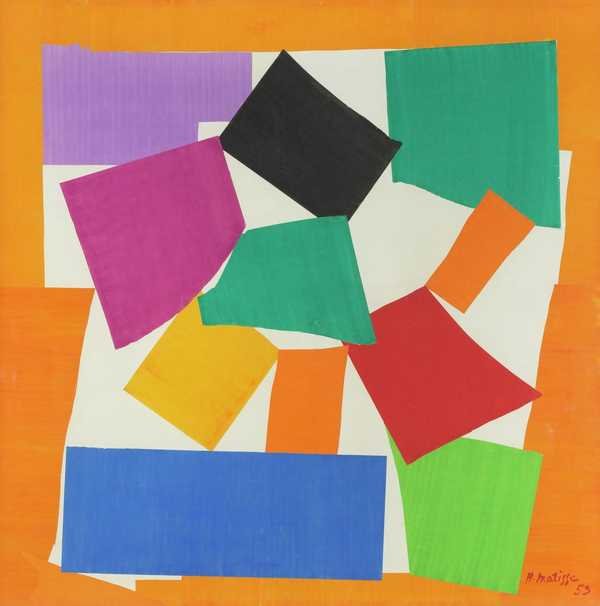
Henri Matisse. The Snail.
Bỏ cái vỏ, còn lại vòng xoắn.
Drop the shell, keep the spiral.
Tate · Tate
Vẽ thẳng vào màu
Sau năm 1948, sức khoẻ không còn cho phép Henri Matisse đứng trước giá vẽ. Phần lớn thời gian ông phải nằm trên giường. Ông không vẽ tranh sơn dầu nữa. Thay vào đó, ông cắt hoặc xé những hình từ giấy đã được tô sẵn gouache màu tươi. Người Pháp gọi chúng là gouaches découpées, gouache cắt.
Matisse đã thử kỹ thuật này từ trước, trong cuốn sách tranh Jazz xuất bản năm 1947. Những năm cuối đời, nó trở thành con đường chính của ông, cùng với công trình trang trí Nhà nguyện Mân Côi ở Vence.
Ông giải thích lý do rất gọn. Cắt giấy cho phép ông vẽ ngay trong màu. Không còn phải vẽ đường viền trước rồi tô màu vào trong, để hai thứ cứ sửa lẫn nhau. Cây kéo đi thẳng vào mảng màu, và đường cắt chính là nét vẽ. Với ông, đó là một sự đơn giản hoá.
Những tác phẩm cắt giấy về sau, như The Snail, có kích thước rất lớn. Bức này gần 2,9 mét mỗi cạnh, lớn hơn cả một người đứng.
Căn phòng ở Hôtel Régina
Người thư ký của Matisse, bà Lydia Delectorskaya, về sau viết thư cho Tate kể lại cách tác phẩm được làm. The Snail ra đời ở Hôtel Régina tại Nice, nơi Matisse làm việc những năm cuối đời.
Matisse luôn có sẵn những tờ giấy đã được các trợ lý tô gouache, đủ mọi màu ông dùng cho giấy cắt. Một tờ giấy trắng làm nền, kích thước do ông chỉ định, được căng lên tường. Matisse cắt từng mảng rồi đưa cho trợ lý, chỉ chính xác chỗ cần đặt. Người trợ lý ghim mảng giấy lên nền.
Khi Matisse thấy bố cục đã xong, các mảng được dán nhẹ lên nền. Tấm panô được gỡ xuống khi ông cần bức tường cho tác phẩm tiếp theo. Theo lời bà Delectorskaya, không có bản vẽ chuẩn bị nào cho tác phẩm này.
Sau đó tác phẩm được gửi về Paris cho Lefebvre-Foinet để dán cố định lên toan. Trước khi xê dịch bất cứ thứ gì, người ta can lại toàn bộ bố cục thật chính xác, để không mảng nào lệch đi dù chỉ một milimét.
Từ con ốc thật đến vòng xoắn
Con gái Matisse, bà Duthuit, kể rằng thời gian ấy cha bà vẽ rất nhiều con ốc, và ý tưởng cho tác phẩm lớn nảy ra từ những bản vẽ đó. Ông kể với nhà văn André Verdet rằng ông cầm con ốc giữa hai ngón tay, vẽ đi vẽ lại, cho đến khi nhận ra một sự cuộn mở.
Trong The Snail không có con ốc nào. Chỉ có những mảng màu nối nhau, cuộn tròn quanh một tâm như vỏ ốc. Các mảng ở giữa tạo thành một vòng đồng tâm, gợi lại đường xoắn của cái vỏ.
Matisse đặt các cặp màu bổ túc cạnh nhau: đỏ với xanh lá, cam với xanh lam, vàng với tím. Mỗi cặp làm màu kia rực lên. Kết quả là một bề mặt rung, dù không có một đường cong nào được vẽ bằng bút.
Bà Delectorskaya viết rằng tên tác phẩm đến từ hình dáng của chuỗi mảng màu cuộn lại như vỏ ốc, và rằng đường xoắn của vỏ ốc gợi hướng chuyển động của vũ trụ. Nên bức này hoàn toàn không trừu tượng. Nhưng nếu ai muốn xem nó là trừu tượng, Matisse cũng đã chọn sẵn một tên khác: La Composition Chromatique, Bố cục sắc màu.
Gần trừu tượng nhất
Catalogue của Tate gọi The Snail là một trong những tác phẩm gần trừu tượng nhất của Matisse. Điều ấy đáng chú ý, vì Matisse cả đời gắn với hình người, nội thất, cửa sổ, hoa lá. Ở tuổi ngoài tám mươi, từ một con vật nhỏ bò chậm, ông đi đến gần biên giới của hình tượng hơn bao giờ hết.
Không lâu sau, ông còn thiết kế một cánh cửa sắt cho một lăng mộ, dựa trên những bản vẽ con ốc, nhưng cánh cửa ấy chưa bao giờ được làm.
Tate mua The Snail năm 1962 từ Jean Matisse, con trai nghệ sĩ, với sự hỗ trợ của hội Friends of the Tate Gallery. Trước đó nó đã đi qua loạt triển lãm những tác phẩm gouache cắt cuối đời của Matisse ở Bern, Amsterdam, Paris, New York, Chicago và San Francisco.
Đứng trước nó hôm nay, người xem thấy những mép giấy cắt, những mảng gouache tô bằng cọ. Đó là dấu vết của một buổi làm việc trong căn phòng ở Nice: một người không đứng được nữa, vẫn tìm ra cách vẽ bằng màu, như Mondrian theo một con đường rất khác cũng từng tin rằng màu thuần có thể tự mang lấy một bức tranh.
Drawing straight into colour
After 1948, ill health kept Henri Matisse from standing at the easel. Much of the time he was confined to bed. He stopped painting in oil. Instead he cut or tore shapes from paper already painted with bright gouache. In French they are called gouaches découpées, cut gouaches.
Matisse had tried the technique earlier, in his picture book Jazz, published in 1947. In his last years it became his main path, together with the decoration of the Chapel of the Rosary at Vence.
He explained why quite simply. Cutting paper let him draw in the colour. No longer outline first and then fill with colour, each modifying the other. The scissors went straight into the colour, and the cut was the drawing. For him it was a simplification.
Some of the later cut outs, like The Snail, were very large. This one is nearly 2.9 metres each way, taller than a standing person.
The room at the Hôtel Régina
Matisse's secretary, Lydia Delectorskaya, later wrote to Tate describing how the work was made. The Snail was made at the Hôtel Régina in Nice, where Matisse worked in his last years.
Matisse always had at hand sheets of paper painted in gouache by assistants, in every colour he used for cut paper. A white paper ground, in dimensions he specified, was put up on the wall. Matisse cut each piece and passed it to an assistant, indicating exactly where it should go. The assistant pinned it to the ground.
When Matisse judged the composition finished, the pieces were lightly stuck down. The panel was taken down when he needed the wall for the next work. According to Delectorskaya, there were no preparatory drawings for it.
The work was then sent to Lefebvre-Foinet in Paris to be mounted on canvas. Before anything was moved, the whole composition was traced with great precision, so that no piece would shift by even a millimetre.
From a real snail to a spiral
Matisse's daughter, Madame Duthuit, said her father made many drawings of snails at the time, and the idea for the large work grew from them. He told the writer André Verdet that he held the snail between two fingers and drew it again and again, until he became aware of an unrolling.
There is no snail in The Snail. Only patches of colour linked together, curling around a centre like a shell. The shapes in the middle form a concentric pattern that echoes the spiral of the shell.
Matisse set complementary colours side by side: red with green, orange with blue, yellow with mauve. Each makes the other brighter. The result is a vibrating surface, though not a single curve was drawn with a pen.
Delectorskaya wrote that the title comes from the form of the colour patches curling like a snail's shell, and that the spiral of the shell echoes the direction of universal movement. So the work is not abstract at all. But for anyone who wanted to see it as abstract, Matisse had chosen another title: La Composition Chromatique, Chromatic Composition.
The nearest to abstraction
Tate's catalogue calls The Snail one of the most nearly abstract of all Matisse's works. That is striking, since Matisse spent his life with figures, interiors, windows, flowers. In his eighties, from a small slow animal, he came closer than ever to the edge of the figurative.
Soon after, he also designed an iron gate for a mausoleum based on his snail drawings, though it was never made.
Tate bought The Snail in 1962 from Jean Matisse, the artist's son, with help from the Friends of the Tate Gallery. Before that it had travelled with the exhibitions of Matisse's late cut gouaches to Bern, Amsterdam, Paris, New York, Chicago and San Francisco.
Standing before it today, you see the cut edges of the paper and the brushed gouache. They are traces of working days in a room in Nice: a man who could no longer stand, still finding a way to draw with colour, much as Mondrian, by a very different route, believed that pure colour could carry a painting on its own.
Modern Art