
Essays · Photography
Hiroshi Sugimoto. Theaters.
Cả một bộ phim, chỉ còn lại ánh sáng.
A whole film, and only light remains.
Fraenkel Gallery · Fraenkel Gallery
Hai tiếng, một lần bấm
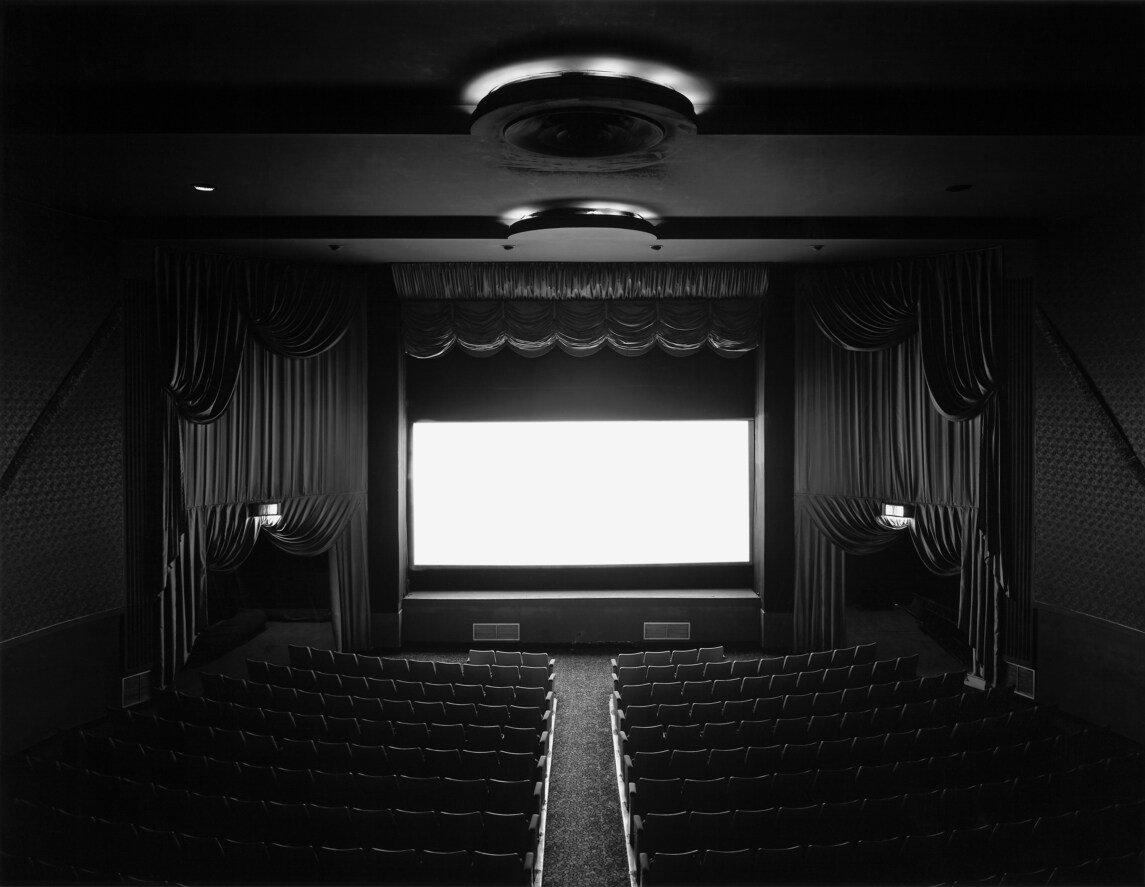
Năm 1976, ở New York, Hiroshi Sugimoto mang một chiếc máy ảnh khổ lớn vào rạp chiếu phim. Khi bộ phim bắt đầu, ông mở màn trập ở khẩu độ rộng. Khi bộ phim kết thúc, khoảng hai tiếng sau, ông đóng màn trập lại. Cả bộ phim được ghi lên một tấm phim duy nhất.
Kết quả là một hình ảnh lạ. Màn ảnh không còn hình nào. Nó là một hình chữ nhật trắng sáng, phẳng lặng, như một ô cửa mở ra ánh sáng. Còn căn phòng quanh nó, những thứ chìm trong bóng tối suốt buổi chiếu, lại hiện ra rõ ràng: hoa văn trên tường, gờ trần chạm nổi, rèm nhung, những hàng ghế trống.
Không có người trong ảnh. Khán giả có đến, có ngồi, có đứng dậy ra về, nhưng họ chuyển động quá nhiều để phim ghi lại được. Chỉ những gì đứng yên suốt hai tiếng mới còn. Căn phòng còn. Người thì biến mất.
Có một nghịch lý ở đây. Chính ánh sáng từ màn ảnh là nguồn duy nhất chiếu sáng căn phòng. Mỗi cảnh sáng trên phim rọi một chút lên trần, lên tường, lên ghế. Hai tiếng như vậy cộng lại đủ để căn phòng hiện lên trên phim. Bộ phim biến mất, nhưng nó để lại dấu trên mọi bề mặt quanh mình.
Những tấm đầu tiên được chụp ở các rạp New York: U.A. Fox năm 1976, Trylon và U.A. Belle Beau năm 1977.
Từ rạp cung điện đến bãi chiếu ngoài trời
Sugimoto tiếp tục loạt Theaters trong nhiều thập kỷ sau đó, và mở rộng ra nhiều kiểu không gian chiếu phim. Có những rạp kiểu cung điện dựng từ đầu thế kỷ 20 ở Mỹ, nội thất trang trí dày đặc như một nhà hát opera. Có những bãi chiếu phim cho ô tô ngoài trời, nơi màn ảnh trắng đứng giữa trời đêm, và bầu trời quanh nó cũng ghi lại mọi thứ chuyển động qua trong suốt thời gian phơi sáng.
Danh sách tên các tấm ảnh là một bản đồ riêng. Royal, San Francisco, năm 1992. Carpenter Center, Richmond, năm 1993. Metropolitan Palace, Los Angeles, năm 1993. Các bãi chiếu Stadium Drive-In ở Orange, Studio Drive-In ở Culver City, Azusa Drive-In, cùng năm 1993. Imax Tempozan, Osaka, năm 1998. Sau đó là châu Âu và Nhật: Cinema Odeon ở Firenze và Palais de Tokyo ở Paris năm 2013, Cinema Teatro Nuovo ở San Gimignano năm 2014, Sogetsu Hall ở Tokyo năm 2017.
Tất cả được in bạc gelatin đen trắng, gắn trên bìa khổ 20 x 24 inch, mỗi tấm in 25 bản. Cách làm không đổi qua bốn thập kỷ. Chỉ căn phòng đổi. Và căn phòng, khi được chiếu sáng bởi chính bộ phim, trở thành nhân vật chính của mỗi tấm ảnh.
Tổng của mọi khoảnh khắc
Một bộ phim là hàng chục nghìn khung hình nối nhau. Mỗi khung có sáng tối riêng. Theaters cộng tất cả những khung ấy lên một bề mặt. Kết quả không phải là một bộ phim đặc biệt nào, mà là thứ chung của mọi bộ phim: ánh sáng chiếu qua.
Đây là một câu hỏi về thời gian mà Sugimoto quay lại suốt sự nghiệp. Nhiếp ảnh thường được hiểu là việc bắt một khoảnh khắc. Sugimoto làm ngược lại: ông để máy ảnh nhìn quá lâu, lâu đến mức mọi khoảnh khắc chồng lên nhau và xoá nhau. Cái còn lại không phải là một thời điểm. Nó là một khoảng thời gian, được nén lại thành hình.
Người xem đứng trước ảnh thường thấy một sự im lặng lạ. Rạp chiếu phim là nơi ồn ào, đầy tiếng nhạc, tiếng thoại, tiếng người. Ảnh không giữ được âm thanh nào. Nó chỉ giữ được ánh sáng, và thứ ánh sáng ấy, trắng tinh, không kể gì cả.
Loạt ảnh này bắt đầu gần như cùng lúc với Dioramas, khi Sugimoto còn là một nhiếp ảnh gia trẻ mới đến New York. Cả hai đều hỏi cùng một điều: máy ảnh thấy gì mà mắt người không thấy?
Two hours, one exposure
In 1976, in New York, Hiroshi Sugimoto carried a large format camera into a cinema. When the film began, he opened the shutter wide. When the film ended, about two hours later, he closed it. The entire film was recorded on a single sheet of negative.
The result is a strange image. The screen held no picture. It was a bright white rectangle, flat and still, like a doorway opening onto light. The room around it, sunk in darkness throughout the screening, appeared clearly: patterns on the walls, carved mouldings, velvet curtains, empty rows of seats.
There are no people in the pictures. The audience came, sat, got up and left, but moved too much for the negative to hold them. Only what stayed still for two hours remains. The room remains. The people vanish.
There is a paradox here. The light from the screen is the only thing lighting the room. Every bright scene casts a little onto the ceiling, the walls, the seats. Two hours of this add up to enough for the room to appear on the negative. The film disappears, yet it leaves its trace on every surface around it.
The first pictures were made in New York theatres: U.A. Fox in 1976, Trylon and U.A. Belle Beau in 1977.
From movie palaces to drive ins
Sugimoto continued Theaters for decades and widened it to many kinds of screening space. There are American movie palaces from the early twentieth century, their interiors as dense with ornament as an opera house. There are drive in cinemas, where a white screen stands under the night sky, and the sky around it records whatever moves across it during the exposure.
The list of titles is a map in itself. Royal, San Francisco, 1992. Carpenter Center, Richmond, 1993. Metropolitan Palace, Los Angeles, 1993. The Stadium Drive In at Orange, the Studio Drive In at Culver City, the Azusa Drive In, all 1993. Imax Tempozan, Osaka, 1998. Then Europe and Japan: Cinema Odeon in Florence and the Palais de Tokyo in Paris in 2013, Cinema Teatro Nuovo in San Gimignano in 2014, Sogetsu Hall in Tokyo in 2017.
All are black and white gelatin silver prints, mounted at 20 by 24 inches, each in an edition of 25. The method has not changed in four decades. Only the room changes. And the room, lit by the film itself, becomes the true subject of each picture.
The sum of every moment
A film is tens of thousands of frames in a row. Each has its own light and dark. Theaters adds all of them onto one surface. The result is not any particular film but what all films share: light passing through.
It is a question about time that Sugimoto returns to throughout his career. Photography is usually understood as catching a moment. Sugimoto does the opposite: he lets the camera look too long, so long that every moment overlays and erases the others. What remains is not an instant. It is a span of time, compressed into an image.
Viewers often sense a strange silence before these pictures. A cinema is a loud place, full of music, dialogue, people. The photograph keeps no sound. It keeps only light, and that light, pure white, says nothing at all.
The series began almost alongside Dioramas, when Sugimoto was a young photographer newly arrived in New York. Both ask the same thing: what does the camera see that the human eye does not?
Photography