
Essays · Photography
Joel Meyerowitz. Morandi's Objects.
Những đồ vật đã ngồi mẫu cho một họa sĩ cả đời.
The objects that sat for a painter all his life.
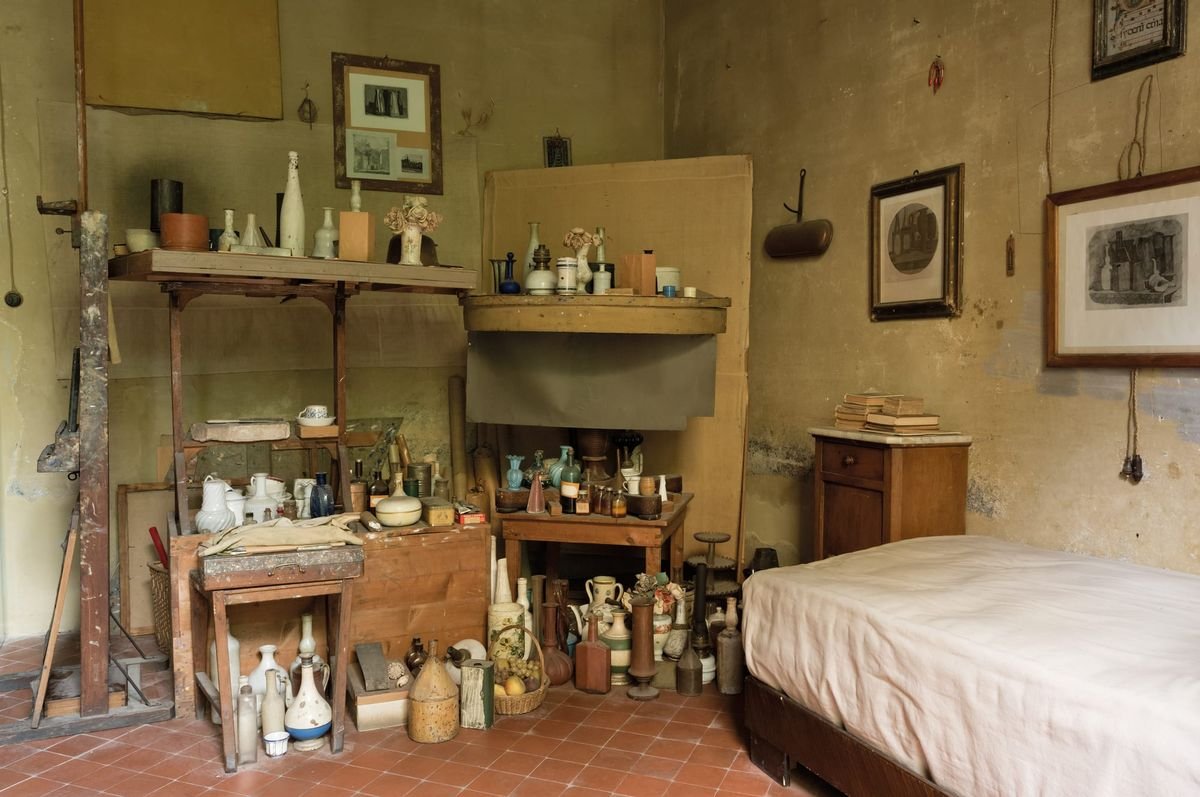
©Joel Meyerowitz · Hyperallergic
Một căn phòng ở số 36 via Fondazza
Giorgio Morandi sống và làm việc gần như cả đời trong một căn hộ ở số 36 via Fondazza, Bologna. Xưởng vẽ của ông là một căn phòng nhỏ, cũng là phòng ngủ. Ở đó, ông vẽ những bức tĩnh vật nổi tiếng nhất của hội hoạ Ý thế kỷ 20: vài chai lọ, vài hộp, xếp sát nhau trên một mặt bàn, sắc màu trầm như bụi.
Morandi mất năm 1964. Căn hộ về sau được giữ lại như một bảo tàng nhỏ mang tên Casa Morandi, và phần lớn các phòng thường không mở cho công chúng. Những đồ vật ông vẽ vẫn ở đó.
Mùa xuân năm 2015, nhiếp ảnh gia người Mỹ Joel Meyerowitz, khi ấy đang sống cùng vợ là nhà văn Maggie Barrett ở Tuscany, được phép vào làm việc trong căn phòng này. Ông ở lại với những đồ vật của Morandi và chụp chúng, từng món một.
Từng món một, trên mặt bàn cũ
Cách Meyerowitz làm việc rất giản dị. Ông cầm từng đồ vật lên, xoay nó trong tay, rồi đặt nó xuống mặt bàn của Morandi, chính mặt bàn còn chi chít những vết đánh dấu của họa sĩ. Ông không mang đèn. Ánh sáng là ánh sáng tự nhiên ấm của căn phòng, cùng nguồn sáng đã đổ những chiếc bóng trong tranh Morandi.
Danh sách đồ vật dài hơn người ta tưởng. Bình hoa, vỏ ốc, chai đựng bột màu, hoa lụa, hộp thiếc, phễu, bình tưới. Khoảng 300 món. Nhiều món bám bụi, sứt mẻ, màu đã xỉn. Trong ảnh, chúng hiện lên với những sắc màu trầm như đá quý cũ, thứ màu mà người xem tranh Morandi sẽ nhận ra ngay. Không món nào quý. Tất cả đều từng được nhìn rất lâu.
Phía sau, bức tường cũ bong tróc, màu nâu sữa như một ly cà phê. Meyerowitz không dọn dẹp, không lau chùi. Đồ vật hiện ra đúng như chúng đã nằm đó nhiều thập kỷ.
Ông kể rằng khi làm việc, ông chờ một thoáng nhận ra, cảm giác rằng có điều gì trong đồ vật vừa sống dậy. Đó là lúc ông bấm máy.
Hai cách nhìn gặp nhau
Morandi không vẽ đồ vật vì giá trị của chúng. Phần lớn là đồ dùng thường ngày, không có gì đắt giá. Ông dùng chúng như những khối hình học: tròn, trụ, hộp, chữ nhật, bầu dục. Meyerowitz mô tả việc Morandi sắp xếp chúng như dựng nên một trường lực, nơi các hình khối kéo đẩy nhau.
Nhiếp ảnh của Meyerowitz vốn đi theo hướng khác. Ông được biết đến nhiều nhất với ảnh đường phố màu ở New York và ảnh ánh sáng ven biển Cape Cod. Ở Bologna, ông chậm lại. Không có đám đông, không có khoảnh khắc thoáng qua. Chỉ có một cái bàn, một đồ vật, và thời gian. Một người quen săn khoảnh khắc trên phố đã chọn ngồi yên trong một căn phòng nhỏ.
Cuộc gặp này là cuộc gặp giữa hội hoạ và nhiếp ảnh. Người xem tranh Morandi quen nhìn đồ vật đã được họa sĩ nhìn giùm, đã thành màu và nét. Ảnh của Meyerowitz trả chúng về làm vật: bụi thật, vết nứt thật, chai lọ có nhãn thật. Và vì vậy, người xem thấy rõ hơn Morandi đã biến đổi chúng nhiều đến mức nào.
Cuốn sách và bản mở rộng
Bộ ảnh được Damiani xuất bản thành sách năm 2016. Tháng 4 năm 2026, nhà xuất bản này ra bản mở rộng mang tên Morandi's Objects: The Complete Archive of Casa Morandi, thêm hơn 130 ảnh, kèm bài viết của Meyerowitz và Maggie Barrett.
Bộ ảnh có thể đọc cạnh những bàn tiệc đã tàn của Laura Letinsky. Hai người cùng tìm vẻ đẹp trong những vật bình thường nhất trong nhà. Letinsky chụp vật sau khi con người dùng xong. Meyerowitz chụp vật sau khi người nhìn chúng đã mất.
A room at 36 via Fondazza
Giorgio Morandi lived and worked almost all his life in an apartment at 36 via Fondazza, Bologna. His studio was a small room that was also his bedroom. There he painted some of the best known still lifes of twentieth century Italian art: a few bottles, a few boxes, packed together on a tabletop, their colours muted as dust.
Morandi died in 1964. The apartment was later kept as a small museum, Casa Morandi, and most of its rooms are usually closed to the public. The objects he painted are still there.
In the spring of 2015 the American photographer Joel Meyerowitz, then living in Tuscany with his wife, the writer Maggie Barrett, was allowed to work in that room. He stayed with Morandi's objects and photographed them, one at a time.
One by one, on the old tabletop
Meyerowitz's method was plain. He picked up each object, turned it in his hands, then set it down on Morandi's table, the same table still covered in the painter's marks. He brought no lamps. The light was the warm natural light of the room, the same source that cast the shadows in Morandi's paintings.
The list of objects is longer than one might expect. Vases, shells, bottles of pigment, silk flowers, tins, funnels, watering cans. Some 300 items. Many are dusty, chipped, their colours dulled. In the photographs they carry the muted tones of old gemstones, colours any viewer of Morandi's paintings will recognise at once. None is precious. All were looked at for a very long time.
Behind them, the old walls are peeling, the milky brown of a cortado. Meyerowitz did not tidy or wipe anything. The objects appear exactly as they had sat for decades.
He has said that while working he waited for a flicker of recognition, a sense that something in the object had come alive. That was when he pressed the shutter.
Two ways of seeing meet
Morandi did not paint objects for their value. Most were everyday things, nothing costly. He used them as geometry: circle, cylinder, box, rectangle, oval. Meyerowitz describes Morandi's arrangements as a force field in which the forms pull and push against one another.
Meyerowitz's own photography had gone another way. He is best known for colour street pictures in New York and for the coastal light of Cape Cod. In Bologna he slowed down. No crowd, no passing instant. Only a table, an object, and time. A man used to chasing instants on the street chose to sit still in a small room.
This is a meeting of painting and photography. Viewers of Morandi are used to objects already seen for them, turned into colour and line. Meyerowitz's photographs return them to being things: real dust, real cracks, bottles with real labels. And so the viewer sees more clearly how far Morandi transformed them.
The book and its expansion
Damiani published the photographs as a book in 2016. In April 2026 the same publisher released an expanded edition, Morandi's Objects: The Complete Archive of Casa Morandi, with more than 130 additional pictures and essays by Meyerowitz and Maggie Barrett.
The series can be read beside the finished tables of Laura Letinsky. Both look for beauty in the most ordinary things of a home. Letinsky photographs objects after people have finished using them. Meyerowitz photographs objects after the man who looked at them has gone.
Photography