
Essays · Contemporary Art
John Akomfrah. Vertigo Sea.
Biển giữ lại mọi thứ con người muốn quên.
The sea keeps what people would rather forget.
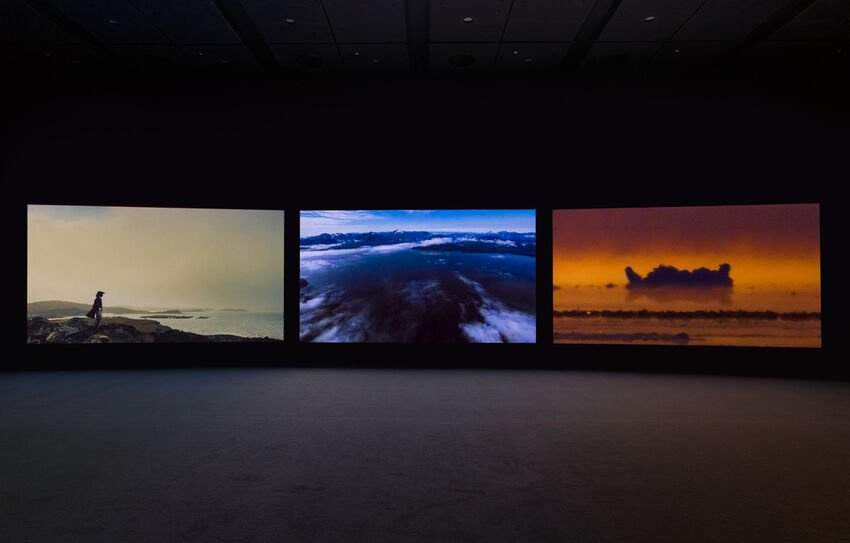
© John Akomfrah · SFMOMA
Ba màn hình, một vùng nước
Vertigo Sea là một sắp đặt video ba kênh John Akomfrah hoàn thành năm 2015. Ba màn hình đặt cạnh nhau, âm thanh vòm 7.1 bao lấy căn phòng. Tác phẩm dài 48 phút 30 giây, gần bằng một bộ phim điện ảnh ngắn.
Tác phẩm ra mắt tại Venice Biennale năm 2015. Ba năm sau, năm 2018, nó được ba bảo tàng cùng mua và cùng sở hữu: SFMOMA ở San Francisco, Museum of Contemporary Art Chicago và Solomon R. Guggenheim Museum ở New York. Một tác phẩm về biển được chia giữa ba thành phố, cách nhau hàng nghìn cây số.
Người xem không nhìn một khung hình. Họ phải chọn nhìn đâu. Đôi khi ba màn chiếu ba cảnh khác nhau. Đôi khi một cảnh bị kéo dài qua cả ba. Đôi khi hai màn đứng yên trong khi màn thứ ba chuyển động. Mắt không bao giờ nắm được toàn bộ cùng lúc.
Tư liệu thiên nhiên và những đoạn lịch sử
Phần lớn hình ảnh biển trong Vertigo Sea đến từ kho tư liệu phim thiên nhiên của BBC. Đó là những thước phim quen thuộc với khán giả truyền hình: đàn cá lấp lánh, sóng vỡ trên đá, băng trôi ở vùng cực. Akomfrah đặt chúng cạnh những đoạn khác: cảnh săn cá voi, cảnh đánh bắt, hình ảnh những con thuyền chở người di cư.
Giữa các đoạn tư liệu là những cảnh ông quay mới. Một nhân vật mặc trang phục thế kỷ mười tám đứng lặng trên bờ, nhìn ra biển. Vài đồ vật đặt rải rác trên nền đá, như bị sóng đánh dạt vào. Các cảnh này không kể chuyện. Chúng đứng như người chứng kiến.
Bên dưới hình ảnh là giọng đọc trích từ nhiều văn bản về biển, trong đó có Moby-Dick của Herman Melville và bài thơ dài Whale Nation của Heathcote Williams. Trang của gallery đại diện cho ông mô tả tác phẩm là một cuộc khảo sát về điều Ralph Waldo Emerson từng gọi là biển cao cả. Chữ cao cả ở đây mang cả hai nghĩa: đẹp đến choáng ngợp và đáng sợ đến choáng ngợp.
Tên tác phẩm cũng nói điều đó. Vertigo là cơn chóng mặt khi đứng trước một thứ quá lớn.
Người làm phim của ký ức di dân
Akomfrah sinh ở Accra, Ghana, và lớn lên ở Anh. Năm 1982, ông cùng một nhóm bạn lập Black Audio Film Collective ở London, một nhóm làm phim tập trung vào đời sống của người da đen ở Anh. Phim đầu tay của ông, Handsworth Songs năm 1986, nhìn lại những cuộc bạo loạn năm 1985 ở Birmingham và London. Sau này, ông làm việc cùng David Lawson và Ashitey Akomfrah dưới tên Smoking Dogs Films.
Những gì ông theo đuổi suốt bốn thập kỷ có thể tóm trong vài chữ: ký ức, hậu thuộc địa, thời gian, và đời sống của những cộng đồng di cư. Ông hay làm việc bằng tư liệu, ghép các mảnh hình ảnh có sẵn để chúng nói một điều khác với lúc ban đầu.
Trong Vertigo Sea, biển trở thành nơi các lịch sử ấy gặp nhau. Những con tàu chở người bị bắt làm nô lệ vượt Đại Tây Dương. Những con thuyền chở người rời quê tìm một bờ khác. Những con tàu săn cá voi. Tất cả đi trên cùng một mặt nước. Akomfrah không xếp hạng nỗi đau nào lớn hơn. Ông đặt chúng cạnh nhau và để người xem tự nhìn ra mối nối.
Vì sao tác phẩm đáng nhớ
Vertigo Sea khó xem. Nó dài, nó đẹp, rồi nó làm người xem khó chịu ngay giữa lúc đang thấy đẹp. Một cảnh cá voi lặn xuống lòng biển có thể khiến người ta nín thở. Cảnh tiếp theo có thể là máu loang trên mặt nước.
Chính sự khó chịu đó là điều tác phẩm muốn giữ. Nó nhắc rằng những hình ảnh thiên nhiên dễ chịu nhất cũng nằm trên cùng một mặt nước với những câu chuyện không ai muốn kể. Biển không tách chúng ra. Chỉ có cách con người chọn nhìn mới tách.
Nó khác hẳn những mặt biển tĩnh lặng của Hiroshi Sugimoto, nơi nước và trời chỉ còn là một đường chân trời. Ở Akomfrah, mặt biển luôn có người, có tàu, có máu. Nhiều năm sau, người ta vẫn nhắc Vertigo Sea khi nói về tác phẩm video ở quy mô lớn. Không phải vì nó có câu trả lời. Vì nó đặt quá nhiều thứ nặng nề vào cùng một căn phòng, và để chúng thở.
Three screens, one body of water
Vertigo Sea is a three-channel video installation John Akomfrah completed in 2015. Three screens stand side by side and 7.1 surround sound fills the room. It runs 48 minutes and 30 seconds, close to the length of a short feature.
The work premiered at the Venice Biennale in 2015. In 2018 it was acquired jointly by three museums: SFMOMA in San Francisco, the Museum of Contemporary Art Chicago and the Solomon R. Guggenheim Museum in New York. A work about the sea, shared among three cities thousands of kilometres apart.
Viewers do not watch a single frame. They must choose where to look. Sometimes the three screens show three different scenes. Sometimes one scene stretches across all three. Sometimes two stand still while the third moves. The eye never holds the whole at once.
Nature footage and fragments of history
Much of the sea imagery in Vertigo Sea comes from the BBC natural history archive. It is footage television audiences know well: shimmering shoals, waves breaking on rock, drifting polar ice. Akomfrah sets it beside other material: whaling, industrial fishing, boats carrying migrants.
Between the archive clips are scenes he shot himself. A figure in eighteenth century dress stands still on a shore, facing the water. A few objects lie scattered on the rocks, as if washed up. These scenes tell no story. They stand like witnesses.
Under the images runs a voice reading from texts about the sea, among them Herman Melville's Moby-Dick and Heathcote Williams's long poem Whale Nation. His gallery describes the work as an exploration of what Ralph Waldo Emerson called the sublime seas. Sublime here carries both meanings: overwhelmingly beautiful and overwhelmingly frightening.
The title says the same. Vertigo is the dizziness of standing before something too large.
A filmmaker of diaspora memory
Akomfrah was born in Accra, Ghana, and grew up in Britain. In 1982 he co-founded the Black Audio Film Collective in London, a group making films about Black life in Britain. His first film, Handsworth Songs of 1986, looked back at the 1985 riots in Birmingham and London. Later he worked with David Lawson and Ashitey Akomfrah as Smoking Dogs Films.
What he has pursued for four decades fits into a few words: memory, the postcolonial, time, and the lives of migrant communities. He often works with archives, assembling existing images so that they say something other than what they first said.
In Vertigo Sea the ocean becomes the place where these histories meet. Ships carrying enslaved people across the Atlantic. Boats carrying people away from home toward another shore. Whaling ships. All moving on the same surface. Akomfrah does not rank one grief above another. He places them side by side and lets viewers find the joins.
Why it stays with you
Vertigo Sea is hard to watch. It is long, it is beautiful, and then it unsettles you in the middle of the beauty. A whale diving into the deep can make you hold your breath. The next shot can be blood spreading on the water.
That discomfort is what the work wants to keep. It reminds us that the most soothing nature images float on the same water as stories no one wants to tell. The sea does not separate them. Only the way people choose to look does.
It is far from the still seascapes of Hiroshi Sugimoto, where water and sky reduce to one horizon. In Akomfrah the surface always holds people, ships, blood. Years later, Vertigo Sea is still named when people talk about large scale video installation. Not because it offers answers. Because it puts so many heavy things into one room and lets them breathe.
Contemporary Art