
Essays · Olfactory Art
Jost Amman. The Sense of Smell.
Một mùi hương, và cái khung lớn hơn nó.
A scent, and the frame larger than it.
© Victoria and Albert Museum, London · Victoria and Albert Museum (V&A)
Một tờ giấy nhỏ hơn bàn tay
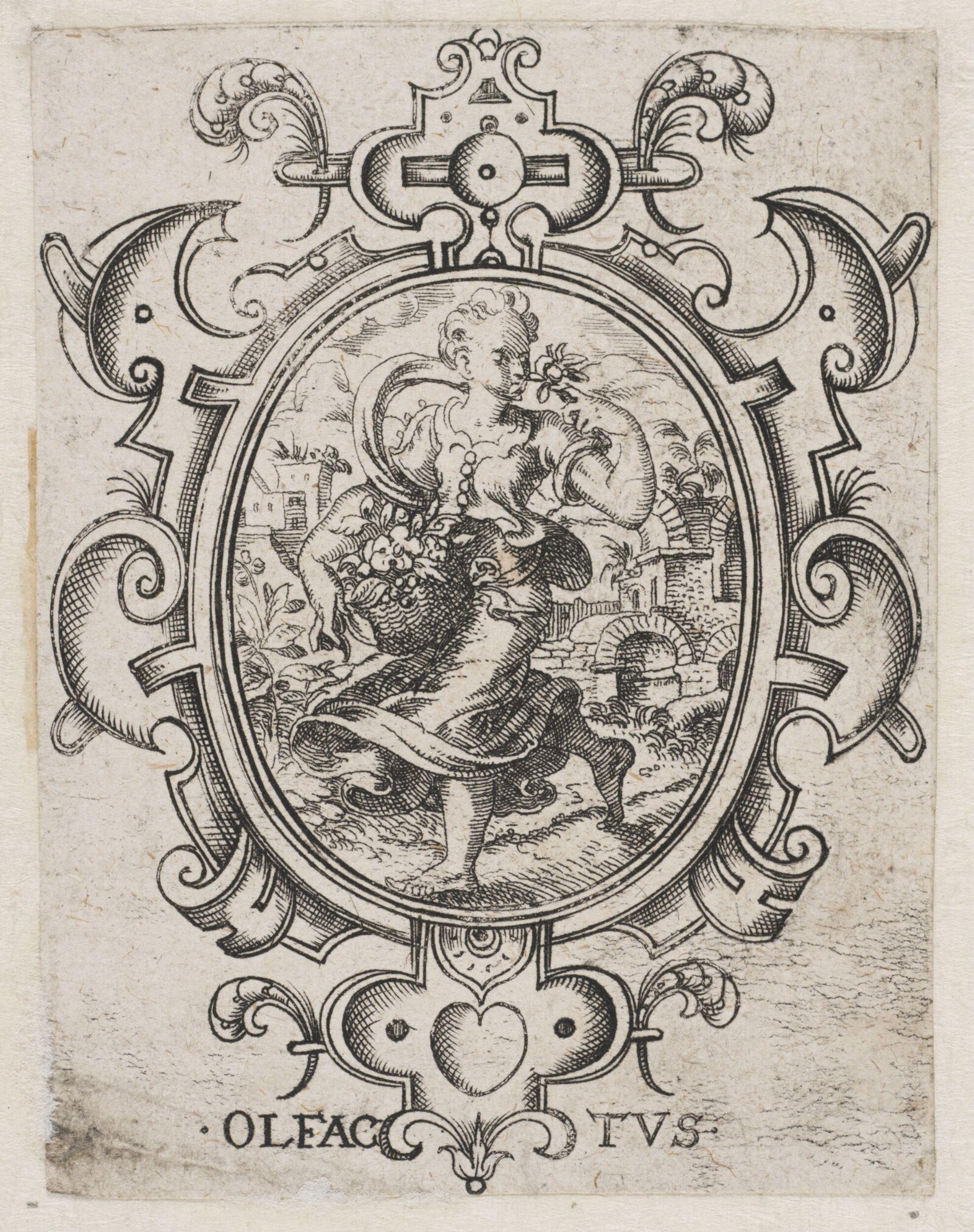
Bản in The Sense of Smell ở Victoria and Albert Museum chỉ cao khoảng 8 cm, rộng khoảng 6 cm. Tờ giấy đã bị cắt sát mép từ trước khi vào bảo tàng. Nó đến V&A từ bộ sưu tập Rosenheim và được ghi sổ năm 1923.
Đây là một tờ trong loạt The Five Senses, năm giác quan, làm ở Đức vào cuối thế kỷ 16. V&A giữ đủ cả loạt. Mỗi giác quan là một người phụ nữ trong một ô bầu dục, mỗi ô có một khung trang trí riêng, mỗi khung có một chữ Latin bên dưới. Thị giác cầm gương. Thính giác ôm đàn. Vị giác đưa trái cây lên miệng. Khứu giác cầm hoa.
Trong ô của khứu giác, người phụ nữ đang bước nhanh qua một vùng quê. Váy cô bay về phía sau. Một tay đưa nhành hoa nhỏ lên sát mũi, tay kia ôm một giỏ đầy hoa. Bên cạnh cô, một con vật nhỏ nhảy lên, dáng như một con chó. Phía sau là tường thành, mái vòm, những vòm đá đổ nát. Tất cả được khắc bằng những nét mảnh, dày đặc, trên một diện tích không lớn hơn con tem thư là bao.
Hai người thợ, hai kỹ thuật
Bảo tàng ghi hai tên. Jost Amman làm phần khắc axit, tức là phần hình người và phong cảnh. Stefan Herman khắc phần khung bằng dao khắc. Hai kỹ thuật cho hai loại nét khác nhau. Khắc axit cho nét mềm, gần với nét bút vẽ. Khắc chạm cho đường cong sắc và đều, hợp với những hoạ tiết trang trí đối xứng.
Jost Amman sinh ở Zürich năm 1539 và mất ở Nuremberg năm 1591. Ông chuyển tới Nuremberg khoảng năm 1560 và làm việc cho Virgil Solis, một trong những người làm tranh minh hoạ sách lớn nhất thời đó. Về sau, chính Amman trở thành một trong những người minh hoạ sách làm nhiều nhất ở Đức. Khoảng 1.500 bản in được gắn với tên ông. Một học trò của ông từng kể rằng trong bốn năm, Amman vẽ nhiều tới mức một xe chở cỏ cũng không chở hết.
Tác phẩm được nhớ nhất của ông là cuốn Ständebuch, in ở Frankfurt năm 1568, tập tranh khắc gỗ về các nghề nghiệp thời đó: thợ in, thợ giày, thợ bạc, người bán thuốc. Amman là người vẽ đời sống hằng ngày. Ông quen nhìn người ta cầm dụng cụ, đứng trước quầy, làm một việc cụ thể bằng tay.
Năm giác quan như một mẫu hình
Vẽ năm giác quan thành năm hình người là một thói quen phổ biến của tranh in phương Bắc thế kỷ 16 và 17. Tranh in nhỏ thời đó thường được mua theo bộ, dán vào album, hoặc dùng làm mẫu cho những người làm đồ trang trí. Một tờ giấy nhỏ như thế này có thể đi rất xa, được chép lại, được đưa vào những đồ vật khác.
Vì vậy mỗi giác quan cần một vật dễ nhận. Với khứu giác, vật ấy là hoa, và thường có thêm con chó, con vật sống bằng mũi. Những thứ này lặp lại qua nhiều loạt tranh của nhiều nghệ sĩ khác, như bản khứu giác của Adriaen Collaert theo Maarten de Vos. Người xem thời đó đọc được ngay, như đọc một ký hiệu.
Điều khác ở bản của Amman là tỷ lệ. Khung chiếm gần hết tờ giấy. Cảnh chính bị đẩy vào giữa, nhỏ lại. Ở chân khung là một trái tim, hai bên là chữ OLFAC và TVS. Đây là một tờ giấy về trang trí nhiều ngang với một tờ giấy về giác quan.
Vì sao đáng nhìn lại
Bốn trăm năm sau, tờ giấy này cho thấy một điều giản dị: con người đã tìm cách vẽ mùi từ rất lâu, và cách đầu tiên luôn là vẽ cử chỉ. Không ai vẽ được mùi hoa. Người ta vẽ một người đang ngửi.
Cử chỉ ấy vẫn còn quen với chúng ta. Cúi xuống một bông hoa. Nâng một nhành lá lên mũi. Nhắm mắt lại một chút. Bản in của Amman giữ nó lại trong một khoảng giấy nhỏ hơn lòng bàn tay, giữa một khung xoắn phức tạp của thời Phục hưng phương Bắc.
Người xem hôm nay có thể nhìn nó như một vật trang trí. Hoặc như một bằng chứng rằng khứu giác, giác quan khó vẽ nhất, đã có chỗ của nó trong bộ năm, ngang hàng với mắt và tai.
A sheet smaller than a hand
The Sense of Smell at the Victoria and Albert Museum is about 8 cm tall and 6 cm wide. The sheet was trimmed close before it reached the museum. It came to the V&A from the Rosenheim collection and was registered in 1923.
It is one sheet from The Five Senses, made in Germany in the late sixteenth century. The V&A holds the whole series. Each sense is a woman in an oval, each oval has its own ornamental frame, each frame a Latin word beneath. Sight holds a mirror. Hearing holds a lute. Taste lifts fruit to her mouth. Smell holds flowers.
In the oval for smell, the woman strides quickly across open country. Her skirt flies back. One hand raises a small sprig to her nose; the other arm carries a basket full of flowers. Beside her a small animal leaps, shaped like a dog. Behind her are city walls, a dome, broken stone arches. All of it is cut in fine, dense lines, on an area hardly larger than a postage stamp.
Two makers, two techniques
The museum records two names. Jost Amman made the etching, the figure and the landscape. Stefan Herman engraved the frame. The two techniques give two kinds of line. Etching gives a soft stroke, close to a pen. Engraving gives crisp, even curves, suited to symmetrical ornament.
Jost Amman was born in Zürich in 1539 and died in Nuremberg in 1591. He moved to Nuremberg around 1560 and worked for Virgil Solis, then one of the leading book illustrators. Amman himself became one of the most prolific illustrators in Germany. About 1,500 prints are attributed to him. A pupil once claimed that in four years he drew more than a hay wagon could carry.
His best remembered work is the Ständebuch, printed in Frankfurt in 1568, a book of woodcuts of the trades of the day: printer, shoemaker, goldsmith, apothecary. Amman drew daily life. He was used to watching people hold tools, stand at counters, do one specific thing with their hands.
The five senses as a pattern
Showing the five senses as five figures was a common habit of northern prints in the sixteenth and seventeenth centuries. Small prints of the time were often bought in sets, pasted into albums, or used as models by makers of decorative objects. A small sheet like this one could travel far, be copied, be carried into other objects.
So each sense needed an object that was easy to read. For smell, that object was the flower, often with a dog, the animal that lives through its nose. These signs recur across many series by other artists, such as the smell plate by Adriaen Collaert after Maarten de Vos. Viewers of the time read them at once, like a symbol.
What sets Amman's version apart is scale. The frame fills almost the whole sheet. The scene is pushed to the centre and shrinks. At the foot of the frame sits a heart, with OLFAC and TVS on either side. It is a sheet about ornament as much as a sheet about a sense.
Why it is worth another look
Four hundred years on, the sheet shows something simple: people tried to picture smell very early, and the first method was always to picture a gesture. No one could draw the scent of a flower. They drew someone smelling.
The gesture is still familiar. Leaning over a bloom. Lifting a leaf to the nose. Closing the eyes a little. Amman holds it in a space smaller than a palm, inside a knotted frame of the northern Renaissance.
Today one can see it as ornament. Or as evidence that smell, the hardest sense to draw, had its place in the set of five, level with the eye and the ear.
Olfactory Art