
Essays · Olfactory Art
Koo Jeong A. Odorama (Charing Cross).
Càng xuống sâu, mùi gỗ càng đặc.
The deeper you go, the thicker the wood.
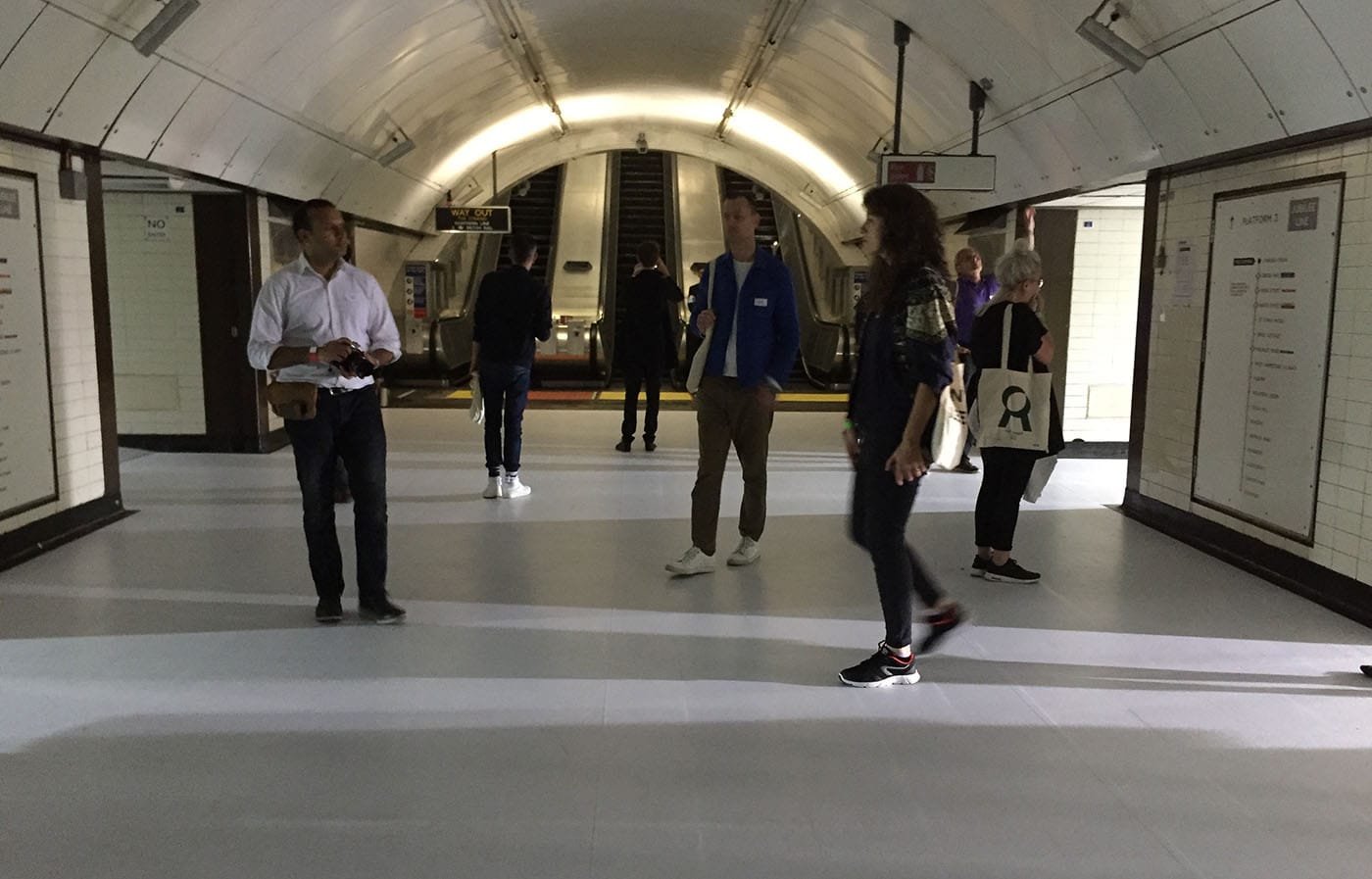
Photo for Hyperallergic · Hyperallergic
Một sân ga không còn tàu
Ngày 2 tháng 7 năm 2016, London tổ chức Art Night lần đầu tiên, một đêm nghệ thuật đưa các tác phẩm vào những nơi thường không dành cho nghệ thuật. Năm ấy, chương trình do Institute of Contemporary Arts, ICA, làm khách mời giám tuyển cùng Kathy Noble.
Một trong những địa điểm là sân ga đã bỏ không của ga tàu điện ngầm Charing Cross. Đây là nơi từng được dùng để quay một cảnh trong phim Skyfall. Không còn tàu chạy qua. Chỉ còn đường ray, gạch men, bảng chỉ dẫn cũ và bóng tối của đường hầm.
Nghệ sĩ Hàn Quốc Koo Jeong A đặt vào đó tác phẩm Odorama. Bà không mang theo tượng, tranh hay màn hình. Theo mô tả của Hyperallergic, bà chỉ dùng ánh sáng và một mùi, với ý định làm lệch cảm nhận của công chúng về thực tại.
Người xem đi xuống cầu thang dẫn tới sân ga. Càng xuống, một mùi ngọt, ấm, có chất đất càng đậm hơn. Tới sân ga, nó đã đặc lại, chiếm lấy không khí.
Gỗ trầm, một vết thương thành mùi
Mùi ấy đến từ gỗ trầm, phần gỗ có nhựa của cây dó ở châu Á. Nhựa hình thành khi cây tự vệ trước nấm và mốc. Nói cách khác, mùi trầm là mùi của một cái cây đang chống lại tổn thương. Thứ được con người quý là dấu vết của một phản ứng sinh tồn.
Trong phần giới thiệu tác phẩm, Koo nhắc đến việc cây dó mọc tự nhiên được luật pháp bảo vệ như một loài nguy cấp, không được chặt. Theo lời bà, chỉ có thể thu những khúc gỗ đã đổ xuống vì sét đánh, rồi bị gió và dòng sông đưa đi qua nhiều năm.
Chi tiết ấy làm mùi trong đường hầm mang theo một hành trình dài hơn nhiều so với vài bậc cầu thang. Trước khi tới London, khúc gỗ đã bị sét, bị gió, bị nước. Cái mũi của người xem đứng ở cuối con đường ấy. Người xem không thấy sét, không thấy dòng sông. Họ chỉ ngửi được kết quả của chúng.
Cũng cần nói rằng mùi không dịu với tất cả mọi người. Người viết bài trên Hyperallergic kể mình bị hắt hơi và có triệu chứng như dị ứng phấn hoa, và thấy những người xem khác cũng vậy. Tác giả thích câu chuyện của gỗ, nhưng thấy khó nối nó với chính sân ga bỏ hoang.
Ánh sáng và không khí làm vật liệu
Tên Odorama gợi tới những thử nghiệm điện ảnh có mùi, nơi mùi được coi như một thứ phụ trợ cho hình ảnh. Ở Charing Cross, trật tự đảo lại. Hình ảnh gần như không có. Ánh sáng chỉ đủ để thấy đường đi. Mùi là thứ chính.
Koo Jeong A từ lâu làm việc với những can thiệp nhỏ, gần như vô hình, vào không gian có sẵn. Odorama ở Charing Cross đi tới gần cực của lối làm ấy. Bà còn mang cái tên này sang những dự án khác, như ODORAMA CITIES. Không có vật nào để nhìn. Người xem mang tác phẩm về theo quần áo, theo tóc, theo hơi thở.
Một sân ga tàu điện ngầm là nơi người ta đi qua nhanh nhất có thể. Không ai dừng lại ngửi một sân ga. Odorama bắt người xem đi chậm lại, vì cơ thể cần thời gian để hiểu một thứ mùi đang dày lên. Một nơi để đi qua trở thành một nơi để ở lại.
Tác phẩm đáng nhớ vì nó cho thấy mùi có thể đè lên kiến trúc. Bê tông, gạch và đường ray vẫn còn nguyên. Nhưng người bước ra khỏi đêm ấy nhớ một khu rừng, một cái cây bị sét đánh, và một mùi gỗ mà họ không biết tên.
A platform without trains
On 2 July 2016 London held the first Art Night, a night of art that placed works in spaces not usually meant for art. That year the programme was guest curated by the Institute of Contemporary Arts, the ICA, with Kathy Noble.
One of the sites was a disused platform at Charing Cross Underground station, the same place where a scene from Skyfall was filmed. No trains pass. There are only rails, tiles, old signs and the dark of the tunnel.
The Korean artist Koo Jeong A placed Odorama there. She brought no sculpture, painting or screen. According to Hyperallergic, she used nothing more than light and a particular smell, with the aim of altering the public's sense of reality.
Visitors walked down the stairs to the platform. The further they went, the stronger a sweet, warm, earthy smell became. By the platform it had thickened and taken over the air.
Agarwood, a wound turned into smell
The smell came from agarwood, the resinous wood of Asian agar trees. The resin forms when the tree defends itself against fungus and mould. In other words, agarwood smells of a tree resisting injury. What people treasure is the trace of a survival response.
In her notes on the work, Koo explains that wild agar trees are protected by law as an endangered species and may not be felled. As she describes it, only wood that has fallen after lightning strikes, carried by wind and rivers over the years, can be gathered.
That detail gives the smell in the tunnel a journey far longer than a few flights of stairs. Before reaching London the wood had met lightning, wind and water. The visitor's nose stands at the end of that road. Visitors see no lightning, no river. They only smell what these left behind.
The smell was not gentle for everyone. The Hyperallergic writer describes sneezing and symptoms like hay fever, and noticed other visitors reacting the same way. The writer liked the story of the wood but struggled to connect it to the abandoned platform itself.
Light and air as material
The name Odorama recalls scented cinema experiments, where smell was an accessory to the image. At Charing Cross the order is reversed. There is almost no image. The light is just enough to see the way. Smell is the main thing.
Koo Jeong A has long worked with small, nearly invisible interventions in existing spaces. Odorama at Charing Cross goes close to the far end of that approach. She has carried the name into other projects too, such as ODORAMA CITIES. There is nothing to look at. Visitors carry the work home in their clothes, their hair, their breath.
An Underground platform is a place people pass through as fast as they can. Nobody stops to smell one. Odorama makes visitors slow down, because the body needs time to understand a smell that is growing denser. A place for passing through becomes a place to stay.
The work stays in memory because it shows that smell can overlay architecture. The concrete, tiles and rails remain. But those who came out of that night remember a forest, a tree struck by lightning, and a smell of wood they could not name.

Olfactory Art