
Essays · Olfactory Art
Maki Ueda. Dog's Nose (Ars Electronica Version).
Thành phố có một bản đồ khác, ở độ cao của mũi chó.
The city has another map, at the height of a dog's nose.
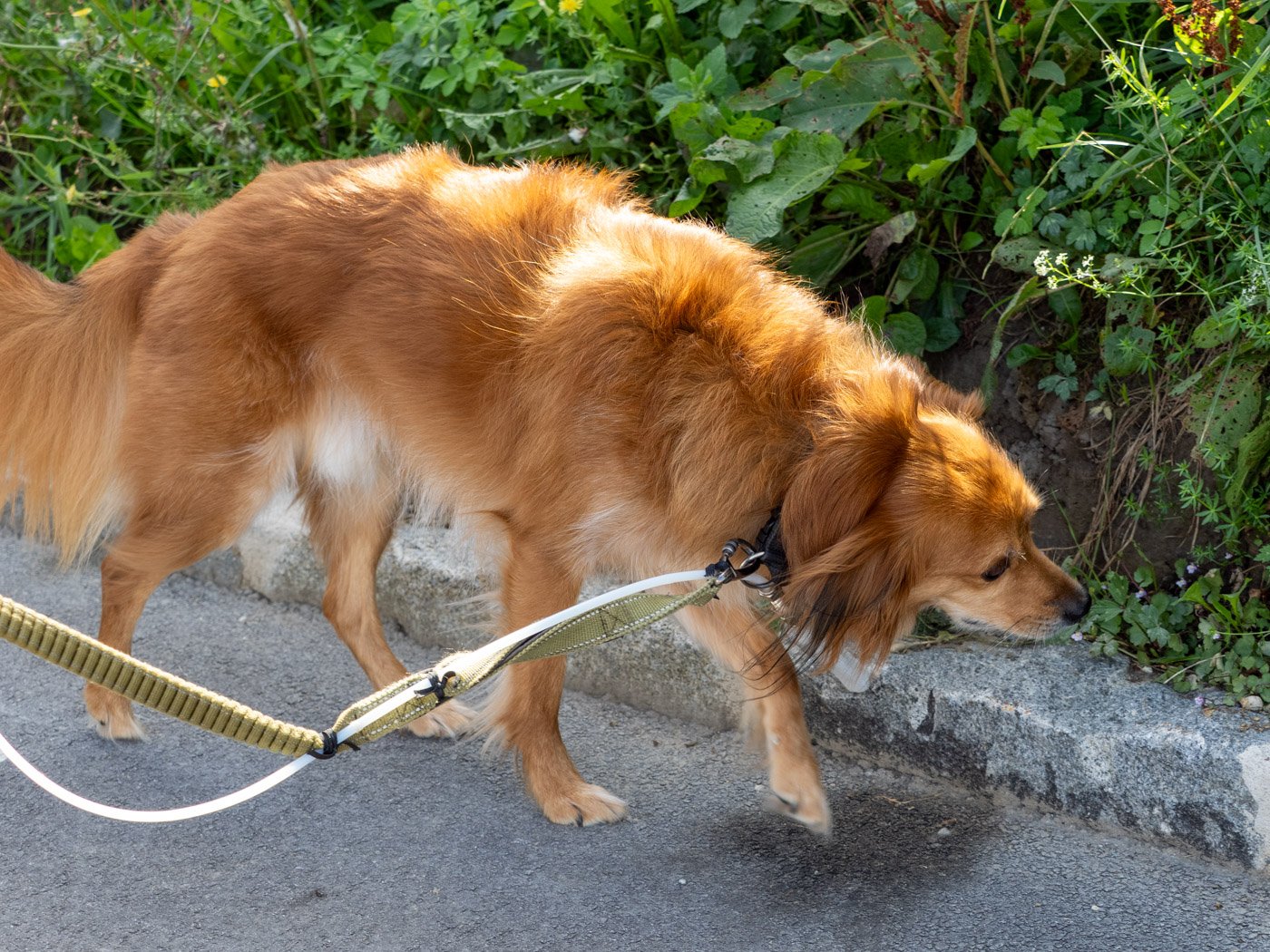
Photo: Konflozius · Maki Ueda (official artist site)
Một giờ đi dạo ở Linz
Sáng ngày 3 tháng 9 năm 2026, từ 10 giờ 30 đến 11 giờ 30, một chú chó đực bảy tuổi tên Wim rời Ars Electronica Center ở Linz, nước Áo, và đi dạo quanh thành phố. Wim không đi một mình. Trên người nó có một thiết bị đo khí cầm tay tên FAIMS Mobile. Trong phần ghi công của tác phẩm, Wim được gọi là nhà nghiên cứu khứu giác.
Suốt một giờ, thiết bị ghi lại các phân tử bay hơi trong không khí ở độ cao mũi của Wim. Dữ liệu được chia thành bốn nhóm: amoniac, phân tử cỡ nhỏ, cỡ vừa và cỡ lớn. Mỗi nhóm cho ra một tấm bản đồ phân bố riêng trên nền đường phố Linz.
Kết quả là bốn tấm bản đồ của cùng một buổi sáng, cùng một lộ trình, nhưng không tấm nào giống tấm nào. Chỗ này đậm amoniac. Chỗ kia dày phân tử lớn. Người đi bộ bình thường có thể đi qua cả hai chỗ mà không để ý gì.
Phần phân tích kỹ thuật do Katsuya Ujimoto của công ty Ricoh thực hiện. Ảnh tư liệu của Konflozius. Maki Ueda là tác giả và người nghiên cứu. Dog's Nose (Ars Electronica Version) là phiên bản được làm riêng cho Ars Electronica, liên hoan nghệ thuật, công nghệ và xã hội tổ chức hằng năm ở Linz.
Ghi lại, rồi phát lại
Ueda gọi Dog's Nose là một hệ thống bio-logging để ghi và phát lại cảnh mùi. Bio-logging là cách các nhà sinh học gắn thiết bị lên động vật để thu dữ liệu từ đời sống của chính con vật đó. Ở đây, thứ được thu không phải nhịp tim hay vị trí, mà là không khí con chó đang hít.
Trước phiên bản Linz, dự án đã đi qua Tokyo. Theo trang của nghệ sĩ, chó Chiyoko, chó của chính Ueda và được bà gọi là người thầy về khứu giác, đã đeo cảm biến đi qua Shibuya, Harajuku, công viên Yoyogi và đại lộ Meiji trong tổng cộng khoảng sáu giờ.
Nửa sau của hệ thống là phát lại. Dữ liệu được đưa vào một bản đồ thu nhỏ có thể ngửi, dùng thiết bị phun mùi điều khiển số và kỹ thuật vi nang. Người xem không nhìn bản đồ bằng mắt là đủ. Họ phải cúi xuống, đưa mũi lại gần.
Chỗ khó của việc ghi mùi là mùi không có một đơn vị chung như pixel hay nốt nhạc. Ueda không cố tái tạo từng mùi cụ thể của Linz. Bà ghi lại cấu trúc của nó: phân tử nào, cỡ nào, dày ở đâu. Cảnh mùi được phát lại là một bản dịch, không phải một bản sao.
Chính khoảng cách giữa bản dịch và bản gốc làm tác phẩm đáng nghĩ. Ta không bao giờ ngửi được như Wim. Nhưng ta có thể biết rằng thế giới của Wim tồn tại, và nó có hình dạng.
Chính trị của cái mũi
Dog's Nose thuộc một nhóm dự án Ueda đặt tên là Olfacto-Politics. Từ khoá bà gắn cho nó gồm sự tham gia đa loài và khứu giác số. Hai từ khoá ấy chỉ ra hai hướng của tác phẩm.
Hướng thứ nhất là con chó. Trong phần lớn lịch sử, chó làm việc cho mũi của con người: đánh hơi con mồi, tìm người mất tích, dò chất nổ. Dog's Nose đổi vị trí ấy. Wim không tìm thứ con người muốn tìm. Nó chỉ đi như một con chó đi, và con người đi theo để học cách thành phố hiện ra với nó.
Hướng thứ hai là máy. Thiết bị đo không ngửi như chó, cũng không ngửi như người. Nó đếm phân tử. Giữa ba cái mũi đó, sinh học, máy móc và con người, tác phẩm cho thấy không có cái mũi nào là chuẩn. Mỗi cái đọc một phần.
Ueda là nghệ sĩ người Nhật làm việc lâu năm ở Hà Lan và lấy khứu giác làm chất liệu chính. Các dự án trước của bà, như Olfactoscape dựng ở Osaka năm 2010, thường đặt người xem vào một không gian mùi dựng sẵn. Dog's Nose đi ra ngoài phòng triển lãm, xuống mặt đường, và mời một loài khác làm tác giả chung.
Điều đáng nhớ ở tác phẩm là sự khiêm tốn của nó trước con chó. Một giờ đi dạo, bốn tấm bản đồ, và một lời thừa nhận rằng thành phố ta tưởng đã quen vẫn còn những lớp ta chưa từng ngửi thấy.
An hour's walk in Linz
On the morning of 3 September 2026, between 10:30 and 11:30, a seven year old male dog named Wim left the Ars Electronica Center in Linz, Austria, for a walk through the city. He carried a handheld gas measurement device called FAIMS Mobile. In the work's credits, Wim is listed as the olfactory researcher.
For an hour the device logged volatile molecules in the air at the height of Wim's nose. The data was sorted into four groups: ammonia, small molecules, middle sized molecules and large ones. Each group produced its own distribution map laid over the streets of Linz.
The result is four maps of the same morning and the same route, none alike. Here, heavy ammonia. There, a thick band of large molecules. An ordinary pedestrian could walk through both without noticing a thing.
The technical analysis was carried out by Katsuya Ujimoto of Ricoh. Photographs are by Konflozius. Maki Ueda is the author and researcher. This version was made for Ars Electronica, the annual festival of art, technology and society held in Linz.
Record, then play back
Ueda describes Dog's Nose as a bio-logging system for capturing and playing back smellscapes. Bio-logging is the practice, familiar to biologists, of fitting instruments to animals to gather data from their own lives. Here the data is not heart rate or position but the air the dog is breathing.
Before Linz the project passed through Tokyo. According to the artist's site, Chiyoko, Ueda's own dog and, in her words, her olfactory mentor, wore the sensor through Shibuya, Harajuku, Yoyogi Park and Meiji-dori for about six hours in total.
The second half of the system is playback. The data is turned into a small scale map that can be smelled, using digitally controlled scent spray and microencapsulation. Looking at the map is not enough. Visitors have to bend down and bring their nose close.
The difficulty in recording smell is that it has no common unit, no pixel, no musical note. Ueda does not try to reproduce each odour of Linz. She records its structure: which molecules, what size, how dense and where. The smellscape that comes back is a translation, not a copy.
That gap between translation and original is what makes the work worth thinking about. We will never smell as Wim does. But we can know that his world exists, and that it has a shape.
The politics of a nose
Dog's Nose belongs to a group of projects Ueda calls Olfacto-Politics. The keywords she attaches to it include multispecies engagement and digital olfaction, and they point in two directions.
The first is the dog. For most of history dogs have worked for human noses: tracking game, finding the lost, sniffing out explosives. Dog's Nose reverses the arrangement. Wim is not searching for what people want found. He simply walks as a dog walks, and people follow to learn how the city appears to him.
The second is the machine. The device does not smell like a dog or like a person. It counts molecules. Between the three noses, biological, mechanical and human, the work shows that none of them is the standard. Each reads a part.
Ueda is a Japanese artist who has long worked in the Netherlands and whose main material is smell. Her earlier projects, such as Olfactoscape, built in Osaka in 2010, often placed visitors inside a constructed space of smell. Dog's Nose steps out of the gallery, down onto the pavement, and invites another species to share the authorship.
What stays with you is the work's modesty before the dog. One hour's walk, four maps, and an admission that a city we think we know still has layers we have never smelled.
Olfactory Art