
Essays · Modern Art
Marcel Duchamp. Fountain.
Bản gốc đã mất. Tác phẩm vẫn còn.
The original is lost. The work remains.
Tate · Tate
Một vật mua ở cửa hàng thiết bị vệ sinh
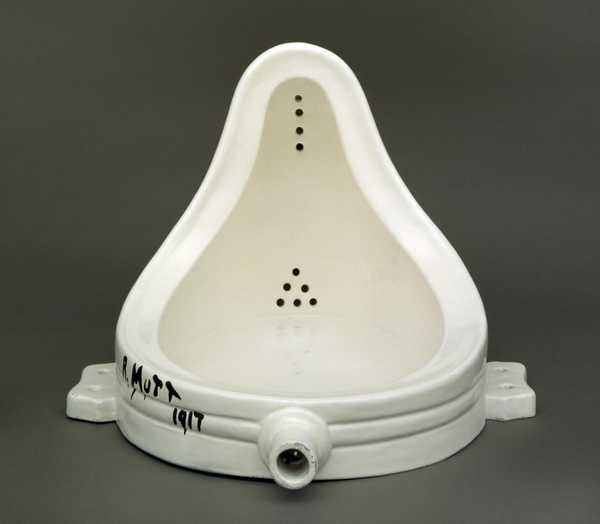
Mùa xuân năm 1917, ở New York, Marcel Duchamp mua một chiếc bồn tiểu tiêu chuẩn từ một nhà cung cấp thiết bị vệ sinh. Về sau ông nhớ lại đó là hãng J.L. Mott Iron Works. Ông xoay nó nằm ngửa, không để đứng như khi lắp trên tường. Bằng sơn đen, ông viết lên mép: R. Mutt 1917.
Rồi chiếc bồn tiểu được gửi đến triển lãm đầu tiên của Society of Independent Artists, một hội nghệ sĩ mới lập, dưới tên một người không ai biết là Richard Mutt. Tên tác phẩm là Fountain, đài phun nước.
Duchamp gọi những vật như thế là readymade: một đồ vật sản xuất hàng loạt được nghệ sĩ chỉ định làm tác phẩm. Trước đó ông đã có Bottle Rack năm 1914, một giá phơi chai. Nhưng không readymade nào gây chuyện như chiếc bồn tiểu này.
Cái tên cũng là một trò đùa. Duchamp kể Mutt đến từ Mott, tên hãng sứ, sửa đi một chữ theo bộ truyện tranh Mutt and Jeff đang rất quen thuộc thời ấy. Chữ Richard thêm vào sau, một tiếng lóng Pháp chỉ người lắm tiền.
Duchamp chưa bao giờ giải thích vì sao ông xoay chiếc bồn tiểu. Ông say mê bài toán biểu diễn chiều thứ tư, vốn hay được minh hoạ bằng hình khối xoay trong sách toán. Và cùng lúc ấy ông đang làm dở một tác phẩm lớn về máy móc và ham muốn, The Large Glass, mà rất ít người biết đến.
Một hội không có ban giám khảo
Duchamp chuyển từ Paris sang New York năm 1915. Ông là một trong những người sáng lập hội, ngồi trong ban điều hành và phụ trách treo tranh. Hội tuyên bố không có ban giám khảo, không có giải thưởng: hội viên gửi gì cũng được trưng. Duchamp còn đề nghị treo tác phẩm theo thứ tự chữ cái của họ nghệ sĩ, để không ai phải xếp hạng ai.
Chiếc bồn tiểu thử đúng lời hứa đó. Trong lúc dựng triển lãm tại Grand Central Palace, khoảng mười thành viên ban điều hành có mặt đã bàn và bỏ phiếu. Với cách biệt sát nút, họ quyết định không trưng Fountain. Triển lãm mở cửa ngày 10 tháng 4 năm 1917 mà không có nó. Họ cho rằng một món đồ vệ sinh không thể là nghệ thuật, lại còn khiếm nhã.
Duchamp và nhà sưu tập Walter Arensberg từ chức để phản đối. Lúc ấy gần như không ai công khai biết Duchamp chính là người đứng sau R. Mutt. Về sau ông giải thích: nếu các đồng nghiệp biết, câu trả lời của họ có thể đã khác, và phép thử sẽ không còn là phép thử.
Có người đọc chuyện này như một lần Duchamp diễn lại chuyện cũ. Năm 1912, ở Salon des Indépendants tại Paris, ông đã bị khéo léo yêu cầu rút bức Nude Descending a Staircase, No.2 ngay trước ngày khai mạc. Ông làm theo, nhưng về sau coi đó là một bước ngoặt của đời mình.
Tấm ảnh, bài báo và cái vật biến mất
Chỉ vài ngày sau khai mạc, Duchamp tìm thấy chiếc bồn tiểu cất sau một tấm vách trong phòng trưng bày, rồi mang đến cho nhiếp ảnh gia Alfred Stieglitz chụp. Tấm ảnh xong trước ngày 19 tháng 4 năm 1917. Trên chiếc bồn tiểu trong ảnh có treo một nhãn địa chỉ, và nhờ đọc kỹ nhãn ấy người ta biết địa chỉ trên đó là của Louise Norton, một người bạn thân của Duchamp.
Tháng 5 năm 1917, số thứ hai của tạp chí nhỏ The Blind Man in tấm ảnh kèm một bài không ký tên bênh vực Mr Mutt. Ý chính của bài rất gọn: ông Mutt có tự tay làm cái bồn hay không chẳng quan trọng. Ông đã chọn nó. Ông đặt một vật thường ngày vào chỗ mà công dụng của nó biến mất dưới một cái tên mới, một góc nhìn mới.
Sau đó, chính chiếc bồn tiểu biến mất. Vài tấm ảnh được cho là chụp năm 1918 cho thấy nó treo ở cửa xưởng của Duchamp. Rồi không ai biết nó đi đâu. Tate cho rằng có thể nó đã bị vứt đi khi Duchamp sang Buenos Aires năm 1918.
Như vậy, tác phẩm nổi tiếng nhất của Duchamp được rất ít người tận mắt thấy. Phần lớn lịch sử của nó là lịch sử của một tấm ảnh.
Những bản sao ký năm 1964
Đến những năm 1950 và 1960, thế hệ nghệ sĩ mới coi các readymade thời Dada của Duchamp là tiền lệ cho chính họ. Bảo tàng và gallery hỏi mượn những vật đã mất từ lâu. Duchamp cho phép làm bản sao Fountain năm 1950 và năm 1963.
Năm 1964, Galleria Schwarz ở Milan làm lại Fountain thành một ấn bản tám chiếc, dựa trên tấm ảnh của Stieglitz và làm việc sát với Duchamp. Thêm bốn chiếc nữa: một cho Duchamp, một cho nhà buôn Arturo Schwarz, hai cho các triển lãm bảo tàng. Bản sao làm bằng đất nung tráng men, sơn trắng để giống sứ gốc. Chữ ký R. Mutt được vẽ lại bằng sơn đen. Duchamp ký tên mình ở mặt sau.
Chiếc ở Tate được mua năm 1999 với sự hỗ trợ của hội Friends of the Tate Gallery, và nằm trong những phòng trưng bày đầu tiên của Tate Modern năm 2000. Năm 2004, trong một cuộc thăm dò 500 chuyên gia nghệ thuật Anh, Fountain được chọn là tác phẩm có ảnh hưởng nhất thế kỷ hai mươi.
Có người thấy bản sao đi ngược tinh thần readymade: một vật chọn ở một thời điểm, giờ lại được đúc lại theo mẫu. Duchamp thì không bận tâm. Ông sẵn lòng bỏ đi hào quang của bản duy nhất, miễn là nhiều người được xem và ý tưởng thì sống tiếp.
Bought from a plumbing supplier
In spring 1917, in New York, Marcel Duchamp bought a standard urinal from a sanitary ware supplier. He later recalled the firm as J.L. Mott Iron Works. He turned it onto its back rather than standing it upright as it would hang on a wall. In black paint he wrote on the rim: R. Mutt 1917.
The urinal was then submitted to the first exhibition of the Society of Independent Artists, a newly founded society, under the name of an unknown Richard Mutt. The title was Fountain.
Duchamp called such things readymades: a mass produced object designated by the artist as a work. He had already made Bottle Rack in 1914. But no readymade caused trouble like this one.
The name was a joke too. Duchamp said Mutt came from Mott, the sanitary firm, altered after the comic strip Mutt and Jeff. Richard was added as French slang for a man with money.
Duchamp never explained why he turned the urinal. He was fascinated by the problem of showing a fourth dimension, often illustrated in mathematics books by rotating solids. And at the same time he was working on a large piece about machines and desire, The Large Glass, which very few people knew about.
A society with no jury
Duchamp had moved from Paris to New York in 1915. He helped found the society, sat on its board and headed the hanging committee. The society promised no jury and no prizes: whatever members sent would be shown. Duchamp even proposed hanging works alphabetically by surname so that no one would rank anyone.
The urinal tested that promise. During the installation at the Grand Central Palace, about ten directors discussed it and voted. By a narrow margin they excluded Fountain. The show opened on 10 April 1917 without it. In their view a piece of sanitary ware could not be art, and was indecent besides.
Duchamp and the collector Walter Arensberg resigned in protest. At the time almost no one publicly knew that Duchamp was behind R. Mutt. He later explained that if his colleagues had known, their answer might have been different, and the test would no longer have been a test.
Some read the episode as Duchamp replaying an old wound. In 1912, at the Salon des Indépendants in Paris, he had been quietly asked to withdraw Nude Descending a Staircase, No.2 days before the opening. He complied, but later called it a turning point in his life.
A photograph, an article, a vanished object
Within days of the opening, Duchamp found the urinal stored behind a partition and took it to the photographer Alfred Stieglitz. The picture was taken by 19 April 1917. An address label hangs from the urinal in the photograph, and careful reading of it shows the address of Louise Norton, one of Duchamp's close friends.
In May 1917 the second issue of the small magazine The Blind Man printed the photograph with an unsigned editorial defending Mr Mutt. Its point was simple: whether Mr Mutt made the fountain with his own hands does not matter. He chose it. He placed an ordinary article where its useful meaning disappeared under a new title and point of view.
Then the urinal itself disappeared. Photographs believed to date from 1918 show it hanging in the doorway of Duchamp's studio. After that, no one knows. Tate suggests it may have been thrown out when Duchamp left for Buenos Aires in 1918.
So Duchamp's most famous work was seen by very few people. Much of its history is the history of a photograph.
Replicas signed in 1964
By the 1950s and 1960s a new generation of artists saw Duchamp's Dada readymades as precedents for their own work. Museums and galleries asked to borrow objects long lost. Duchamp authorised replicas of Fountain in 1950 and 1963.
In 1964 the Galleria Schwarz in Milan produced Fountain in an edition of eight, based on Stieglitz's photograph and made in close contact with Duchamp. Four more were made: one for Duchamp, one for the dealer Arturo Schwarz, two for museum exhibitions. The replicas are glazed earthenware painted white to resemble the original porcelain. The R. Mutt signature was repainted in black. Duchamp signed his own name on the back.
Tate's example was bought in 1999 with help from the Friends of the Tate Gallery and was shown in the opening displays of Tate Modern in 2000. In 2004 a poll of 500 British art experts named Fountain the most influential artwork of the twentieth century.
Some felt the replicas betrayed the readymade: an object chosen at one moment, now fabricated to a model. Duchamp did not mind. He was happy to lose the aura of the unique original, as long as more people could see the work and the idea survived.
Modern Art