
Essays · Olfactory Art
Nonomura Ninsei. Incense Burner.
Chỗ từng dành cho hơi thổi, giờ dành cho khói thơm.
Where breath once passed, scented smoke now passes.
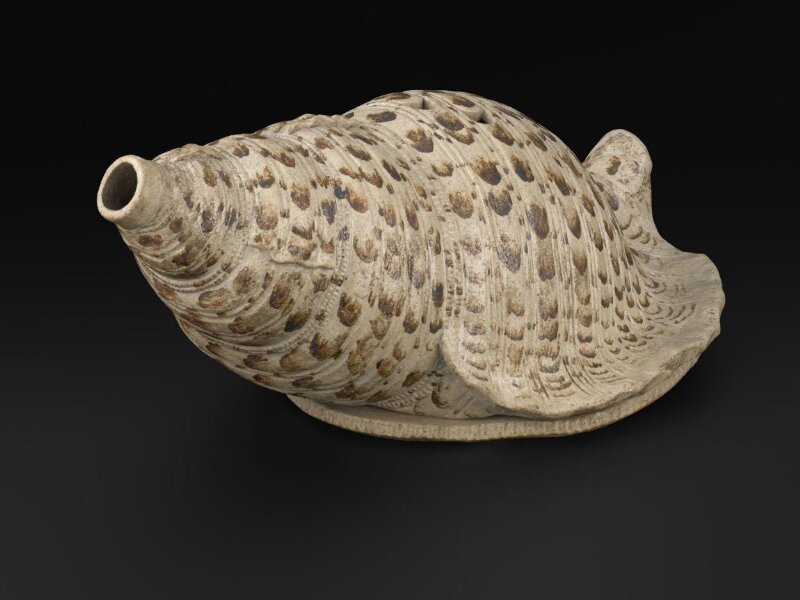
© Victoria and Albert Museum, London · Victoria and Albert Museum (V&A)
Tù và của người trên núi
Chiếc lư hương thuộc Victoria and Albert Museum ở London, số hiệu 260-1877. Nó được làm ở lò Omuro, Kyoto, trong khoảng năm 1660 đến 1680. Chất liệu là gốm sành, phủ men trong, bên dưới men là những chấm màu nâu sắt. Dưới đáy có con dấu mang tên Ninsei.
Hình dáng là một chiếc tù và ốc. Theo V&A, nó mô phỏng loại tù và mà các yamabushi mang theo. Yamabushi là những nhà tu khổ hạnh sống và tu tập trên núi. Họ thổi tù và làm từ vỏ ốc biển lớn, tiếng vang dội qua thung lũng.
Chiếc lư hương cao 11,5 cm, dài 27,6 cm, sâu 15,7 cm. Nó nằm ngang như một vỏ ốc đặt trên bàn. Vật gồm ba phần: thân lư, nắp, và một lớp lòng đặt vào bên trong.
Những chấm nâu dưới men làm bề mặt lấm tấm, gợi đến lớp vỏ ốc thật. Màu sắc giữ ở mức rất ít. Không có gì được vẽ thêm lên trên. Tất cả sự chú ý dồn vào hình khối: vòng xoắn, miệng loe, độ cong của thân.
Ninsei và lò Omuro
Nonomura Ninsei là tên nghề. Tên thật của ông là Nonomura Seiemon, hoạt động khoảng từ năm 1640 đến 1690. Năm 1647, ông lập lò Omuro gần chùa Ninnaji, ở phía tây bắc Kyoto.
V&A ghi rằng trong những năm 1660 và 1670, Ninsei phát triển một lối trang trí men màu trên men rất rực rỡ, gần với hội hoạ. Men màu phủ lên thân gốm như một lớp tranh, hoa lá, núi non, vàng bạc.
Chiếc lư hương này đi theo hướng ngược lại. Màu gần như không có, chỉ có men trong và nâu sắt. V&A mô tả nó là sự tiết chế về màu, đi cùng sự phóng khoáng về hình. Ninsei không cần vẽ lên vật để nó nổi bật. Ông để chính hình dáng làm việc đó.
Con dấu tên dưới đáy cũng đáng để ý. Rất nhiều đồ gốm cùng thời không mang tên người làm. Con dấu nhỏ này buộc vật vào một người, một lò, một phong cách. Ba thế kỷ rưỡi sau, bảo tàng vẫn đọc được tên ấy và ghi vào hồ sơ.
Từ Kyoto tới Philadelphia
Hồ sơ của V&A ghi một đường đi khá xa. Chiếc lư hương được mua từ các uỷ viên Nhật Bản tại Triển lãm Philadelphia năm 1876, và nhập vào bộ sưu tập năm 1877. Tức là khoảng hai trăm năm sau khi ra lò, nó rời Nhật như một đại diện cho gốm Kyoto trước khách phương Tây.
Thời Minh Trị, chính phủ Nhật gửi hàng loạt đồ mỹ nghệ tới các triển lãm thế giới. Bên cạnh những đồ mới làm, việc gửi đi một chiếc lư hương thế kỷ 17 mang dấu Ninsei cho thấy người Nhật khi ấy muốn giới thiệu không chỉ những gì họ đang làm, mà cả những gì họ coi là gốc của mình.
Ở Nhật, lư hương gốm như thế này thuộc về phòng trà, phòng khách, nơi hương được đốt nhẹ trong không gian nhỏ. Ở London, nó nằm trong tủ kính, không còn khói. Người xem chỉ thấy hình tù và, không nghe tiếng, không ngửi mùi.
Chiếc lư hương đáng nhớ vì nó giữ hai thứ đã biến mất cùng lúc. Tiếng của chiếc tù và mà nó mô phỏng. Và mùi của thứ hương mà nó từng toả ra. Còn lại là đất nung, men trong, và một con dấu nhỏ ghi tên người làm.
The mountain ascetic's trumpet
The burner belongs to the Victoria and Albert Museum in London, museum number 260-1877. It was made at the Omuro kiln in Kyoto between about 1660 and 1680. It is stoneware with a clear glaze over stippled underglaze iron brown. A stamp on the base reads Ninsei.
Its form is a conch shell trumpet. According to the V&A, it imitates the trumpets carried by yamabushi, the mountain ascetics who lived and practised in the mountains. They blew trumpets made from large sea shells, and the sound echoed across the valleys.
The burner is 11.5 cm high, 27.6 cm wide and 15.7 cm deep. It lies on its side like a shell resting on a table. It has three parts: the body, a lid, and an insert that sits inside.
The brown stippling beneath the glaze speckles the surface, recalling a real shell. Colour is kept to a minimum. Nothing is painted on top. All attention goes to the form: the spiral, the flared mouth, the curve of the body.
Ninsei and the Omuro kiln
Nonomura Ninsei is an art name. His proper name was Nonomura Seiemon, active from about 1640 to 1690. In 1647 he set up the Omuro kiln near Ninnaji temple in the northwest of Kyoto.
The V&A notes that in the 1660s and 1670s Ninsei developed a highly colourful overglaze style, close to painting. Enamel colours lay over the clay like a painted surface: flowers, mountains, gold and silver.
This burner goes the other way. There is almost no colour, only clear glaze and iron brown. The V&A describes it as restraint in tone paired with exuberance in form. Ninsei did not need to paint on the object to make it stand out. He let the shape do that.
The stamped name on the base is worth noticing. Much pottery of the time carries no maker's name. This small stamp ties the object to one person, one kiln, one style. Three and a half centuries later, the museum still reads that name and writes it into the record.
From Kyoto to Philadelphia
The V&A record traces a long journey. The burner was bought from the Japanese Commissioners at the Philadelphia Exposition of 1876 and entered the collection in 1877. About two centuries after leaving the kiln, it left Japan as a representative of Kyoto ceramics before Western visitors.
In the Meiji era the Japanese government sent large numbers of crafts to world exhibitions. Alongside newly made work, a seventeenth century burner stamped Ninsei suggests that Japan wanted to show not only what it was making, but what it considered its roots.
In Japan, a ceramic burner like this belonged to a tea room or a reception room, where incense burned gently in a small space. In London it sits in a case, without smoke. Visitors see the trumpet's shape but hear no sound and smell nothing.
The burner is worth remembering because it holds two things that have both disappeared. The sound of the trumpet it imitates. And the smell of the incense it once released. What remains is fired clay, clear glaze, and a small stamp bearing its maker's name.
Olfactory Art