
Essays · Olfactory Art
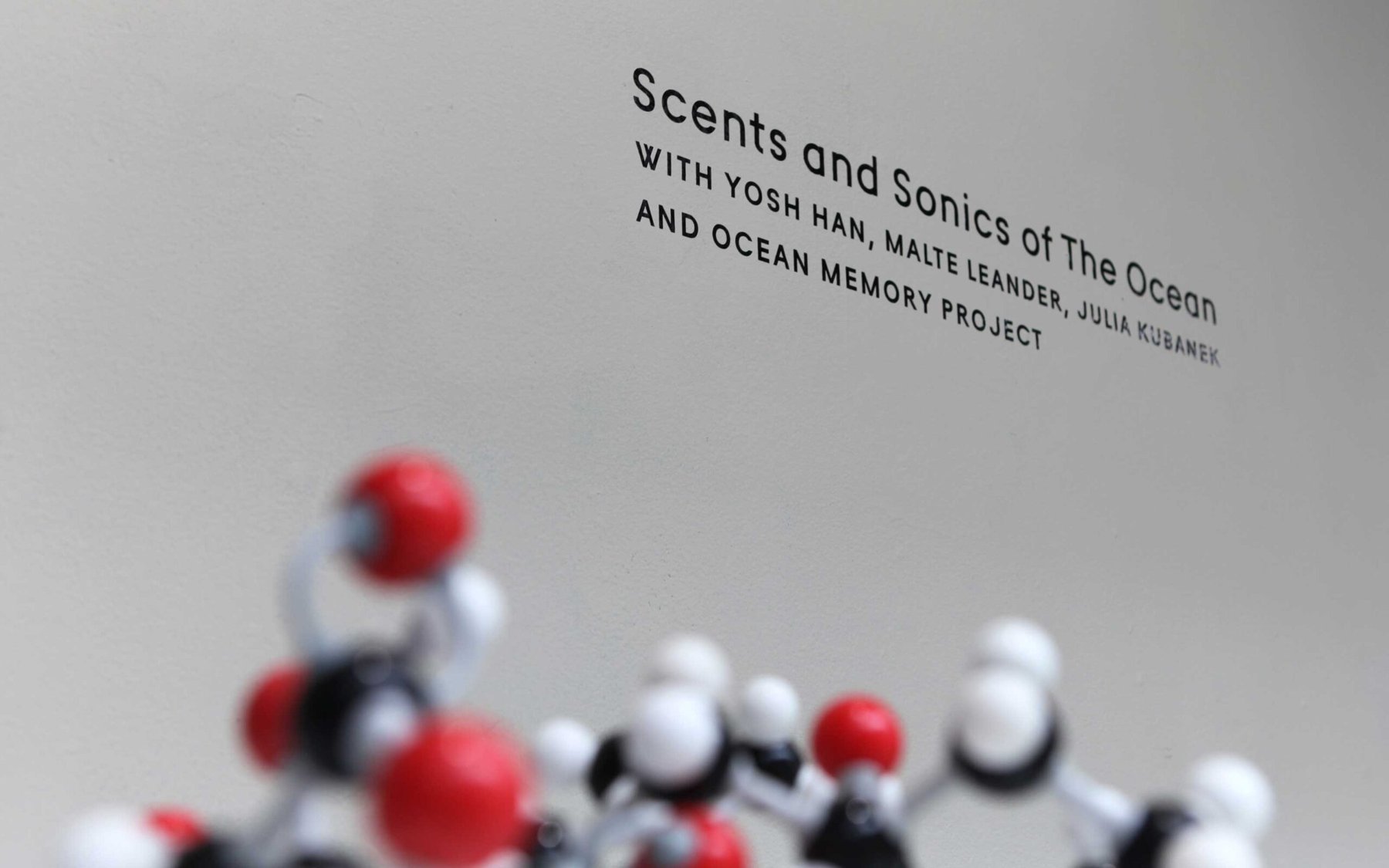
Scents and Sonics of The Ocean.
Một phân tử mùi cũng có thể được nghe.
A scent molecule can also be heard.
Institute for Art and Olfaction · Institute for Art and Olfaction
Bốn bên, một hòn đảo
Scents and Sonics of The Ocean mở tại IAO Gallery, phòng trưng bày của Institute for Art and Olfaction ở Chinatown, Los Angeles, từ ngày 20 tháng Một đến ngày 2 tháng Hai năm 2024. Tên đầy đủ của triển lãm dài hơn: những dấu vết đa giác quan về ký ức đã mất và được phục hồi của đảo Sapelo.
Sapelo là một hòn đảo chắn sóng ngoài khơi bang Georgia, bờ đông nước Mỹ. Bốn bên cùng làm việc về nó.
Yosh Han là perfumer, người sáng lập dòng nước hoa YOSH, đã làm trong ngành hương liệu gần ba mươi năm. Bà cũng là một thuyền trưởng có bằng của lực lượng tuần duyên Mỹ. Malte Leander là nghệ sĩ âm thanh và nhà soạn nhạc sống ở Montréal, làm nhạc cụ thể và cảnh âm thanh, thường về đề tài sinh thái. Julia Kubanek là giáo sư Viện Công nghệ Georgia, nghiên cứu cách sinh vật biển dùng tín hiệu hoá học để giao tiếp, tìm nơi sống, tìm bạn đời và tránh kẻ săn mồi.
Bên thứ tư là Ocean Memory Project, một mạng lưới hơn một trăm nhà nghiên cứu thuộc nhiều ngành: hải dương học, thần kinh học, mỹ thuật, sân khấu, lịch sử, triết học. Ý tưởng về ký ức đại dương ra đời năm 2016 tại một hội nghị liên ngành của các Viện Hàn lâm Quốc gia Mỹ. Dự án ở Los Angeles được tài trợ qua chương trình Keck Futures Initiative của các Viện Hàn lâm.
Từ phân tử đến âm thanh
Cách làm của nhóm là một chuỗi chuyển dịch. Mùi của hòn đảo được quy về các phân tử cụ thể. Mỗi phân tử có một dấu vân phổ, tức cách cấu trúc hoá học của nó phản ứng với ánh sáng trong máy quang phổ. Dấu vân ấy là một dải số liệu có đỉnh, có đáy, có nhịp.
Leander dùng những dải số liệu ấy làm vật liệu dựng cảnh âm thanh. Không phải tiếng sóng thu ngoài bãi, không phải tiếng chim. Là âm thanh sinh ra từ chính hình dạng của phân tử mùi.
Trong phòng, mùi và tiếng cùng có mặt. Người xem ngửi một thứ và nghe bản dịch của nó cùng lúc. Hai giác quan được đặt cạnh nhau không để minh hoạ cho nhau, mà để cùng chỉ về một nguồn: một hòn đảo mà phần lớn khách ở Los Angeles chưa từng đến.
Cùng dự án, Yosh Han còn làm một cuộc đi bộ ngửi mùi, được thu thành một bản podcast chừng mười bốn phút. Mô hình này học từ cuộc đi bộ nghe, soundwalk, mà nhà soạn nhạc R. Murray Schafer phát triển từ thập niên 1970.
Ký ức đã mất và được phục hồi
Chữ ký ức trong tên dự án không chỉ là ẩn dụ. Sapelo có dấu vết người sống từ hơn bốn nghìn năm trước. Đầu thế kỷ 19, người da đen bị bắt làm nô lệ và bị đưa đến đảo để trồng mía cùng các cây khác trên đồn điền. Sau Nội chiến, những người da đen ở lại lập các khu định cư quanh đảo, góp phần làm nên văn hoá Gullah Geechee của vùng đất thấp ven biển.
Ngày nay cộng đồng ấy còn lại rất ít người sống thường trực trên đảo. Nhiều thứ đã mất: nhà, đất, thói quen, những mùi của một đời sống từng có.
Đặt cạnh lịch sử ấy, câu hỏi về ký ức đại dương trở nên cụ thể hơn. Biển giữ lại gì? Những đầm lầy muối, những dòng triều, những sinh vật đọc nhau bằng hoá chất. Kubanek nghiên cứu chính loại ký ức này: tín hiệu hoá học mà sinh vật biển để lại cho nhau, thứ ngôn ngữ đã có trước con người rất lâu.
Triển lãm không kể lại lịch sử bằng chữ. Nó đặt người xem vào một căn phòng có mùi và tiếng, và để họ tự nối.
Vì sao đáng nhớ
Nhiều tác phẩm mùi hương làm việc với ký ức cá nhân: mùi nhà bà, mùi một mùa hè. Scents and Sonics làm việc với một thứ lớn hơn và chậm hơn. Ký ức của một vùng nước, của một hòn đảo, của một cộng đồng co lại theo thời gian.
Điều đáng nhớ là cách nhóm từ chối một lối tắt. Họ không thu tiếng sóng rồi xịt mùi biển lên. Họ đi qua phân tử, qua phổ, qua số liệu. Khoa học ở đây không phải để chứng minh điều gì. Nó là một cây cầu giữa hai giác quan vốn hiếm khi nói chuyện với nhau.
Cũng có những người khác đi theo hướng này, dựng lại một khu rừng bằng dữ liệu, như Refik Anadol trong Machine Dreams: Rainforest. Nhưng ở Sapelo, dữ liệu không đi về phía hình ảnh. Nó đi về phía mũi và tai.
Khi rời phòng, người xem không mang theo một hình ảnh. Họ mang theo một mùi và một âm thanh, hai dấu vết của cùng một nơi chốn.
Four parties, one island
Scents and Sonics of The Ocean opened at IAO Gallery, the space of the Institute for Art and Olfaction in Chinatown, Los Angeles, from 20 January to 2 February 2024. Its full title is longer: multisensorial traces of lost and recovered memories of Sapelo Island.
Sapelo is a barrier island off the coast of Georgia, on the American east coast. Four parties worked on it together.
Yosh Han is a perfumer, founder of the YOSH line, with close to three decades in the flavour and scent industry. She is also a licensed captain with the US Coast Guard. Malte Leander is a sound artist and composer based in Montréal, working with musique concrète and soundscape, often on ecological themes. Julia Kubanek is a professor at the Georgia Institute of Technology who studies how marine organisms use chemical signals to communicate, find habitat, find mates and avoid predators.
The fourth is the Ocean Memory Project, a network of more than a hundred researchers across oceanography, neuroscience, visual art, theatre, history and philosophy. The idea of ocean memory emerged in 2016 at a transdisciplinary conference of the US National Academies. The Los Angeles project was funded through the Academies' Keck Futures Initiative.
From molecule to sound
The method is a chain of translations. The smells of the island are traced to specific molecules. Each molecule has a spectroscopic signature: the way its chemical structure responds to light in a spectrometer. That signature is a band of data with peaks, troughs and rhythm.
Leander used those bands as material for soundscapes. Not waves recorded on the beach, not birdsong. Sound generated from the shape of the scent molecule itself.
In the room, smell and sound are present together. A visitor smells something and hears its translation at once. The two senses are not placed side by side to illustrate each other, but to point to a single source: an island most visitors in Los Angeles have never seen.
Within the same project, Yosh Han developed a smell walk, recorded as a podcast of about fourteen minutes. The format borrows from the soundwalk that composer R. Murray Schafer developed in the 1970s.
Memory lost and recovered
The word memory in the title is not only a metaphor. Sapelo shows traces of human life from more than four thousand years ago. In the early nineteenth century, enslaved Black people were brought to the island by force to farm sugar cane and other crops. After the Civil War, Black residents founded settlements around the island and helped shape the Gullah Geechee culture of the lowcountry.
Today very few people from that community still live on the island full time. Much has gone: houses, land, habits, the smells of a life that once was.
Set beside that history, the question of ocean memory becomes concrete. What does the sea keep? Salt marshes, tides, organisms that read one another through chemistry. Kubanek studies exactly this kind of memory: the chemical signals marine life leaves for itself, a language far older than ours.
The exhibition does not retell the history in words. It places visitors in a room of smell and sound, and lets them make the connection.
Why it stays
Many scent works deal with personal memory: a grandmother's house, one summer. Scents and Sonics deals with something larger and slower. The memory of a body of water, an island, a community shrinking over time.
What stays is how the group refused a shortcut. They did not record waves and spray a sea smell over them. They went through molecules, spectra, data. Science here proves nothing. It is a bridge between two senses that rarely speak to each other.
Others have moved in this direction, rebuilding a forest from data, as Refik Anadol did in Machine Dreams: Rainforest. But at Sapelo the data does not move toward images. It moves toward the nose and the ear.
Leaving the room, visitors do not carry an image. They carry a smell and a sound, two traces of the same place.
Olfactory Art