
Essays · Olfactory Art
Refik Anadol. Machine Dreams: Rainforest.
Hình ảnh có thể tổng hợp. Mùi thì vẫn phải đến từ một vật.
Images can be synthesised. A smell still has to come from something.
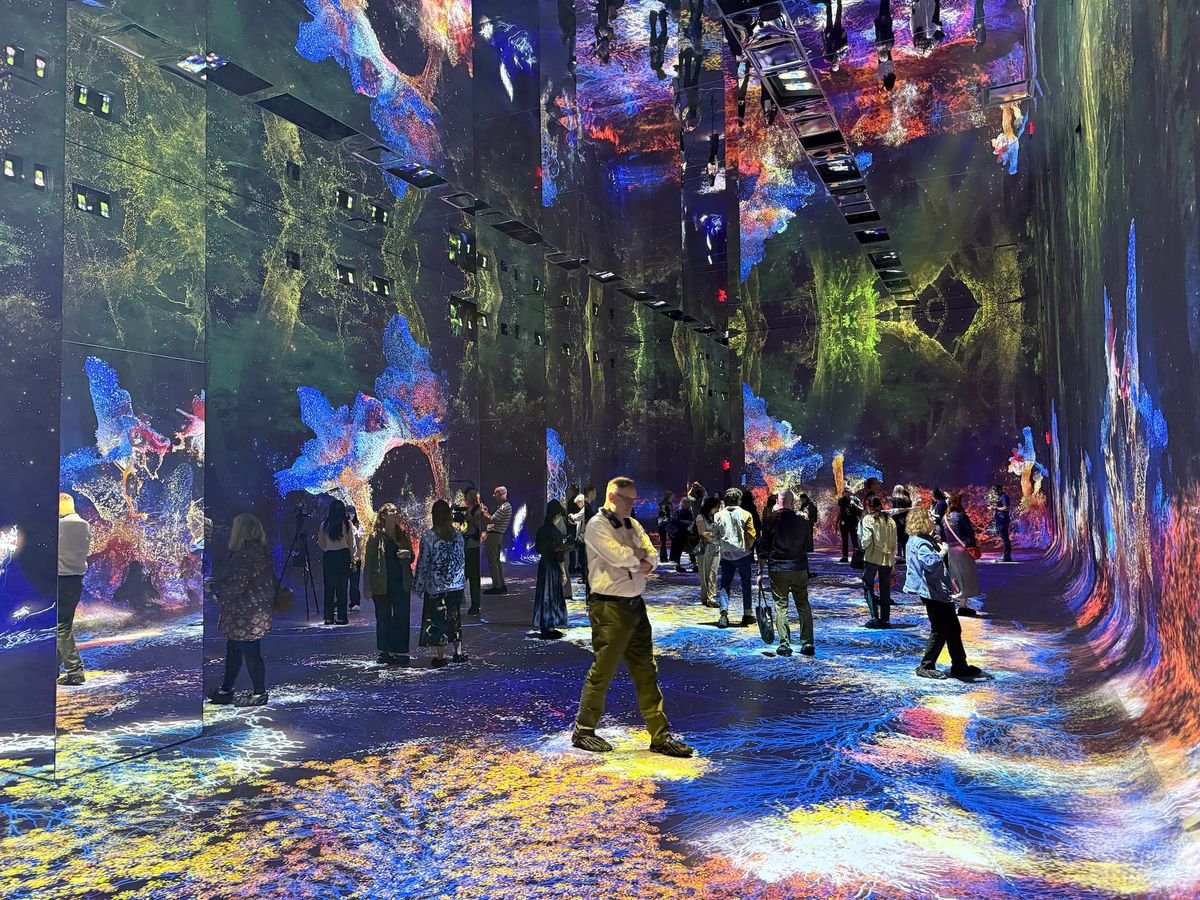
Photo Matt Stromberg/Hyperallergic · Hyperallergic
Một bảo tàng cho nghệ thuật máy
Ngày 20 tháng 6 năm 2026, Dataland mở cửa ở trung tâm Los Angeles. Bảo tàng tự giới thiệu là bảo tàng đầu tiên trên thế giới dành cho nghệ thuật trí tuệ nhân tạo. Nó nằm trong khu Grand LA trên đại lộ Grand Avenue, một khu phức hợp cao tầng do Frank Gehry thiết kế.
Người sáng lập là nghệ sĩ Refik Anadol và cộng sự lâu năm của ông, Efsun Erkılıç. Anadol được biết đến qua những bức tường màn hình khổng lồ, nơi dữ liệu biến thành những dòng màu chảy không ngừng. Dataland là lần đầu ông có một toà nhà riêng cho kiểu tác phẩm ấy.
Triển lãm khai mạc có tên Machine Dreams: Rainforest. Người xem đi xuống một thang cuốn dài để vào một không gian rộng, lát gương. Trên tường, trên sàn, trên trần, hình ảnh chuyển động liên tục: những đường đồ hoạ máy tính dần thành mạng sợi nấm, rồi thành hoa, thành cây.
Rừng làm từ dữ liệu
Theo bài viết trên Hyperallergic, hình ảnh được tạo từ khoảng 1,2 tỷ điểm dữ liệu thu từ 16 khu rừng mưa trên thế giới. Nguồn dữ liệu đến từ những đối tác như Smithsonian, Phòng thí nghiệm Điểu học Cornell, Viện Bảo tồn Getty và Bảo tàng Lịch sử Tự nhiên London.
Từ đó, nhóm của Anadol huấn luyện một mô hình họ gọi là Large Nature Model, một mô hình máy học chỉ học từ dữ liệu về thiên nhiên. Máy không chụp lại một khu rừng cụ thể nào. Nó tạo ra những dạng cây, hoa và nấm chưa từng tồn tại, nhưng trông như có thể tồn tại.
Âm thanh đi cùng hình ảnh. Lúc đầu là những lớp âm nền tối giản, rồi chuyển dần sang nhạc có cao trào như nhạc phim. Xen giữa là tiếng chim, tiếng khỉ hú. Người xem còn được đeo một vòng tay ghi lại nhịp tim, nhiệt độ và độ dẫn điện của da.
Mùi đeo trên cổ
Phần khác thường nhất của Machine Dreams: Rainforest nằm ở mùi. Mỗi người xem được đeo một thiết bị nhỏ quanh cổ, do L'Oréal Luxe phát triển. Thiết bị toả ra một mùi được mô tả là mùi mặt đất rừng ẩm.
Trong nhiều tác phẩm sắp đặt dùng mùi, mùi được khuếch tán ra cả phòng. Ai bước vào cũng ngửi thấy cùng một thứ. Ở đây, mùi được mang theo từng người. Nó đi cùng cơ thể qua không gian gương, ở gần mũi hơn bất cứ hình ảnh nào.
Đặt cạnh hàng tỷ điểm dữ liệu, chiếc thiết bị ấy gợi một câu hỏi đơn giản. Máy có thể tạo ra hình ảnh của một khu rừng chưa từng có. Nhưng để người xem cảm thấy mình đang ở trong rừng, bảo tàng vẫn cần đến mùi đất, thứ vật chất nhất trong tất cả.
Mặt đất rừng ẩm, ở bất cứ đâu, thường gợi những thứ rất vật chất: lá mục, rễ cây, đất vừa ngấm mưa. Mùi không cần đẹp. Nó chỉ cần gợi được những thứ không máy chiếu nào đưa lên tường được.
Khi quá nhiều giác quan cùng lúc
Nhà phê bình Matt Stromberg của Hyperallergic mô tả chuyến đi của mình qua triển lãm bằng hai cảm giác cùng lúc. Ông thấy háo hức và bị cuốn vào hình ảnh. Nhưng ông cũng thấy buồn nôn, tim đập nhanh, như cơ thể không theo kịp lượng kích thích dồn tới.
Nhận xét ấy nói nhiều về tác phẩm. Hình, âm và mùi được đưa vào cùng lúc, với cường độ cao. Người xem không có khoảng trống để tự nhìn, tự ngửi. Mọi giác quan được dẫn đi theo một kịch bản.
Anadol từng đưa dữ liệu của bảo tàng vào tác phẩm ở nhiều nơi, như trong Unsupervised tại MoMA. Ở Dataland, ông thêm mùi. Và chính mùi, thứ nhỏ nhất trong căn phòng, lại nhắc người xem rằng họ vẫn có một cơ thể, vẫn cần một mặt đất để đứng lên.
A museum for machine art
On 20 June 2026, Dataland opened in downtown Los Angeles. It calls itself the world's first museum of AI arts. It sits inside the Grand LA development on Grand Avenue, a high rise complex designed by Frank Gehry.
Its founders are the artist Refik Anadol and his longtime partner Efsun Erkılıç. Anadol is known for enormous screen walls where data turns into rivers of colour that never stop moving. Dataland is the first time he has a building of his own for that kind of work.
The opening exhibition is Machine Dreams: Rainforest. Visitors ride a long escalator down into a wide, mirrored space. On the walls, the floor and the ceiling, images keep moving: computer graphics slowly becoming networks of fungal threads, then flowers, then trees.
A forest made of data
According to Hyperallergic, the images are generated from around 1.2 billion data points gathered from 16 rainforests around the world. The data comes from partners including the Smithsonian, the Cornell Lab of Ornithology, the Getty Conservation Institute and the Natural History Museum in London.
From this, Anadol's team trained what they call a Large Nature Model, a machine learning model taught only on data about nature. The machine does not record any particular forest. It produces forms of trees, flowers and fungi that have never existed but look as if they could.
Sound travels with the images. At first, sparse ambient layers; then music that builds like a film score. In between, birdsong and the howls of monkeys. Visitors also wear a wristband that records heart rate, temperature and skin conductivity.
A smell worn at the neck
The most unusual part of Machine Dreams: Rainforest is the smell. Each visitor wears a small device around the neck, developed by L'Oréal Luxe. It releases a scent described as damp forest floor.
In many installations that use smell, the scent is diffused through the whole room. Everyone who enters breathes the same thing. Here, the smell travels with each person. It moves with the body through the mirrored space, closer to the nose than any image.
Set beside a billion data points, the device raises a simple question. A machine can generate pictures of a forest that never was. But to make visitors feel they are inside one, the museum still reaches for the smell of soil, the most material thing of all.
A damp forest floor, anywhere, calls up very material things: rotting leaves, roots, soil that has just taken in rain. The smell does not need to be beautiful. It only needs to recall what no projector can put on a wall.
When every sense arrives at once
Writing for Hyperallergic, the critic Matt Stromberg described his walk through the show in two registers at once. He was thrilled and absorbed by the images. He also felt queasy, his heart racing, as if his body could not keep up with the stimulation.
That account says a lot about the work. Image, sound and smell come together, all at high intensity. Visitors are left no room to look or smell on their own terms. Every sense is led along a script.
Anadol has fed museum data into his work before, as in Unsupervised at MoMA. At Dataland he adds smell. And the smell, the smallest thing in the room, is what reminds visitors that they still have a body, and still need ground to stand on.
Olfactory Art