
Essays · Olfactory Art
Không rõ tác giả, Ý. Pomander.
Một quả táo bạc. Bên trong là mùi, bên ngoài là lời.
A silver apple. Scent inside, words around it.
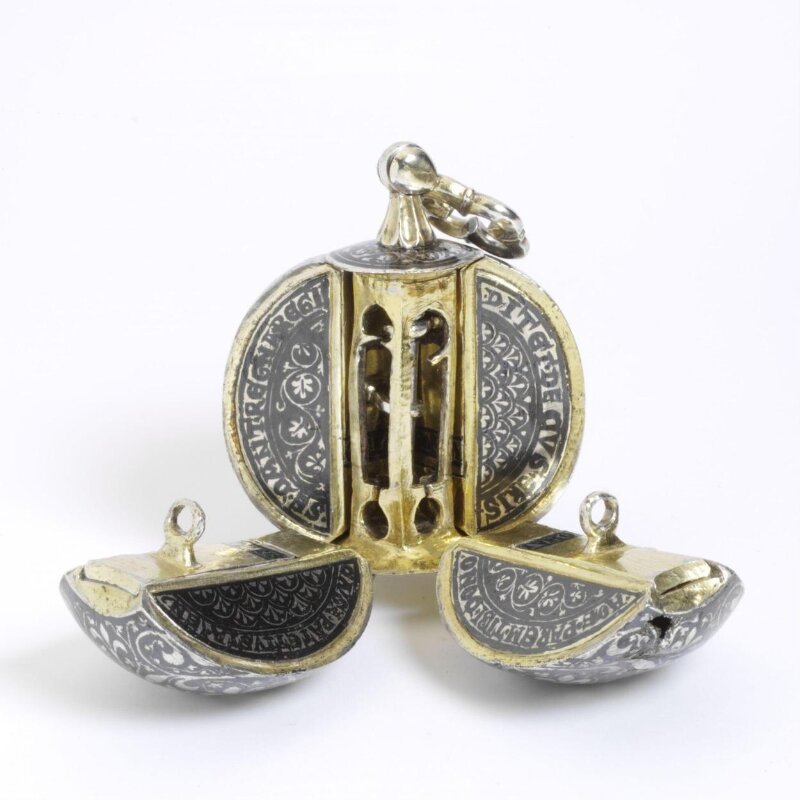
© Victoria and Albert Museum, London; Bequeathed by Francis Reubell Bryan · Victoria and Albert Museum (V&A)
Một quả táo mở ra
Nó cao 6,5 cm, rộng 4 cm. Vừa lòng bàn tay. Hình dáng là một quả táo, làm bằng bạc, mạ vàng từng phần, và khảm niello, một hợp chất kim loại màu đen điền vào đường khắc để hoa văn nổi lên trên nền bạc.
Thân quả táo chia làm bốn múi. Các múi được giữ lại bằng một cái chốt có ren ở đầu, gắn vào một cái đỉnh tám cạnh có gờ. Trên đỉnh là một cái quai hình bốn cánh, gắn bằng bản lề. Khi vặn chốt, bốn múi tách ra như vỏ một trái cây.
Theo Victoria and Albert Museum, mỗi múi ban đầu đựng gia vị hoặc chất thơm. Quả cầu được treo vào một sợi thắt lưng dài quấn quanh eo hoặc hông. Mặt trong và mặt ngoài phủ dây lá cuộn và hoa văn hình học.
Hãy hình dung nó đang được dùng. Người đeo vặn chốt, mở một múi, đặt vào đó một nhúm gia vị khô hay một chút sáp thơm, rồi khép lại. Mùi có lẽ thoát ra qua những khe giữa các múi. Nó ở ngang tầm tay, đủ gần để đưa lên mũi khi cần, đủ xa để không ai phải cúi xuống. Một vật nhỏ như vậy nhưng có đủ bản lề, chốt ren, quai: nó được làm để mở và đóng rất nhiều lần.
Bảo tàng ghi nó được làm ở Ý, khoảng năm 1350. Người làm không rõ tên.
Bốn nhân vật, một quả táo
Điều làm chiếc pomander này khác những chiếc khác là chữ. Trên nắp mỗi múi khắc một cái tên: Juno, Venus, Pallas, Paris. Quanh viền mỗi múi là một dòng chữ Latin.
Đó là chuyện Paris phân xử. Trong thần thoại, chàng hoàng tử thành Troy phải trao một quả táo vàng cho nữ thần đẹp nhất trong ba vị. Mỗi nữ thần hứa một thứ. Theo bản dịch của bảo tàng, Juno hứa cho chàng một người vợ. Venus hứa niềm vui. Pallas, tức Minerva, hứa những vương quốc. Múi cuối cùng thuộc về Paris, và lời ở đó chọn Venus.
Sự lựa chọn ấy, theo câu chuyện, mở đầu cuộc chiến thành Troy. Nhưng trên một quả cầu hương đeo ở thắt lưng, nó có lẽ mang nghĩa khác: một lời chọn, một lời tỏ tình. Quả táo trong chuyện và quả táo bạc trong tay trùng nhau.
Chính cái tên pomander cũng dẫn về quả táo. Nó đi từ chữ Latin chỉ một quả táo long diên hương. Ở đây, hình dáng, câu chuyện và cái tên đều là táo.
Thắt lưng như một lời hứa
Bảo tàng đặt chiếc pomander vào bối cảnh của thắt lưng thời Trung cổ. Những dòng chữ và hình ảnh lãng mạn trên thắt lưng cho thấy chúng đôi khi là quà tìm hiểu hay quà cưới. Trong lễ cưới của người Do Thái thời Trung cổ có nghi thức hai vợ chồng trao thắt lưng cho nhau. Ở vùng Czech, khoảng năm 1500, chú rể được ghi lại là tặng thắt lưng cho cô dâu.
Một quả cầu hương treo trên sợi thắt lưng như thế vì vậy có thể cũng là một món quà tình yêu. Bảo tàng dùng chữ "có thể". Không có tên người tặng, không có tên người nhận.
Món đồ đã đi qua nhiều bộ sưu tập ở Anh. Nó từng được trưng bày ở Leeds năm 1868, qua hai lần bán đấu giá ở Christie's năm 1884 và 1925, rồi được V&A mua lại bằng quỹ di tặng của Francis Reubell Bryan. Gần đây hơn, nó có mặt trong danh mục triển lãm A Feast for the Senses của Walters Art Museum năm 2016, một triển lãm về các giác quan trong nghệ thuật Trung cổ.
Ở một bài khác, Penta đọc một pomander thế kỷ 17 có sáu ngăn và một hộp giấm thơm, nơi mùi hương được xem như một lớp che chắn. Chiếc pomander Ý này cũ hơn ba thế kỷ, và nói một chuyện khác. Mùi ở đây gần cơ thể theo một cách riêng tư hơn: nó đi cùng một lời thề.
An apple that opens
It is 6.5 cm tall and 4 cm wide. It fits in a palm. It is shaped like an apple, made of silver, partly gilded, and inlaid with niello, a black metallic compound filling the engraved lines so the pattern stands out against the silver.
The body divides into four segments, held by a pin with a screw at the top, fixed to an octagonal gadrooned head. On that head a quatrefoil handle is hinged. Unscrew the pin and the four segments open like the skin of a fruit.
According to the Victoria and Albert Museum, each segment originally held spices or perfumes. The pomander hung from a long belt or girdle circling the waist or hips. Inside and out, it is covered with scrolling foliage and geometric patterns.
Imagine it in use. The wearer unscrews the pin, opens a segment, puts in a pinch of dry spice or a little scented paste, and closes it. The smell probably escaped through the seams between the segments. It sits at hand height, close enough to lift to the nose, far enough that no one has to lean in. Small as it is, it has a hinge, a screw, a handle: it was made to be opened and closed many times.
The museum records it as made in Italy around 1350. The maker is unknown.
Four figures, one apple
What sets this pomander apart is its words. On the cover of each segment is a name: Juno, Venus, Pallas, Paris. Around each edge runs a line of Latin.
It is the Judgment of Paris. In the myth, the Trojan prince must give a golden apple to the most beautiful of three goddesses, and each offers him something. In the museum's translation, Juno promises a spouse, Venus promises delight, Pallas, that is Minerva, promises kingdoms. The last segment belongs to Paris, and its words choose Venus.
In the story, that choice sets the Trojan War in motion. On a scent case worn at the waist, it likely meant something else: a choice, a declaration. The apple of the myth and the silver apple in the hand become one.
The word pomander itself leads back to an apple. It comes from the Latin for an apple of ambergris. Here shape, story and name are all apples.
A girdle as a promise
The museum places the pomander in the context of medieval girdles. Romantic inscriptions and images on girdles show they were sometimes courtship or marriage gifts. Medieval Jewish weddings included a formal exchange of girdles between spouses, and Czech bridegrooms around 1500 are recorded giving girdles to their brides.
A scent case hanging from such a girdle may therefore also have been a gift of love. The museum says "may". There is no name of giver or receiver.
The object passed through several English collections. It was shown in Leeds in 1868, sold twice at Christie's, in 1884 and 1925, and bought by the V&A with funds from the Francis Reubell Bryan bequest. More recently it appeared in the catalogue of A Feast for the Senses at the Walters Art Museum in 2016, an exhibition on the senses in medieval art.
In another essay Penta reads a seventeenth century pomander with six chambers and a vinaigrette, where scent was treated as a shield. This Italian one is three centuries older and says something else. Scent here is close to the body in a more private way: it travels with a vow.
Olfactory Art