
Essays · Contemporary Art
Random International. Rain Room.
Mưa lùi lại quanh ta. Nhưng mùi của mưa thì không.
The rain steps back from us. Its smell does not.
Một cơn mưa biết ta đang ở đâu
Rain Room là một sắp đặt Random International làm năm 2012. Đó là một vùng mưa nhân tạo rộng khoảng 100 mét vuông, rơi liên tục từ trần xuống một mặt sàn lưới.
Người xem bước vào cơn mưa. Và mưa ngừng rơi ở đúng nơi họ đứng. Khi họ bước tiếp, khoảng trống khô di chuyển theo, như một chiếc ô vô hình. Phía sau họ, mưa lại rơi.
Để làm được điều đó, studio dùng những camera theo dõi ba chiều gắn phía trên, nhận biết vị trí và chuyển động của từng người. Phần mềm viết riêng điều khiển những van điện từ, bật tắt dòng nước qua những tấm ngói nhựa đúc gắn trên dầm thép. Một hệ thống quản lý nước thu nước rơi xuống sàn lưới để dùng lại.
Tất cả những bộ phận ấy được giấu đi. Người xem chỉ thấy mưa, một nguồn sáng duy nhất chiếu từ xa, và chính họ đứng khô giữa màn nước.
The Curve, London
Tác phẩm ra mắt tại The Curve, không gian triển lãm dài và cong của Barbican Centre ở London, từ 3 tháng 10 năm 2012 đến 4 tháng 3 năm 2013. Triển lãm có sự hỗ trợ của Maxine and Stuart Frankel Foundation for Art và Arts Council England.
Sau London, Rain Room đi tới nhiều nơi: MoMA ở New York, LACMA ở Los Angeles, Yuz Museum ở Thượng Hải, Sharjah Art Foundation ở Các Tiểu vương quốc Ả Rập Thống nhất, Museum of Contemporary Art ở Busan, Melbourne, và Maxine and Stuart Frankel Foundation for Art ở Michigan.
Mỗi nơi, tác phẩm được dựng lại cho vừa không gian, nhưng nguyên tắc không đổi: một cơn mưa luôn nhường chỗ cho người.
Điều khiển hay bị theo dõi
Random International mô tả tác phẩm bằng một ý khá rõ: sự hiện diện của con người ngăn mưa rơi, và qua đó tác phẩm nhìn vào cách mối quan hệ giữa con người với nhau và với tự nhiên ngày càng đi qua công nghệ.
Nhìn từ bên ngoài, Rain Room trông như một phép màu. Người xem có cảm giác mình ra lệnh cho mưa. Nhưng thật ra chính máy móc đang quan sát họ, từng bước, từng cử động. Chiếc ô vô hình chỉ tồn tại vì camera không rời mắt khỏi người đứng dưới nó.
Người bước chậm thì khô. Người chạy thì ướt, vì hệ thống cần thời gian để phản ứng. Tác phẩm dạy người xem đi theo nhịp của máy mà họ không nhận ra. Và đó có lẽ là điều đáng nghĩ nhất: sự tự do trong Rain Room là một sự tự do được tính toán.
Vì sao cơn mưa ấy còn ở lại
Rain Room trở thành một trong những tác phẩm sắp đặt được nhắc tới nhiều nhất của thập niên 2010. Nó sinh ra đúng lúc điện thoại có camera tốt và mạng xã hội bắt đầu định hình cách người ta đi bảo tàng. Một người đứng khô giữa mưa là một bức ảnh ai cũng muốn chụp.
Nhưng nếu bỏ đi lớp hình ảnh ấy, điều còn lại vẫn đáng chú ý. Tác phẩm dùng một thứ rất quen, mưa, và thay đổi đúng một quy luật: mưa không chạm vào ta. Chỉ một thay đổi ấy đủ để người xem nhìn lại mưa như lần đầu.
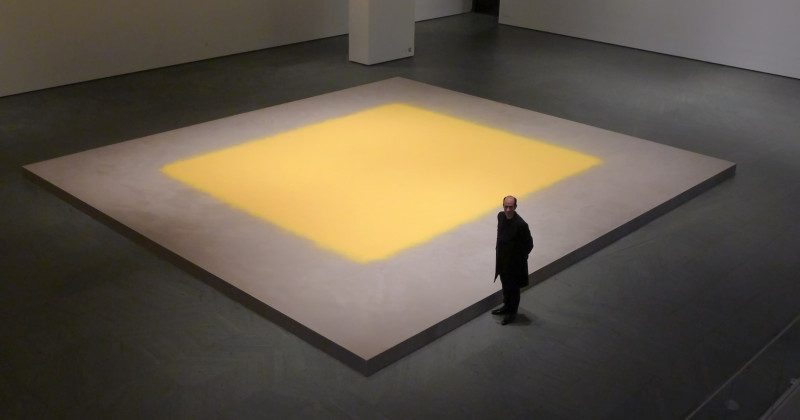
Nó đứng cùng dòng với mặt trời nhân tạo của Olafur Eliasson ở Tate Modern, cũng ở London, cũng đem thời tiết vào trong nhà. Eliasson để người xem nằm dưới một thứ không thể chạm tới. Random International để người xem đi giữa một thứ không chạm tới họ.
Bước ra khỏi phòng, trời London có thể đang mưa thật. Mưa ấy không lùi lại cho ai. Và người xem, lần đầu tiên sau một lúc lâu, để nó rơi lên mình.
A rain that knows where we are
Rain Room is an installation Random International made in 2012. It is a field of artificial rain of about 100 square metres, falling without pause from the ceiling onto a grated floor.
Visitors walk into the rain. And the rain stops exactly where they stand. When they move, the dry space moves with them, like an invisible umbrella. Behind them the rain falls again.
To do this the studio uses 3D tracking cameras overhead that register each person's position and movement. Custom software controls solenoid valves, opening and closing the flow through injection moulded tiles fixed to steel beams. A water management system collects what falls through the grated floor to use again.
All of this is hidden. Visitors see only rain, a single light shining from far away, and themselves standing dry inside the water.
The Curve, London
The work premiered in The Curve, the long curving gallery of the Barbican Centre in London, from 3 October 2012 to 4 March 2013. The exhibition was supported by the Maxine and Stuart Frankel Foundation for Art and Arts Council England.
After London, Rain Room travelled widely: MoMA in New York, LACMA in Los Angeles, the Yuz Museum in Shanghai, the Sharjah Art Foundation in the United Arab Emirates, the Museum of Contemporary Art in Busan, Melbourne, and the Maxine and Stuart Frankel Foundation for Art in Michigan.
Each time it is rebuilt to fit the space, but the principle stays: a rain that always makes way for people.
Control, or being watched
Random International describes the work plainly: human presence stops the rain from falling, and through this the work looks at how our relationships with one another and with nature are increasingly mediated by technology.
From outside, Rain Room looks like magic. Visitors feel they are commanding the rain. In fact the machine is watching them, every step, every gesture. The invisible umbrella exists only because the cameras never take their eyes off the person beneath it.
Walk slowly and you stay dry. Run and you get wet, because the system needs time to respond. The work teaches visitors to move at the machine's pace without their noticing. That may be the most interesting part: the freedom in Rain Room is a calculated freedom.
Why that rain remains
Rain Room became one of the most talked about installations of the 2010s. It arrived just as phone cameras improved and social media began to shape how people visit museums. A person standing dry in the rain is a picture everyone wants to take.
Strip that layer away and what remains is still worth noticing. The work takes something very familiar, rain, and changes one rule: the rain does not touch us. That one change is enough to make visitors see rain as if for the first time.
It belongs with Olafur Eliasson's artificial sun at Tate Modern, also in London, also bringing weather indoors. Eliasson lets people lie beneath something they cannot reach. Random International lets people walk through something that will not reach them.
Stepping outside, it may really be raining in London. That rain makes way for no one. And visitors, for the first time in a while, let it fall on them.
Contemporary Art