
Essays · Modern Art
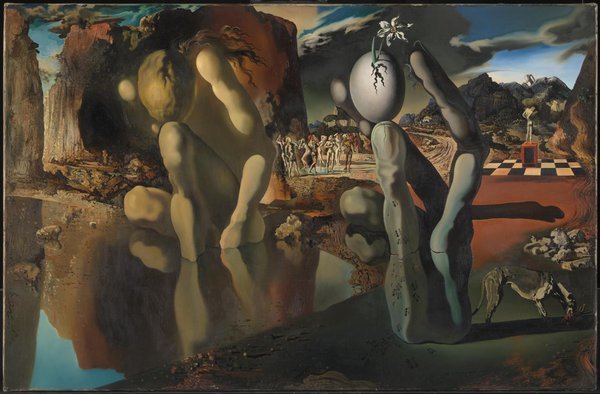
Salvador Dalí. Métamorphose de Narcisse.
Nhìn đủ lâu, một hình sẽ trở thành hình khác.
Look long enough and one shape becomes another.
Tate · Tate
Hai hình, một câu chuyện
Metamorphosis of Narcissus, tên gốc tiếng Pháp là Métamorphose de Narcisse, là tranh sơn dầu trên toan Salvador Dalí vẽ năm 1937. Tác phẩm thuộc bộ sưu tập Tate ở London.
Bố cục chia làm hai nửa gần đối xứng. Bên trái, một thân người màu vàng nâu ngồi co gối bên mép nước, đầu cúi xuống đầu gối, như đang soi mình. Bên phải, ở cùng vị trí, là một bàn tay khổng lồ bằng đá xám, các ngón tay dựng lên, giữ một quả trứng. Quả trứng nứt, và từ đó mọc lên một bông hoa thuỷ tiên.
Hai hình có cùng đường viền. Đầu gối của người ngồi là quả trứng. Cánh tay và thân người là những ngón tay. Khi đã thấy sự trùng khớp ấy, rất khó nhìn một hình mà không thấy hình kia.
Phía sau là một cảnh núi đá, ánh chiều, và những nhân vật nhỏ. Trên mặt bàn tay có đàn kiến bò, một hình ảnh Dalí dùng nhiều lần. Ở góc tranh có một con chó đang gặm mồi.
Chuyện cổ về Narcissus
Tên tác phẩm lấy từ thần thoại Hy Lạp, qua thơ của Ovid. Narcissus là một chàng trai đẹp đến mức yêu chính cái bóng của mình trên mặt nước. Anh ngồi mãi bên hồ, không rời được, rồi tàn đi. Nơi anh ngồi mọc lên một bông hoa mang tên anh, hoa thuỷ tiên.
Dalí vẽ đúng khoảnh khắc biến hoá ấy. Người chưa hẳn đã mất, hoa chưa hẳn đã thành. Hai trạng thái tồn tại cạnh nhau trên cùng một mặt toan, như hai khung hình của một đoạn phim.
Câu chuyện cổ kết thúc bằng một cái chết. Bức tranh của Dalí thì kết thúc bằng một mầm sống. Quả trứng nứt ra không phải để vỡ, mà để một thứ khác chui lên. Cái tôi say mê chính mình không biến mất, nó chuyển sang một dạng khác.
Cùng năm ấy, Dalí viết một bài thơ dài mang cùng tên, in kèm với hình bức tranh. Ông muốn người xem đọc thơ và nhìn tranh song song, để thấy sự biến hoá diễn ra từng bước.
Phương pháp hoang tưởng phê phán
Dalí gọi cách làm việc của mình là phương pháp hoang tưởng phê phán. Hiểu đơn giản: ông cố ý nuôi một cách nhìn ám ảnh, nơi một hình có thể đồng thời là hình khác, rồi vẽ lại nó bằng kỹ thuật tỉ mỉ, chính xác như một bức ảnh.
Hình ảnh kép là công cụ chính của phương pháp này. Mây thành đầu người, đá thành thân thể, một đàn người thành khuôn mặt. Metamorphosis of Narcissus được xem là một trong những ví dụ rõ nhất: hai hình tách hẳn ra hai bên để người xem tự so.
Những năm ấy, nhóm Siêu thực ở Paris quan tâm đến giấc mơ và những gì nằm dưới ý thức. Các hoạ sĩ trong nhóm tìm những cách khác nhau để đưa phần ấy lên mặt tranh. Max Ernst cào, cọ, in vết lên giấy, như trong Celebes ông dựng lên một con thú nửa máy móc. Dalí đi hướng ngược lại: không để ngẫu nhiên dẫn đường, mà dựng từng chi tiết thật sắc để cái phi lý trông như có thật.
Bức tranh mang đến nhà Freud
Dalí ngưỡng mộ Sigmund Freud từ lâu. Năm 1938, khi Freud đã rời Vienna sang sống ở London, Dalí được đưa đến gặp ông, và mang theo bức tranh này.
Lựa chọn ấy có lý do. Trong các bài viết của Freud, Narcissus là tên của sự say mê chính mình. Dalí đem đến cho người đã đặt tên cho khái niệm ấy một bức tranh về chính huyền thoại gốc.
Cuộc gặp ngắn. Nhưng nó cho thấy Dalí xem bức tranh này là tác phẩm tiêu biểu nhất của mình lúc bấy giờ, thứ ông muốn đặt trước mặt người mà ông coi là thầy.
Đứng trước tranh hôm nay, người xem vẫn làm lại đúng việc Dalí mong muốn: nhìn bên trái, nhìn bên phải, rồi nhìn lại bên trái. Mỗi lần nhìn, người ngồi bên hồ lại giống bàn tay đá thêm một chút.
Two shapes, one story
Metamorphosis of Narcissus, Métamorphose de Narcisse in the original French, is an oil painting on canvas made by Salvador Dalí in 1937. It is in the collection of Tate in London.
The composition splits into two near symmetrical halves. On the left a golden brown figure crouches at the water's edge, head bowed to the knee, as if gazing at his reflection. On the right, in the same position, is a huge grey stone hand, fingers raised, holding an egg. The egg has cracked, and from it grows a narcissus flower.
The two shapes share one outline. The knee of the crouching figure is the egg. The arm and body are the fingers. Once you see the match, it is hard to look at one without seeing the other.
Behind them lies a rocky landscape, late light and small figures. Ants crawl over the stone hand, an image Dalí used often. In one corner a dog gnaws at its prey.
The old story of Narcissus
The title comes from Greek myth, through the poetry of Ovid. Narcissus was a young man so beautiful that he fell in love with his own reflection in water. He sat by the pool, unable to leave, and wasted away. Where he had been, a flower bearing his name appeared.
Dalí painted the moment of change itself. The man is not quite gone; the flower is not quite formed. Both states sit side by side on the same canvas, like two frames of a film.
The old story ends in death. Dalí's painting ends in a sprout. The egg cracks not to break but to let something else come through. The self absorbed ego does not vanish; it passes into another form.
The same year Dalí wrote a long poem of the same title, published with a reproduction of the painting. He wanted viewers to read and look in parallel, following the transformation step by step.
The paranoiac critical method
Dalí called his way of working the paranoiac critical method. Put simply, he deliberately cultivated an obsessive way of seeing in which one image could at the same time be another, and then painted it with a meticulous, almost photographic technique.
The double image was the method's main tool. Clouds become heads, rocks become bodies, a crowd becomes a face. Metamorphosis of Narcissus is often seen as one of the clearest examples: the two images set apart so that the viewer can compare them.
In those years the Surrealists in Paris were drawn to dreams and to what lies beneath consciousness. Its painters found different ways to bring that to the surface. Max Ernst scraped, rubbed and printed textures, and in Celebes built a beast that is half machine. Dalí went the other way: not letting chance lead, but building every detail sharply so that the irrational looks real.
The painting brought to Freud
Dalí had long admired Sigmund Freud. In 1938, after Freud had left Vienna for London, Dalí was taken to meet him and brought this painting along.
The choice made sense. In Freud's writing, Narcissus names a fascination with oneself. Dalí brought the man who had given that idea its name a painting of the original myth.
The meeting was brief. But it shows that Dalí considered this his most representative work at the time, the one he wanted to set before the man he regarded as a master.
Standing before it today, viewers still do what Dalí hoped: look left, look right, look left again. Each time, the figure by the pool looks a little more like the stone hand.

Modern Art