
Essays · Contemporary Art
Taryn Simon. Paperwork and the Will of Capital.
Hoa đứng giữa những chữ ký. Rồi hoa héo.
Flowers stood between the signatures. Then they wilted.
Bó hoa trong ảnh báo chí
Dự án bắt đầu từ ảnh. Không phải ảnh nghệ thuật, mà ảnh báo chí và ảnh chính thức chụp ở các buổi ký kết: hiệp định, tuyên bố, bản ghi nhớ, hiệp ước, những khoảnh khắc đồng thuận được sắp đặt để lưu lại. Xem nhiều ảnh như thế, Taryn Simon nhận ra một chi tiết lặp đi lặp lại. Gần như lúc nào cũng có hoa.
Hoa đặt trên bàn, giữa hai người ký. Hoa đặt phía sau, cạnh lá cờ. Hoa không phải nhân vật chính, nhưng hoa luôn có mặt, như một phần của sân khấu quyền lực. Simon quyết định dựng lại chính những bó hoa ấy.
Các buổi ký được chọn trải rộng về thời gian và địa lý. Có Tuyên bố Bratislava ngày 3 tháng 8 năm 1968. Có Hiệp định thành lập Tổng công ty Tài chính Thương mại Hồi giáo Quốc tế ngày 30 tháng 5 năm 2006. Có Bản ghi nhớ giữa Campuchia và Úc ngày 26 tháng 9 năm 2014. Mỗi hiệp ước là một bức ảnh.
Nội dung các văn bản ấy rất khác nhau, từ chính trị đến tài chính. Nhưng trong ảnh, chúng trông giống nhau đến lạ: vài người mặc com lê, một cái bàn, mấy cây bút, và một bó hoa. Chính sự giống nhau ấy cho thấy nghi thức quan trọng không kém nội dung.
Bốn nghìn mẫu hoa và một nhà thực vật học
Để dựng lại các bó hoa, Simon nhập về hơn 4.000 mẫu hoa và cây từ Aalsmeer ở Hà Lan, chợ đấu giá hoa lớn nhất thế giới, nơi khoảng hai mươi triệu bông hoa đến và đi mỗi ngày. Bà làm việc cùng nhà thực vật học Daniel Atha của Vườn Thực vật New York để nhận diện từng loài trong ảnh gốc.
Chú thích của mỗi tác phẩm ghi cả nguồn gốc từng loài hoa. Cẩm chướng từ Colombia. Hồng lai trà từ Ecuador. Đồng tiền và cẩm tú cầu lá lớn từ Hà Lan. Lan Dendrobium từ Thái Lan. Một bó hoa trên bàn ký kết hoá ra là một bản đồ thương mại toàn cầu thu nhỏ.
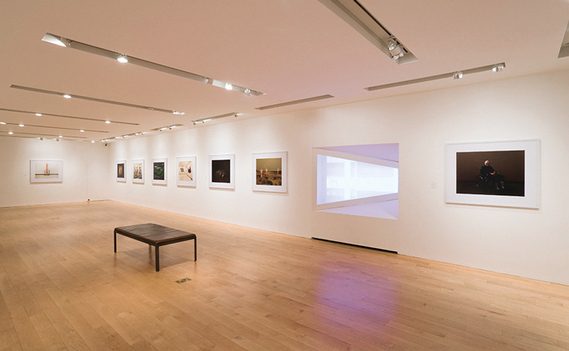
Bộ ảnh gồm 36 tác phẩm. Mỗi tấm chụp một bó hoa dựng lại, in phun lưu trữ, kèm văn bản trên giấy tiêu bản. Khung làm bằng gỗ gụ, theo kiểu đồ nội thất phòng họp hội đồng quản trị. Mỗi tấm cao khoảng 216 cm. Ảnh to, màu tươi, gần với tranh tĩnh vật hoa của hội hoạ Hà Lan hơn là ảnh tài liệu.
Ép khô, khâu lại, đổ bê tông
Phần thứ hai của dự án là điêu khắc, loại hình Simon lần đầu thử. Những mẫu hoa chọn từ 36 bó được làm khô, ép phẳng, rồi khâu lên giấy tiêu bản như cách các vườn thực vật lưu mẫu cây. Một bộ đủ 36 tờ tiêu bản được đặt vào mỗi khối ép bằng bê tông nhuộm màu, có nẹp thép. Tổng cộng 12 khối.
Hình ảnh ấy rất rõ. Hoa, thứ phù du nhất trong phòng, bị giữ lại bằng bê tông, thứ nặng và lâu nhất. Hiệp ước có thể bị xé bỏ, bị lãng quên, bị thay bằng hiệp ước khác. Tiêu bản thì được ép chặt, chờ một người mở ra xem trong tương lai.
Paperwork and the Will of Capital ra mắt tại Biennale Venice lần thứ 56 năm 2015. Năm 2016, Gagosian trưng bày ở 555 West 24th Street, New York, từ ngày 18 tháng 2 đến ngày 26 tháng 3. Cuốn catalog do Hatje Cantz và Gagosian in có phần viết về thực vật của Daniel Atha và một truyện ngắn của nhà văn Hanan al Shaykh.
Cũng như An American Index of the Hidden and Unfamiliar, Simon đặt ảnh cạnh chữ. Nhưng ở đây thứ bị che không nằm sau cánh cửa khoá. Nó nằm ngay giữa khung hình, trên bàn, trước mắt mọi người. Chỉ là không ai nhìn nó.
The bouquet in the press photo
The project begins with photographs. Not art photographs, but press and official pictures taken at signings: agreements, declarations, memorandums, treaties, moments of accord staged to be recorded. Looking at many of them, Taryn Simon noticed a detail that kept returning. There were almost always flowers.
Flowers on the table, between the two signatories. Flowers behind, beside the flags. They are never the main character, but they are always present, part of the stagecraft of power. Simon decided to rebuild those very bouquets.
The signings she chose range across time and place. The Bratislava Declaration of 3 August 1968. The Agreement Establishing the International Islamic Trade Finance Corporation of 30 May 2006. A Memorandum of Understanding between Cambodia and Australia of 26 September 2014. Each agreement is one photograph.
What those documents say varies widely, from politics to finance. Yet in the pictures they look strangely alike: a few people in suits, a table, some pens, and a bouquet. That sameness shows how much the ritual matters, as much as the content.
Four thousand specimens and a botanist
To rebuild the bouquets, Simon imported more than 4,000 flower and plant specimens from Aalsmeer in the Netherlands, the largest flower auction in the world, where some twenty million flowers arrive and leave each day. She worked with botanist Daniel Atha of the New York Botanical Garden to identify each species in the original pictures.
Each work's text records where the flowers came from. Carnation from Colombia. Hybrid tea rose from Ecuador. Gerbera and big leaf hydrangea from the Netherlands. Dendrobium from Thailand. A bouquet on a signing table turns out to be a small map of global trade.
The photographs number 36. Each shows a rebuilt bouquet, an archival inkjet print with text on herbarium paper. The frames are mahogany, in the manner of boardroom furniture. Each stands about 216 cm high. The pictures are large and bright, closer to Dutch flower painting than to documentation.
Dried, sewn, cast in concrete
The second part of the project is sculpture, a medium Simon was trying for the first time. Specimens from the 36 bouquets were dried, pressed and sewn onto herbarium paper, the way botanical gardens keep plant records. A complete set of the 36 botanical sheets was placed in each press made of pigmented concrete with steel braces. Twelve presses in all.
The image is plain. Flowers, the most fleeting thing in the room, held by concrete, the heaviest and most lasting. Treaties can be torn up, forgotten, replaced by others. The specimens stay pressed, waiting for someone in the future to open them.
Paperwork and the Will of Capital was first shown at the 56th Venice Biennale in 2015. In 2016 Gagosian showed it at 555 West 24th Street, New York, from 18 February to 26 March. The catalogue, published by Hatje Cantz and Gagosian, includes botanical texts by Daniel Atha and a short story by Hanan al Shaykh.
As in An American Index of the Hidden and Unfamiliar, Simon sets image beside text. But here what is hidden is not behind a locked door. It sits in the middle of the frame, on the table, in front of everyone. Only no one looks at it.
Contemporary Art