
Essays · Olfactory Art
Utagawa Kunisada. Ka ni sasou haru no tsumeoto.
Mùi đến trước, tiếng đàn theo sau.
The scent arrives first. The music follows.
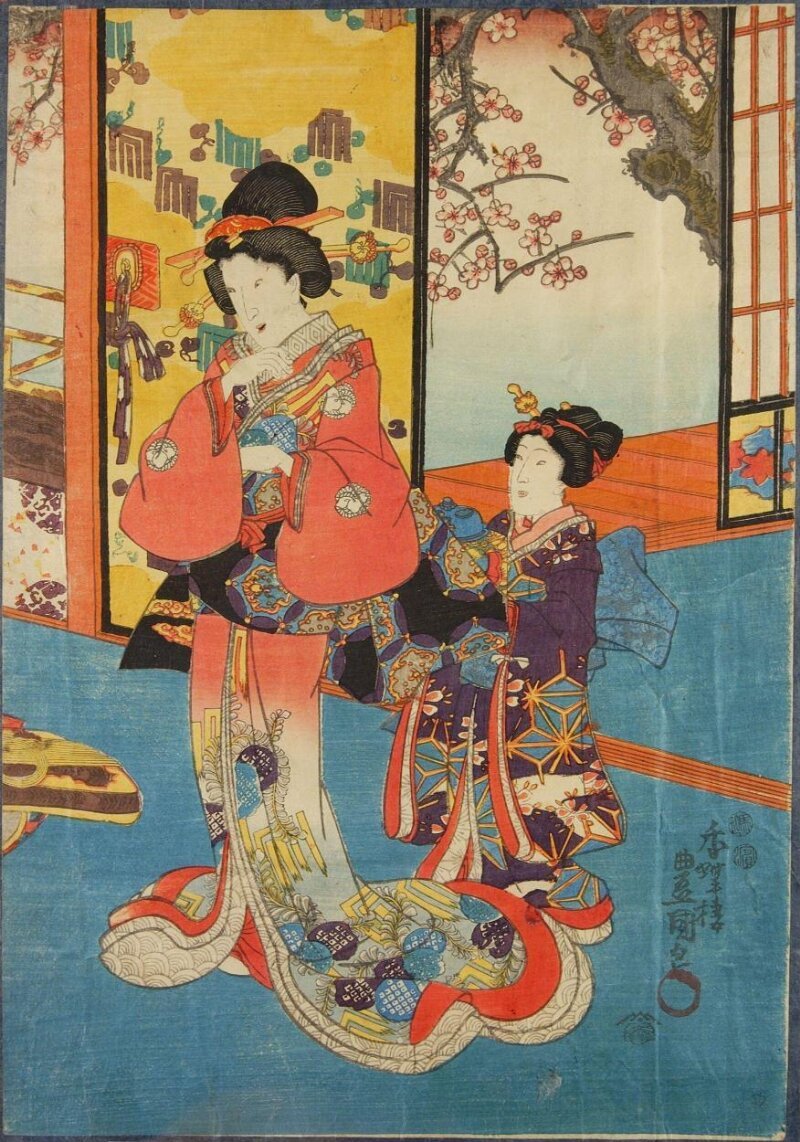
© Victoria and Albert Museum, London · Victoria and Albert Museum (V&A)
Một bộ ba tờ tranh trong một cuốn album
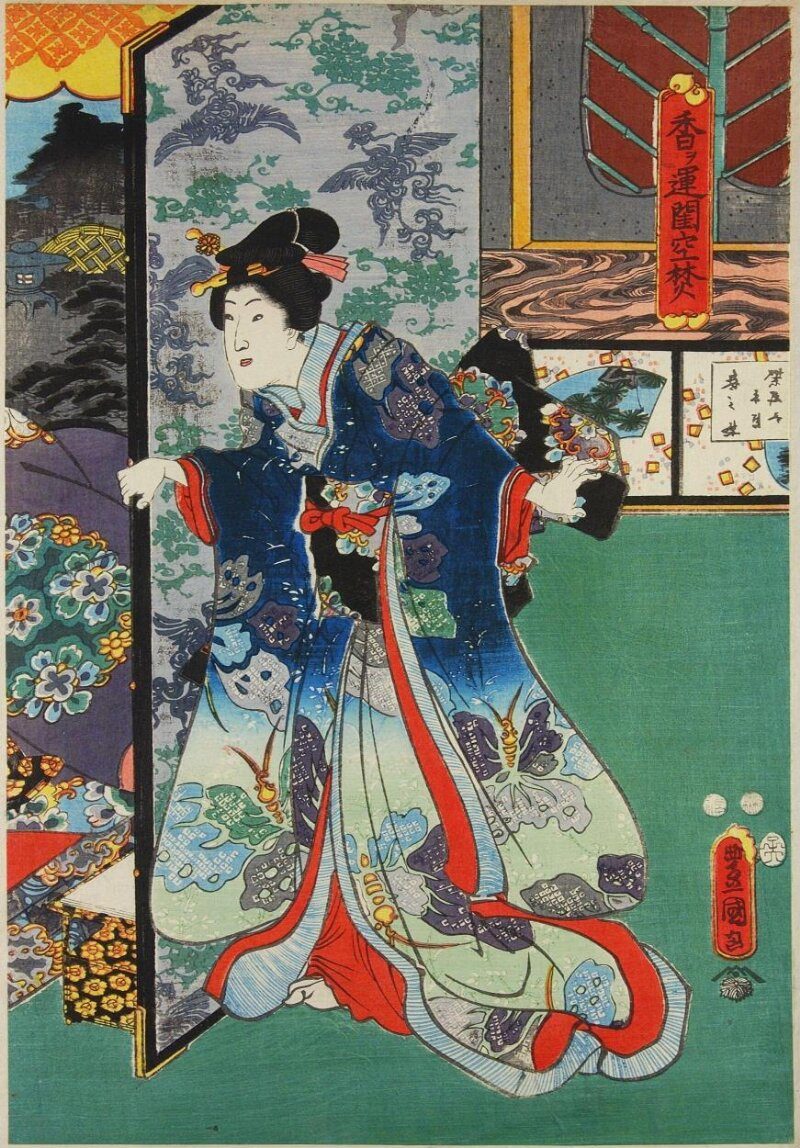
Tác phẩm được in năm 1849 ở Edo, nay là Tokyo. Đó là một bộ ba tờ, mỗi tờ khổ ōban, loại khổ đứng lớn quen thuộc của tranh ukiyo-e. Đặt ba tờ cạnh nhau, người xem có một cảnh rộng liền mạch. Kỹ thuật là nishiki-e, tranh khắc gỗ in nhiều màu, mỗi màu một bản khắc riêng.
Bộ tranh hiện nằm ở Bảo tàng Victoria và Albert tại London. Nó thuộc về một cuốn album gồm nhiều tờ in, được bảo tàng mua lại và vào sổ năm 1879. Nghĩa là chỉ ba mươi năm sau khi được in ở Edo, tờ tranh đã sang tới châu Âu, giữa lúc tranh Nhật đang được giới sưu tập phương Tây săn tìm.
Người vẽ là Utagawa Kunisada, sống từ năm 1786 đến năm 1865. Vào thời điểm làm bộ tranh này, ông đã là một trong những tên tuổi được in nhiều nhất Edo, chuyên về chân dung diễn viên kabuki và hình phụ nữ đẹp, và đã nhận tên hiệu Toyokuni của thầy mình.
Cái tên như một câu thơ
Tên tiếng Nhật của tác phẩm là Ka ni sasou haru no tsumeoto. Bảo tàng dịch sang tiếng Anh theo nghĩa: hương mùa xuân mang tới tiếng đàn koto.
Đọc chậm từng chữ thì thấy nhiều hơn thế. Ka là mùi. Sasou là mời, rủ, dẫn dụ. Haru là mùa xuân. Còn tsumeoto là tiếng của móng gảy, những miếng móng nhỏ đeo vào đầu ngón tay để gảy dây đàn koto. Cái tên không nói đến cây đàn như một vật. Nó nói đến âm thanh sinh ra khi ngón tay chạm dây.
Như vậy cả câu là một chuỗi chuyển động: mùi mời, mùa xuân đến, ngón tay gảy, tiếng vang lên. Không có chủ ngữ con người rõ ràng. Mùi là thứ hành động trước tiên.
Tranh ukiyo-e hay có những cái tên như vậy, vừa mô tả vừa chơi chữ, để người xem có học đọc ra nhiều tầng nghĩa. Ở đây, trò chơi nằm ở chỗ nối hai giác quan mà hội hoạ không chạm tới được.
Hai giác quan tranh không vẽ được
Một bức tranh không có mùi và không có tiếng. Những gì Kunisada có là nét khắc, mảng màu, cách sắp xếp nhân vật trên ba tờ giấy. Vậy mà tác phẩm lại đặt tên theo hai thứ nằm ngoài tầm với của nó.
Đó không phải điều hiếm trong văn hoá Edo. Người thị dân quen đọc tranh cùng với thơ, quen nhìn một cành hoa và nghĩ tới mùi của nó, quen nhìn một người cầm đàn và nghĩ tới bản nhạc. Hình ảnh là điểm xuất phát. Phần còn lại do người xem mang tới.
Mùi hoa xuân ở Nhật gắn với hoa mơ, loại hoa nở sớm khi trời còn lạnh và được thơ ca nhắc tới vì mùi nhiều hơn vì sắc. Tên tác phẩm không nói rõ đó là hoa gì. Penta để nguyên chỗ trống ấy.
Những gì chắc chắn là cái tên xếp mùi đứng trước âm thanh. Khứu giác mở đầu, thính giác đi theo. Trong một bức tranh vốn chỉ dành cho mắt, đó là một lựa chọn đáng để ý.
Vì sao bộ tranh đáng nhớ
Kunisada làm hàng nghìn bản in trong đời. Phần lớn là hình diễn viên, cảnh sân khấu, phụ nữ đẹp. Bộ tranh này thuộc dòng thứ ba, nhưng cái tên của nó khiến nó khác đi.
Nó cho thấy ở Edo giữa thế kỷ 19, mùi hương không chỉ là một thứ để dùng. Nó là một chủ đề đủ quen để đặt vào tên một bộ tranh bán rộng rãi, và đủ tinh tế để được ghép với âm nhạc.
Hôm nay, bộ tranh nằm yên trong một cuốn album ở London. Không có mùi, không có tiếng đàn. Chỉ có cái tên, vẫn làm đúng việc nó được giao từ năm 1849: mời người xem tự ngửi, tự nghe.
A triptych in an album
The work was printed in 1849 in Edo, today's Tokyo. It is a triptych, three sheets in ōban format, the large upright size common in ukiyo-e. Placed side by side, the sheets form one continuous scene. The technique is nishiki-e, full colour woodblock printing, with a separate block for each colour.
The triptych is now at the Victoria and Albert Museum in London. It belongs to an album of prints the museum bought and registered in 1879. Only thirty years after it was printed in Edo, it had reached Europe, at a time when Western collectors were hunting for Japanese prints.
The artist was Utagawa Kunisada, who lived from 1786 to 1865. By the time he made this set, he was one of the most published names in Edo, known for kabuki actors and beautiful women, and had taken his teacher's name, Toyokuni.
A title like a line of verse
The Japanese title is Ka ni sasou haru no tsumeoto. The museum renders it in English as the scent of spring bringing koto music.
Read slowly, it holds more. Ka is scent. Sasou is to invite, to lure, to lead. Haru is spring. Tsumeoto is the sound of the picks, the small plectra worn on the fingertips to pluck the strings of a koto. The title does not name the instrument as an object. It names the sound made when a finger meets a string.
So the whole phrase is a chain of motion: a scent invites, spring arrives, a finger plucks, a note sounds. There is no clear human subject. The scent acts first.
Ukiyo-e often carry titles like this, descriptive and playful at once, so that educated viewers could read several meanings. Here the game lies in joining two senses that painting cannot reach.
Two senses a print cannot show
A print has no smell and no sound. What Kunisada had were carved lines, areas of colour and the placing of figures across three sheets. Yet the work is named after two things outside its reach.
That was not unusual in Edo culture. Townspeople were used to reading images alongside poems, to seeing a branch of blossom and thinking of its smell, to seeing someone with an instrument and thinking of the music. The image was a starting point. The viewer brought the rest.
Spring scent in Japan is tied to plum blossom, an early flower that opens in the cold and is praised in poetry more for its smell than its colour. The title does not say which flower. Penta leaves that space open.
What is certain is that the title puts scent before sound. Smell opens, hearing follows. In a picture made only for the eye, that is a choice worth noticing.
Why the set stays with us
Kunisada produced thousands of prints. Most show actors, stage scenes and beautiful women. This set belongs to the third group, but its title sets it apart.
It shows that in mid nineteenth century Edo, scent was not only something used. It was a subject familiar enough to name a widely sold print, and refined enough to be paired with music.
Today the triptych rests in an album in London. No scent, no music. Only the title, still doing the job it was given in 1849: inviting the viewer to smell and hear for themselves.
Olfactory Art