
Essays · Contemporary Art
Yayoi Kusama. Infinity Mirrored Room: Filled with the Brilliance of Life.
Giữa vô tận, chỉ có một lối đi.
Inside infinity, there is only one path.
Tate · Tate
Một con đường qua mặt nước
Tate ghi năm của tác phẩm là 2011/2017. Chất liệu theo bảo tàng: kính tráng gương, gỗ, nhôm, nhựa, gốm và đèn LED. Nó được giới thiệu lần đầu trong triển lãm hồi cố của Kusama tại Tate Modern năm 2012, rồi về sau thuộc bộ sưu tập của Tate.
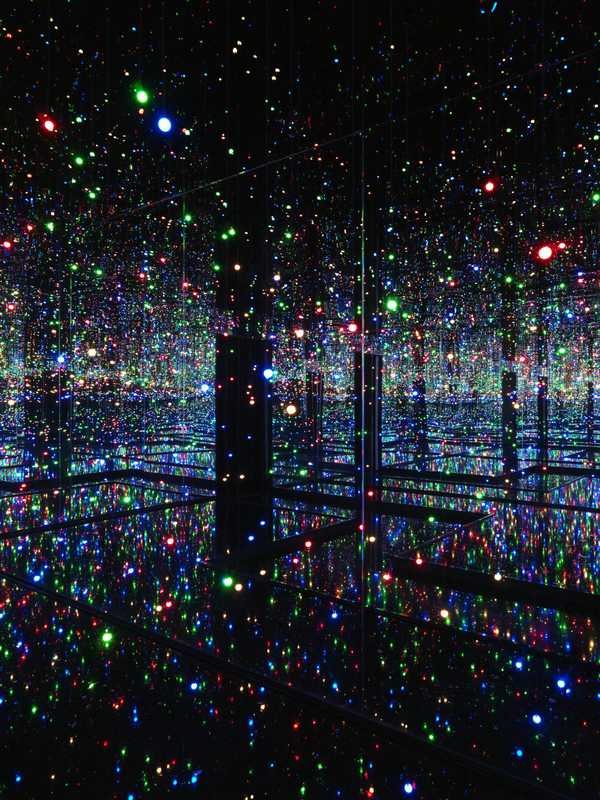
Bước vào, người xem thấy mình đứng trên một lối đi. Hai bên là mặt nước nông, phẳng, tối. Từ trần, hàng trăm bóng đèn nhỏ treo ở nhiều độ cao, đổi màu theo nhịp. Tường là gương. Trần là gương. Mặt nước lại là một tấm gương nữa, nằm ngang.
Kết quả là một không gian không đo được. Những đốm sáng kéo dài ra mọi phía, lên trên, xuống dưới. Người xem nhìn thấy mình lặp lại vô số lần, nhỏ dần, xa dần, giữa những chùm sáng.
Nhưng lối đi thì không lặp. Nó là thứ duy nhất có hướng. Nó bắt đầu ở cửa và kết thúc ở cửa.
Hai phút trong một căn phòng
Từ tháng 5 năm 2021, Tate Modern mở triển lãm Yayoi Kusama: Infinity Mirror Rooms ở tầng bốn toà Blavatnik. Triển lãm kéo dài đến tháng 4 năm 2024, gần ba năm. Đặt cạnh Filled with the Brilliance of Life là một căn phòng khác, Chandelier of Grief, nơi những chùm đèn pha lê xoay tròn như trong một vũ trụ không đáy.
Mỗi lượt khách có khoảng hai phút trong mỗi căn phòng. Tate cũng ghi rằng Filled with the Brilliance of Life đã được điều chỉnh để xe lăn có thể vào, với đủ chỗ quay đầu.
Chi tiết ấy nghe rất kỹ thuật, nhưng nó nói điều gì đó về tác phẩm. Một căn phòng về vô tận vẫn phải tính đến bề rộng của một chiếc xe lăn, bán kính quay của một bánh xe. Ảo giác lớn đến đâu vẫn nằm trên một cái sàn thật, đo bằng centimet. Vô tận ở đây được đóng bằng gỗ, nhôm, gương, và được tính toán để ai cũng có thể bước vào, dù bằng chân hay bằng bánh xe.
Chấm, lưới và sự tự xoá
Yayoi Kusama sinh năm 1929 ở Matsumoto, Nhật Bản. Từ những năm đầu, bà làm việc với sự lặp lại: chấm tròn phủ kín bề mặt, những mạng lưới mảnh không có điểm dừng. Bà đến New York cuối thập niên 1950, và từ giữa thập niên 1960 bắt đầu dùng gương để nhân những hình lặp ấy ra không gian.
Căn phòng gương là bước kéo dài tự nhiên của những bức tranh lưới. Trên tranh, chấm lặp lại trên mặt phẳng. Trong phòng, ánh sáng lặp lại trong không gian ba chiều, và cơ thể người xem trở thành một chấm nữa trong đó.
Kusama nhiều lần nói về ý tưởng tự xoá mình, để cái tôi tan vào một khung cảnh rộng hơn nó. Đứng trên lối đi, nhìn hình mình lặp lại đến khi không còn phân biệt được, người xem hiểu phần nào điều bà muốn nói.
Sự sống như một nhịp đèn
Cái tên nói về sự sống. Nhưng căn phòng gợi đến cả cái chết. Những đốm sáng lơ lửng trên mặt nước tối có thể là sao, là đom đóm, cũng có thể là những ngọn đèn thả trôi. Chúng sáng lên, rồi tắt, rồi sáng lại ở chỗ khác.
Chính nhịp ấy làm căn phòng sống. Nếu mọi bóng đèn cùng sáng mãi, không gian sẽ thành một bức ảnh. Việc chúng đổi màu, tắt đi, khiến người xem luôn thấy một cảnh hơi khác so với giây trước.
So với The Souls of Millions of Light Years Away, nơi người xem đứng yên trên một bệ nhỏ trong chưa đầy một phút, căn phòng ở Tate cho người ta đi. Chỉ vài bước, trên một lối duy nhất. Nhưng đi giữa vô tận khác với đứng giữa vô tận. Mỗi bước đổi góc nhìn. Mỗi bước, hàng trăm đốm sáng dịch chuyển theo.
A path across water
Tate dates the work 2011/2017. Its materials, according to the museum: mirrored glass, wood, aluminium, plastic, ceramic and LEDs. It was first shown in Kusama's retrospective at Tate Modern in 2012 and later entered Tate's collection.
Stepping inside, visitors find themselves on a walkway. On either side is shallow, flat, dark water. From the ceiling hang hundreds of small lights at different heights, changing colour in sequence. The walls are mirrors. The ceiling is a mirror. The water is one more mirror, lying flat.
The result is an unmeasurable space. The points of light stretch in every direction, up and down. Visitors see themselves repeated countless times, smaller and further away, among clusters of light.
But the path does not repeat. It is the only thing with a direction. It starts at the door and ends at the door.
Two minutes in a room
In May 2021 Tate Modern opened Yayoi Kusama: Infinity Mirror Rooms on the fourth floor of the Blavatnik Building. The show ran until April 2024, almost three years. Beside Filled with the Brilliance of Life stood another room, Chandelier of Grief, where rotating crystal chandeliers suggest a bottomless universe.
Each group of visitors had about two minutes in each room. Tate also notes that Filled with the Brilliance of Life was adapted for wheelchair access, with enough space to turn.
It sounds technical, but it says something about the work. A room about infinity must still account for the width of a wheelchair and the turning circle of a wheel. However large the illusion, it rests on a real floor measured in centimetres. Infinity here is built from wood, aluminium and mirror, and planned so that anyone can enter, on foot or on wheels.
Dots, nets and self-obliteration
Yayoi Kusama was born in Matsumoto, Japan, in 1929. From early on she worked with repetition: dots covering surfaces, fine nets without end. She moved to New York in the late 1950s and from the mid 1960s began using mirrors to multiply those repeated forms into space.
The mirror room is a natural extension of the net paintings. On canvas, dots repeat across a plane. In the room, light repeats in three dimensions, and the viewer's body becomes one more dot.
Kusama has often spoken of self-obliteration, of letting the self dissolve into something larger. Standing on the path, watching their image repeat until it can no longer be told apart, visitors understand something of what she means.
Life as a rhythm of lights
The title speaks of life. Yet the room also suggests death. Lights floating over dark water could be stars, fireflies, or lanterns set adrift. They glow, go out, and glow again somewhere else.
That rhythm is what keeps the room alive. If every bulb shone constantly, the space would become a photograph. Because they change colour and switch off, visitors always see a scene slightly different from the second before.
Compared with The Souls of Millions of Light Years Away, where visitors stand still on a small platform for under a minute, the Tate room lets people walk. Only a few steps, on a single path. But walking through infinity is different from standing in it. Each step shifts the view. With each step, hundreds of lights move too.
Contemporary Art