
Essays · Olfactory Art
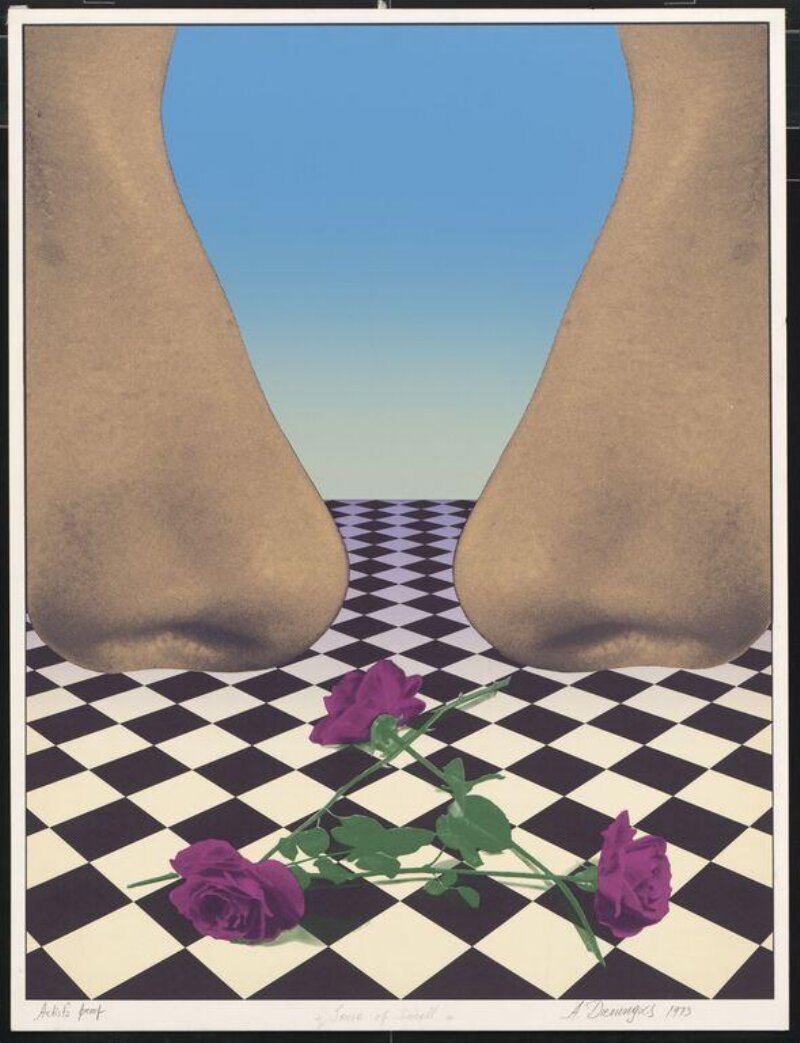
Achilles Droungas. A Sense of Smell.
Đổi tên một bức tranh là đổi chỗ người xem đứng.
To rename a picture is to move where the viewer stands.
© Victoria and Albert Museum, London · Victoria and Albert Museum (V&A)
Hai cánh mũi và ba bông hồng
Phía trên, hai khối màu da khổng lồ chiếm gần hết khổ giấy. Nhìn kỹ mới thấy đó là hai cánh mũi, chụp như từ dưới lên, lỗ mũi hướng xuống. Giữa chúng là một khoảng trời xanh chuyển dần sang nhạt ở chân trời.
Phía dưới là một mặt sàn ô cờ đen trắng, chạy lùi về xa theo luật phối cảnh. Trên sàn có ba bông hồng tím, cành xanh, lá xanh, nằm chéo nhau như vừa bị ai thả xuống.
Không có mặt người. Không có căn phòng. Chỉ có mũi, hoa, sàn và trời. Bốn thứ ấy đủ để dựng một cảnh.
Đây là một bản in lụa màu, làm năm 1973, có lẽ ở London. Bản mà Bảo tàng Victoria và Albert giữ là bản thử của nghệ sĩ, có chữ ký và năm. Ở mép dưới, bằng bút chì, ghi Artist's proof ở bên trái, tên tác phẩm ở giữa, và A. Droungas 1973 ở bên phải.
Một hoạ sĩ in Hy Lạp ở London
Achilles Droungas sinh năm 1940 ở Piraeus, cảng biển của Athens. Ông học đồ hoạ tại Trường Mỹ thuật Athens từ 1958 đến 1965, với thầy Kostas Grammatopoulos. Năm 1970, nhờ học bổng của nhà nước Hy Lạp, ông sang London học tiếp ở Slade School of Fine Art cho đến 1973, năm ông làm bản in này.
Từ cuối thập niên 1960 đến giữa thập niên 1970, Droungas gửi tranh in đến nhiều triển lãm đồ hoạ quốc tế lớn. Các bản in của ông được những nhà xuất bản tranh in ở London, New York và Athens phát hành. Tate giữ một bản in lụa khác của ông, City under Siege, cũng làm năm 1973.
Về sau, ông được biết đến nhiều hơn như một hoạ sĩ vẽ tranh. Phòng tranh Quốc gia Hy Lạp đã dựng một triển lãm hồi cố về ông. Người ta thường xếp tranh ông vào khoảng giữa hiện thực phê phán và siêu thực tả, với một thủ pháp quen thuộc: đánh lừa thị giác, làm cho vật vẽ trông như vật thật.
A Sense of Smell mang đúng dấu vết ấy. Hai cánh mũi được in với độ chi tiết của một bức ảnh, lỗ chân lông, vùng tối, vùng sáng. Nhưng chúng lại treo lơ lửng trên trời, to hơn cả chân trời. Thật ở từng chi tiết, phi lý ở tổng thể.
Khi cái tên đổi nghĩa bức tranh
Hồ sơ của Bảo tàng V&A ghi một chi tiết nhỏ: ngay sau khi phát hành, nghệ sĩ đã đổi tên tác phẩm. Tên đầu tiên là Three Purple Roses. Tên sau là A Sense of Smell.
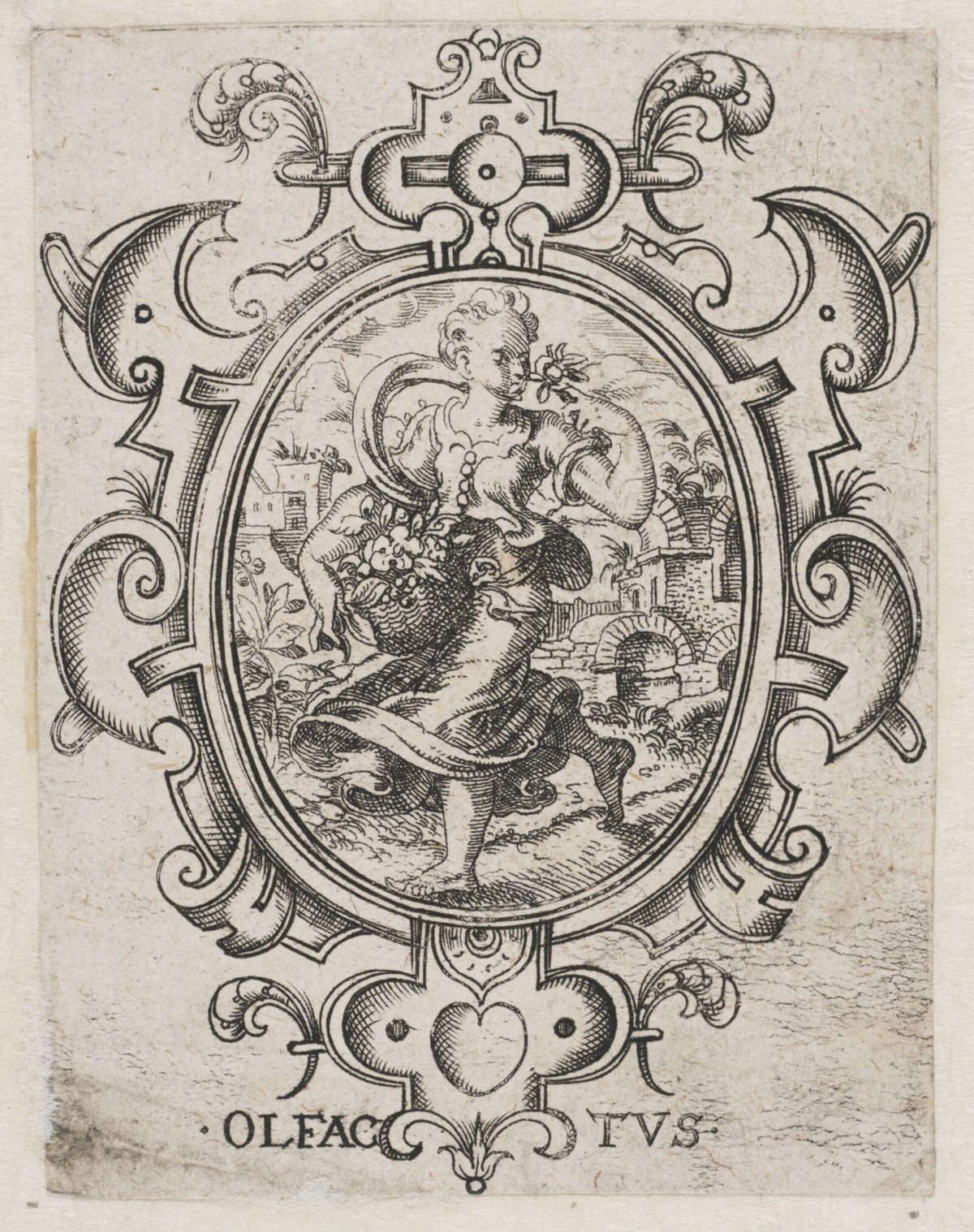
Không một nét nào trên bản in thay đổi. Nhưng cái tên mới kéo bức tranh vào một truyền thống rất dài. Từ thế kỷ 16 và 17, các hoạ sĩ châu Âu đã vẽ năm giác quan thành từng bức riêng. Khứu giác thường được thể hiện bằng một người cầm hoa đưa lên mũi, như trong bản khắc của Abraham Bosse ở Paris.
Droungas giữ lại hai yếu tố cũ nhất của đề tài ấy: bông hoa và cái mũi. Rồi ông bỏ đi người ngửi. Không còn ai cầm hoa, không còn khu vườn, không còn quần áo, không còn câu thơ chú thích. Chỉ còn cơ quan và vật được ngửi, đặt trên một sân khấu trống.
Mặt sàn ô cờ góp phần làm nên cảm giác sân khấu ấy. Nó là thứ rất quen trong tranh siêu thực, một mặt phẳng lý tưởng kéo dài vô tận, nơi mọi vật trở nên xa lạ. Đặt ba bông hồng lên đó, Droungas biến chúng thành vật mẫu. Đặt hai cánh mũi lên trời, ông biến khứu giác thành một thứ khổng lồ, bao trùm, gần như là thời tiết.
Khứu giác là giác quan khó vẽ nhất. Không ai nhìn thấy mùi. Các hoạ sĩ xưa giải quyết bằng biểu tượng. Droungas giải quyết bằng tỉ lệ: làm cho cái mũi lớn đến mức không thể bỏ qua.
Two nostrils and three roses
Above, two huge skin coloured forms fill most of the sheet. Look again and they are nostrils, seen from below, openings facing down. Between them lies a strip of blue sky, paling towards the horizon.
Below is a black and white chequered floor, receding in strict perspective. On it lie three purple roses with green stems and leaves, crossed as if someone had just dropped them.
No face. No room. Only nose, flowers, floor and sky. Four things are enough to build a scene.
It is a colour screenprint made in 1973, probably in London. The impression in the Victoria and Albert Museum is an artist's proof, signed and dated. In pencil along the lower edge: Artist's proof at left, the title in the middle, A. Droungas 1973 at right.
A Greek printmaker in London
Achilles Droungas was born in 1940 in Piraeus, the port of Athens. He studied printmaking at the Athens School of Fine Arts from 1958 to 1965 under Kostas Grammatopoulos. In 1970 a Greek state scholarship took him to the Slade School of Fine Art in London, where he stayed until 1973, the year of this print.
From the late 1960s to the mid 1970s he showed in many major international print exhibitions, and his prints were published in London, New York and Athens. Tate holds another of his 1973 screenprints, City under Siege.
Later he became better known as a painter. The National Gallery of Greece has held a retrospective of his work. His painting is usually placed between critical realism and hyperrealism, with a familiar device: trompe l'oeil, making the painted thing look like the real one.
A Sense of Smell already carries that mark. The nostrils are printed with photographic detail, pores, shadow, highlight. Yet they hang in the sky, larger than the horizon. Real in each detail, absurd as a whole.
When a title changes the picture
The V&A record notes a small fact: shortly after publication the artist changed the title. It was first Three Purple Roses. It became A Sense of Smell.
Not a line on the print changed. But the new title pulls the image into a long tradition. Since the sixteenth and seventeenth centuries European artists had depicted the five senses one by one, and smell was usually a figure raising a flower to the nose, as in Abraham Bosse's Paris etching.
Droungas keeps the two oldest elements of that subject, the flower and the nose, and removes the person. No one holds the flower. No garden, no costume, no caption in verse. Only the organ and the thing smelled, on an empty stage.
The chequered floor helps make that stage. It is familiar from surrealist painting, an ideal plane running to infinity where every object turns strange. Placed on it, the roses become specimens. Placed in the sky, the nostrils turn smell into something vast, enveloping, almost like weather.
Smell is the hardest sense to paint. No one sees a scent. Older painters solved it with symbols. Droungas solves it with scale: the nose grows until it cannot be ignored.
Olfactory Art