
Essays · Olfactory Art
Carrie Paterson. Beneath the Earth, the Sky.
Muốn thấy trời, có khi phải nhìn xuống.
To see the sky, sometimes you look down.
Institute for Art and Olfaction · Institute for Art and Olfaction
Một triển lãm đảo ngược
Tên triển lãm đã là một phép đảo. Dưới mặt đất, bầu trời. Thông thường, trời ở trên, đất ở dưới. Carrie Paterson đổi chỗ chúng, và từ phép đổi chỗ ấy mở ra một loạt câu hỏi về cách con người nhìn thế giới.
Beneath the Earth, the Sky là triển lãm cá nhân của Paterson tại The Institute for Art and Olfaction, phố Chung King, Los Angeles, từ ngày 26 tháng 4 đến 26 tháng 5 năm 2024. Khai mạc tối ngày 26 tháng 4. Ngày 16 tháng 5, nghệ sĩ có buổi trò chuyện cùng Christopher Michno tại phòng trưng bày.
Đảo ngược là một nguyên lý quen thuộc trong điêu khắc: khối đặc thành khoảng rỗng, cái bên trong lộ ra bên ngoài, đế trở thành đỉnh. Paterson dùng nguyên lý ấy để suy ngẫm về những thực hành chiêm nghiệm của con người, những việc người ta làm chậm lại để nhìn cho kỹ.
Trong triển lãm, cây và đá không chỉ là chất liệu. Chúng được xem như cộng sự trong một thực hành mà trang giới thiệu gọi là nghệ thuật công nghệ, xoay quanh ký ức, sự di cư và cảm giác.
Những thực hành chậm
Triển lãm nhắc đến nhiều thực hành chiêm nghiệm. Bonsai, nghệ thuật trồng cây nhỏ trong chậu. Tiểu cảnh, những phong cảnh thu nhỏ có núi đá, cây cỏ. Ném đá thia lia trên mặt nước. Ngắm sao. Điện thờ. Hương trầm.
Đặt cạnh nhau, chúng có một điểm chung. Tất cả đều đòi hỏi thời gian và sự chú ý. Một cây bonsai cần nhiều năm cắt tỉa. Một hòn đá thia lia cần đúng góc tay, đúng mặt nước. Một bầu trời sao chỉ hiện ra khi mắt đã quen với bóng tối. Một que hương cháy theo nhịp của riêng nó, không nhanh hơn được.
Paterson biết những thực hành ấy từ bên trong. Nghệ sĩ hiện làm tình nguyện viên ở vườn ươm bonsai của Huntington Gardens. Việc chăm cây, với Paterson, là một công việc hằng tuần trước khi là một chất liệu nghệ thuật.
Chất liệu trong phòng gồm cây, cây cảnh, đá, bình thuỷ tinh, những thành phần có mùi, và hình ảnh hoa cỏ lấy từ một cuốn lịch Trung Hoa năm 2024. Có những phong cảnh thu nhỏ làm bằng nhiều chất liệu. Có một tác phẩm tưởng niệm không đặt tên.
Từ chậu cây đến các vì sao
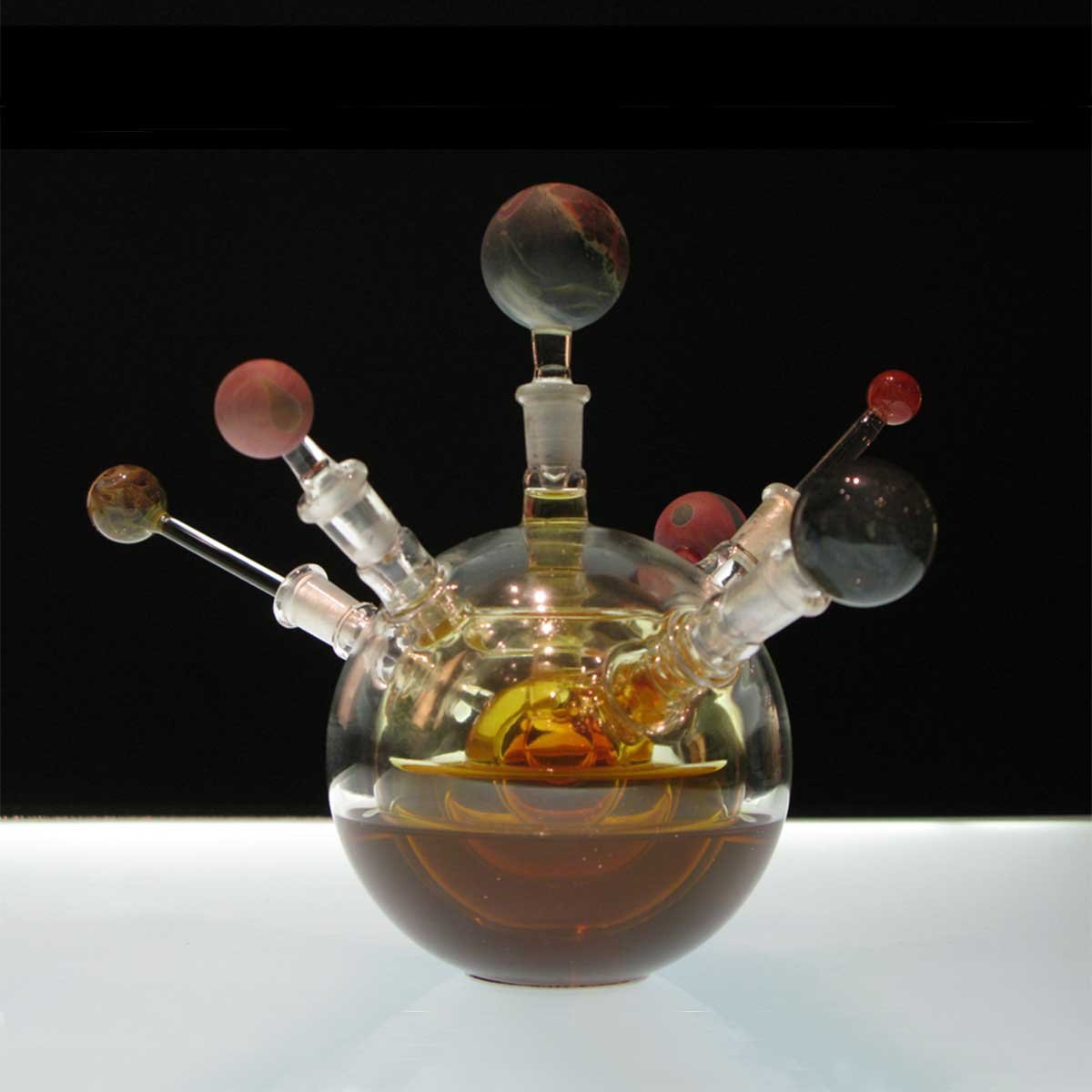
Tên các tác phẩm kéo người xem đi rất xa khỏi chậu cây. Copernican System No. 1 gợi đến hệ Copernicus, mô hình đặt Mặt Trời ở trung tâm, một trong những lần đảo ngược lớn nhất trong lịch sử cách con người hình dung vũ trụ. Three Body Harmony gợi đến bài toán ba vật thể của vật lý, khi ba khối hút lẫn nhau bằng trọng lực. Chemisphere nghe như một bầu khí quyển làm bằng hoá chất.
Và có Homesickness Kit for Spacefarers, bộ đồ nghề cho nỗi nhớ nhà dành cho người du hành vũ trụ. Cái tên ấy có lẽ là chìa khoá của cả triển lãm. Nếu một ngày con người sống xa Trái Đất, họ sẽ mang theo gì để nhớ nhà? Một hòn đá? Một nhánh cây? Một mùi?
Câu hỏi nghe như khoa học viễn tưởng, nhưng nó rất gần đời sống của những người di cư. Trang giới thiệu nói về những chủ đề như sự dịch chuyển, cộng đồng xa xứ, trọng lực, sự mục rữa và đời sống du mục. Người rời quê cũng mang theo những bộ đồ nghề nhỏ như vậy, chỉ là không ai gọi tên chúng.
Hương trầm và ký ức của một gia đình
Paterson sinh năm 1972, lớn lên ở một thị trấn trượt tuyết tại Colorado. Gia đình bên nội là người Do Thái gốc Vienna sống sót qua Thế chiến thứ hai. Gia đình bên ngoại là những nông dân di cư từ vùng Schleswig Holstein. Paterson học văn chương tại Yale và nhận bằng thạc sĩ mỹ thuật tại UC Irvine năm 2001.
Một gia đình như vậy mang trong mình nhiều cuộc ra đi. Có lẽ vì thế, những vật nhỏ, dễ mang theo, có thể đặt lên một chiếc bàn trong căn nhà mới, lại có sức nặng trong thực hành của Paterson. Một chậu cây, một hòn đá, một que hương là thứ người ta có thể dựng lại ở bất cứ đâu.
Hương trầm có vị trí riêng trong danh sách ấy. Ở nhiều nền văn hoá, người ta đốt hương ở điện thờ để nối người sống với người đã khuất, nối mặt đất với một điều gì ở trên cao. Khói là thứ duy nhất trong phòng đi theo chiều ngược với trọng lực. Trong một triển lãm về đất và trời, nó là đường nối giữa hai bên.
Người đọc Penta có thể tìm thêm về nghề làm hương ở The Water and the Wind của Arianna Petrich, về nghề làm hương ở Awaji, Nhật Bản. Ở Paterson, hương không phải một nghề. Nó là một cử chỉ nhỏ, lặp lại, để nhớ.
An exhibition turned upside down
The title is already an inversion. Beneath the earth, the sky. Usually the sky is above and the earth below. Carrie Paterson swaps them, and from that swap opens a series of questions about how people see the world.
Beneath the Earth, the Sky was Paterson's solo exhibition at The Institute for Art and Olfaction on Chung King Road, Los Angeles, from 26 April to 26 May 2024. It opened on the evening of 26 April. On 16 May the artist spoke with Christopher Michno in the gallery.
Inversion is a familiar principle in sculpture: solid becomes void, the inside shows on the outside, the base becomes the top. Paterson uses it to reflect on contemplative practices, the things people slow down for in order to look closely.
In the show, trees and stones are not only materials. They are treated as collaborators in what the gallery text calls an art and technology practice, concerned with memory, migration and sensation.
Slow practices
The exhibition refers to many contemplative practices. Bonsai, the art of growing small trees in pots. Miniature landscapes with rocks and plants. Skipping stones across water. Stargazing. Shrines. Incense.
Side by side they share one thing. All of them ask for time and attention. A bonsai needs years of pruning. A skipping stone needs the right angle of the wrist and the right stretch of water. A night sky only appears once the eyes adjust to the dark. A stick of incense burns at its own pace and cannot be hurried.
Paterson knows these practices from the inside. The artist volunteers at the bonsai nursery of the Huntington Gardens. Tending trees is part of Paterson's working life before it is ever an art material.
The materials in the room include plants, trees, stones, glass vessels, scented elements and images of flowers taken from a 2024 Chinese calendar. There are mixed media miniature landscapes, and an untitled memorial piece.
From a pot to the stars
The titles of the works pull visitors far from the pot. Copernican System No. 1 recalls the Copernican model, which placed the Sun at the centre, one of the great inversions in how people have pictured the universe. Three Body Harmony recalls the three body problem in physics, three masses pulling on one another through gravity. Chemisphere sounds like an atmosphere made of chemistry.
And there is Homesickness Kit for Spacefarers. The title may be the key to the whole show. If people one day live far from Earth, what will they take to remember home? A stone? A branch? A smell?
The question sounds like science fiction, but it is close to the lives of migrants. The gallery text names displacement, diaspora, gravity, decay and nomadic life among its themes. People who leave home carry small kits like this too; no one simply gives them a name.
Incense and a family's memory
Paterson was born in 1972 and grew up in a ski town in Colorado. The paternal side of the family were Viennese Jews who survived the Second World War. The maternal side were immigrant farmers from Schleswig Holstein. Paterson studied literature at Yale and took an MFA at UC Irvine in 2001.
A family like this carries many departures. Perhaps that is why small, portable things, the kind that can be set on a table in a new house, weigh so much in Paterson's practice. A potted tree, a stone, a stick of incense can be set up again anywhere.
Incense holds a particular place on that list. In many cultures people burn it at shrines to link the living with the dead, the ground with something above. Smoke is the only thing in the room that moves against gravity. In an exhibition about earth and sky, it is the line between the two.
Readers of Penta can find more on the craft of incense in Arianna Petrich's The Water and the Wind, on incense craft in Awaji, Japan. For Paterson, incense is not a trade. It is a small gesture, repeated, in order to remember.
Olfactory Art