
Essays · Olfactory Art
Dieter Roth. Staple Cheese (A Race).
Thời gian không vẽ. Nó lên men.
Time does not paint. It ferments.
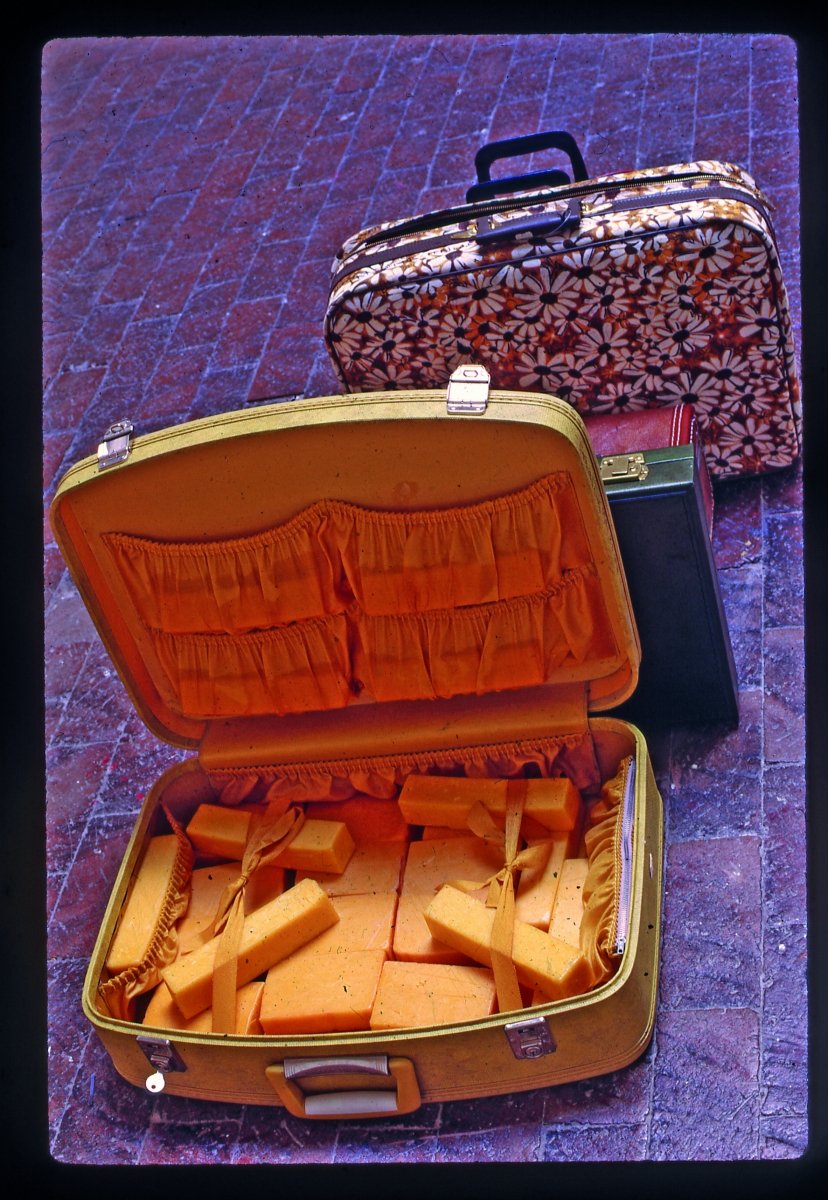
Dieter Roth, Staple Cheese (A Race), 1970, installation view, Eugenia Butler Gallery, Los Angeles (via La Belle Revue) · ArtReview
Ba mươi bảy chiếc vali
Mùa xuân năm 1970, Dieter Roth làm một triển lãm ở Eugenia Butler Gallery, Los Angeles. Vật liệu gồm 37 chiếc vali. Trong mỗi chiếc là một loại pho mát khác nhau. Vali được mở ra, đặt trong phòng trưng bày, và để yên như vậy suốt khoảng một tháng.
Tên tác phẩm là Staple Cheese (A Race). Một cuộc đua. Người ta không đua bằng chân mà bằng tốc độ phân rã: miếng pho mát nào mềm ra, chảy ra, rỉ xuống sàn trước.
Không có người điều khiển cuộc đua. Không có trọng tài. Nhiệt độ của Los Angeles mùa xuân, độ ẩm của không khí, loại sữa, độ già của từng khối pho mát quyết định tất cả. Roth dựng sân, rồi đứng ngoài.
Chiếc vali cũng không được chọn ngẫu nhiên. Nó là đồ vật của người đi đường, của hành lý, của những chuyến đi có điểm đến. Trong phòng trưng bày của Roth, vali không đi đâu cả. Chúng nằm mở nắp, như vừa được đặt xuống ở một nhà ga. Thứ duy nhất còn đang di chuyển là pho mát bên trong: nó chảy, nó lan, nó bay hơi. Người xem đi dọc dãy vali giống như đi dọc một đường chạy, nhìn từng vận động viên chậm chạp tiến về vạch đích là mặt sàn.
Đây là một cách làm quen thuộc với ông. Roth, nghệ sĩ gốc Đức sống nhiều năm ở Thuỵ Sĩ và Iceland, đã dùng thức ăn làm vật liệu từ trước đó. Ông từng làm những cây xúc xích nhồi bằng giấy sách xay nhỏ, gọi là Literaturwurst. Với ông, sự hư hỏng không phải tai nạn của tác phẩm. Nó là tác giả thứ hai.
Mùi đi ra phố
Chuyện xảy ra đúng như có thể đoán. Pho mát bắt đầu thối. Mỗi loại một kiểu mùi, và các kiểu mùi ấy chồng lên nhau trong một căn phòng kín. Nước từ vali rỉ ra, loang xuống sàn. Ruồi kéo đến, rồi nhiều hơn nữa.
Theo ArtReview, cơ quan y tế công cộng của thành phố đã tìm cách đóng cửa gallery. Eugenia Butler không nhượng bộ. Bà bảo vệ tác phẩm bằng một lập luận đơn giản: đây là vòng đời. Gallery tiếp tục mở.
Người ta kể rằng Roth còn gom lại một ít xác ruồi chết trong phòng và gọi chúng là khán giả thật sự của triển lãm. Câu chuyện ấy có thể là giai thoại, nhưng nó nói đúng điều tác phẩm muốn nói. Người đến xem đứng một lúc rồi đi. Ruồi thì ở lại tới cuối.
Ở đây mùi không phải một chi tiết đi kèm. Nó là phần lan xa nhất của tác phẩm. Hình ảnh chỉ tồn tại trong bốn bức tường. Mùi thì vượt qua cửa, đi ra phố, chạm vào những người không hề định đi xem nghệ thuật.
Chống lại sự sạch sẽ
ArtReview đặt Staple Cheese vào một dòng nghệ thuật đương đại đối đầu với ý thức hệ sạch sẽ. Chủ nghĩa hiện đại yêu những bức tường trắng, những bề mặt không tì vết, những căn phòng không mùi. Bảo tàng là nơi vật được giữ cho khỏi thay đổi.
Roth làm điều ngược lại. Ông mang vào phòng trắng đúng thứ mà phòng trắng được xây ra để ngăn: sự mục rữa, vi khuẩn, côn trùng, nước rỉ. Ông không phá tường. Ông để một thứ sống làm hỏng sự im lặng của nó.
Nghề bảo tàng xoay quanh việc giữ cho vật không đổi. Roth thì hỏi: nếu tác phẩm tự thay đổi mỗi ngày, ta có còn cần giữ nó y nguyên? Và nếu mùi của nó khiến ta muốn bỏ đi, thì đó có phải cũng là một cách xem?
Cùng câu hỏi ấy sẽ quay lại nhiều lần sau này, với hoa héo sau kính của Anya Gallaccio, với thịt khô dần trên ma nơ canh. Nhưng ít tác phẩm nào nói nó to như ba mươi bảy chiếc vali pho mát, trong một tháng mùa xuân ở Los Angeles.
Thirty seven suitcases
In the spring of 1970, Dieter Roth made an exhibition at the Eugenia Butler Gallery in Los Angeles. The material was 37 suitcases. Each held a different kind of cheese. The suitcases were opened, set out in the gallery, and left alone for about a month.
The title was Staple Cheese (A Race). A race run not on legs but on the speed of decay: which cheese would soften, slump and seep onto the floor first.
Nobody ran the race. There was no referee. The warmth of a Los Angeles spring, the humidity, the kind of milk, the age of each cheese decided everything. Roth built the track and stepped aside.
The suitcase was not a random choice either. It belongs to travellers, to luggage, to journeys with a destination. In Roth's gallery the suitcases went nowhere. They lay open as if just set down in a station. The only thing still moving was the cheese inside: it flowed, it spread, it evaporated. Walking along the row was like walking beside a track, watching each slow runner edge toward the finish line of the floor.
This was a familiar method for him. Roth, a German born artist who lived for many years in Switzerland and Iceland, had used food as material before. He made sausages stuffed with shredded books, which he called Literaturwurst. For him spoilage was not an accident that happened to the work. It was a second author.
The smell goes out to the street
What happened was what anyone might guess. The cheese began to rot. Each kind rotted its own way, and the smells piled up in a closed room. Liquid leaked from the suitcases and spread over the floor. Flies arrived, then more flies.
According to ArtReview, city officials tried to shut the gallery down. Eugenia Butler held firm, defending the work with a simple argument: this is the life cycle. The gallery stayed open.
Roth is said to have gathered some of the dead flies and called them the exhibition's true audience. The story may be legend, but it says exactly what the work says. Visitors stayed a while and left. The flies stayed to the end.
Smell here is not a side effect. It is the part of the work that travelled farthest. The image lived inside four walls. The smell went through the door, out to the street, and reached people who never meant to see any art.
Against cleanliness
ArtReview places Staple Cheese in a line of contemporary art that confronts the ideology of cleanliness. Modernism loved white walls, spotless surfaces, rooms without smell. The museum is where objects are kept from changing.
Roth did the opposite. He brought into the white room exactly what the white room was built to exclude: rot, bacteria, insects, seepage. He did not break the walls. He let something alive spoil their silence.
The museum trade revolves around keeping objects unchanged. Roth asked: if a work changes every day, do we still need to keep it intact? And if its smell makes us want to leave, is that also a way of looking?
The question would return many times, with the flowers wilting behind glass in the work of Anya Gallaccio, with meat drying on a mannequin. But few works say it as loudly as thirty seven suitcases of cheese, over one spring month in Los Angeles.
Olfactory Art