
Essays · Olfactory Art
Flying Object. Tate Sensorium.
Mỗi mùi là một cách đọc bức tranh, không phải bức tranh.
Each scent is a reading of the painting, not the painting.
Tate · Tate
Một phòng tối ở Tate Britain
Mùa hè năm 2015, phòng 34 của Tate Britain ở London được biến thành một không gian tối và kín. Từ 26 tháng Tám đến 4 tháng Mười, khách vào theo từng nhóm nhỏ để xem bốn bức tranh trong bộ sưu tập của bảo tàng. Nhưng họ không chỉ xem. Họ nghe, ngửi, nếm, và cảm thấy một thứ chạm vào tay mà không có gì chạm vào cả.
Dự án mang tên Tate Sensorium. Nó là tác phẩm thắng IK Prize năm ấy, một giải của Tate dành cho ý tưởng dùng công nghệ để đưa người xem đến gần bộ sưu tập, với sự hỗ trợ của Porter Foundation.
Người làm là Flying Object, một studio sáng tạo. Quanh họ là một nhóm chuyên gia ở từng giác quan. Nick Ryan lo âm thanh. Odette Toilette, một người chuyên làm việc với mùi, lo phần hương. Paul A Young, một thợ làm sô cô la, lo phần vị. Annette Mees, người làm kịch tương tác, và Cis O'Boyle, nhà thiết kế ánh sáng, dựng không gian. Phòng thí nghiệm SCHI Lab của Đại học Sussex, do tiến sĩ Marianna Obrist dẫn dắt, mang đến phần chạm.
Kỹ thuật đi kèm khá nhiều. Âm thanh hai tai và âm thanh định hướng tạo cảm giác không gian. Một hệ thống phát nước hoa đưa mùi đến đúng chỗ đúng lúc. Một thiết bị dùng sóng siêu âm tạo cảm giác chạm lên bàn tay qua không khí. Và mỗi người xem đeo một vòng tay đo phản ứng điện trên da, để ghi lại cơ thể họ phản ứng ra sao trước từng bức tranh.
Bốn bức tranh, bốn cách ngửi
Bức đầu tiên là Figure in a Landscape của Francis Bacon, vẽ năm 1945. Một hình người mờ, một bãi cỏ, một khung cảnh trống. Tate Sensorium đặt cạnh nó mùi cỏ và mùi đất, cùng tiếng máy móc và thành phố. Người xem còn được nếm một viên sô cô la trông bình thường nhưng bên trong là than, muối biển, mảnh hạt cacao và trà Lapsang Souchong. Vị đắng, mặn, khói.
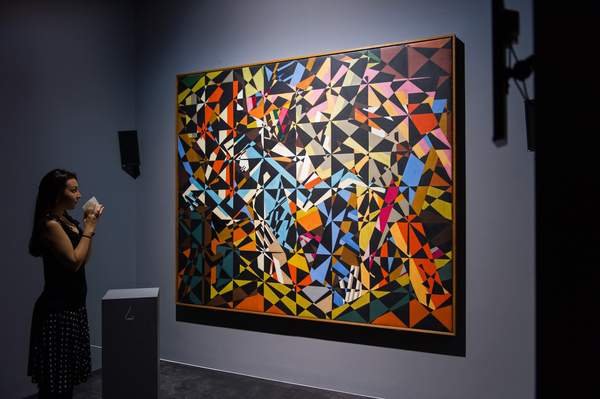
Bức thứ hai là In the Hold của David Bomberg, vẽ khoảng năm 1913 đến 1914, lấy cảm hứng từ những người phu bến tàu làm việc trong khoang một con tàu. Bức tranh gần như trừu tượng, những mảnh hình học vỡ ra. Dự án đưa vào đó tiếng động của một bến tàu trước Thế chiến thứ nhất và mùi sơn.
Bức thứ ba là Interior II của Richard Hamilton, năm 1964. Một nội thất sạch, phẳng, lạnh. Âm thanh là tiếng bước chân xen tiếng giấy sột soạt. Mùi là keo xịt tóc, dung môi, và mùi chất đánh bóng đồ gỗ. Những mùi của một ngôi nhà được dọn dẹp mỗi ngày, lặp đi lặp lại.
Bức thứ tư là Full Stop của John Latham, năm 1961, một vòng tròn đen lớn làm bằng sơn phun. Ở đây, phần chính là cảm giác chạm. Âm thanh đi cùng thiết bị siêu âm, để người xem cảm thấy trên tay một thứ như hạt sơn đang rơi, dù không có gì thật sự chạm vào.
Diễn giải, không phải phục dựng
Điều quan trọng cần nói rõ: không mùi nào trong số này là mùi thật của bức tranh. Bacon không vẽ ngoài đồng cỏ với một viên sô cô la trong túi. Hamilton không để lại chai keo xịt tóc nào. Những mùi ấy là lời đọc của một nhóm người sống sau họ nhiều thập kỷ.
Vì vậy Tate Sensorium thú vị ở chỗ nó để lộ việc diễn giải. Một tấm nhãn cạnh bức tranh cũng là diễn giải, nhưng chữ viết trông trung lập. Mùi thì không bao giờ trông trung lập. Khi ngửi thấy keo xịt tóc trước Interior II, người xem biết ngay có ai đó đã chọn mùi này, và họ có thể đồng ý hoặc không.
Vòng tay đo phản ứng của da thêm một tầng nghĩa khác. Bảo tàng không chỉ hỏi bạn nghĩ gì về bức tranh. Nó ghi lại cơ thể bạn làm gì trước bức tranh. Người xem trở thành một phần của dữ liệu.
Ý tưởng đưa mùi vào một hình ảnh không mới. Từ những năm 1960, Sensorama của Morton Heilig đã thử cho người xem phim ngửi thấy cảnh trên màn hình. Tate Sensorium mang câu hỏi ấy vào một bảo tàng hội hoạ, nơi hình ảnh vốn được coi là đủ. Nó không trả lời rằng hình ảnh thiếu. Nó chỉ cho thấy rằng mỗi người xem vẫn luôn mang theo mũi, tai và lưỡi của mình khi đứng trước một bức tranh, dù bảo tàng có nhắc hay không.
A dark room at Tate Britain
In the summer of 2015, gallery 34 at Tate Britain in London became a dark, closed space. From 26 August to 4 October, visitors entered in small groups to see four paintings from the museum's collection. But they did not only look. They listened, smelled, tasted, and felt something touch their hand when nothing was there.
The project was called Tate Sensorium. It won that year's IK Prize, a Tate award for ideas that use technology to bring people closer to the collection, supported by the Porter Foundation.
It was made by Flying Object, a creative studio. Around them stood a team of specialists, one for each sense. Nick Ryan handled sound. Odette Toilette, who works with smell, handled scent. Paul A Young, a chocolatier, handled taste. Annette Mees, an interactive theatre maker, and Cis O'Boyle, a lighting designer, built the space. The SCHI Lab at the University of Sussex, led by Dr Marianna Obrist, brought touch.
There was a good deal of technology. Binaural and directional audio created a sense of space. A perfume release system delivered smell at the right place and time. A device using ultrasound produced touch sensations on the hand through the air. And each visitor wore a wristband measuring the electrical response of the skin, recording how their body reacted to each painting.
Four paintings, four ways to smell
The first painting was Francis Bacon's Figure in a Landscape, from 1945. A blurred figure, a stretch of grass, an empty scene. Tate Sensorium set beside it the smell of grass and earth, with the sound of machines and the city. Visitors also tasted a chocolate that looked ordinary but held charcoal, sea salt, cacao nibs and Lapsang Souchong tea. Bitter, salty, smoky.
The second was David Bomberg's In the Hold, painted around 1913 to 1914 and inspired by dockers working in the hold of a ship. The picture is nearly abstract, broken into geometric shards. The project added the noise of a dockyard before the First World War and the smell of paint.
The third was Richard Hamilton's Interior II, 1964. A clean, flat, cool interior. The sound was footsteps alternating with the rustle of paper. The smell was hairspray, solvent and furniture polish. The smells of a house tidied every day, over and over.
The fourth was John Latham's Full Stop, 1961, a large black circle made with spray paint. Here the main sense was touch. Sound came with the ultrasound device, so visitors felt on their hand something like falling paint, though nothing touched them.
Interpretation, not reconstruction
It should be said plainly: none of these smells is the real smell of the painting. Bacon did not paint in a meadow with chocolate in his pocket. Hamilton left no can of hairspray behind. The smells are a reading by people living decades after them.
That is why Tate Sensorium is interesting: it exposes interpretation. A wall label beside a painting is interpretation too, but text looks neutral. Smell never looks neutral. When visitors smell hairspray in front of Interior II, they know at once that someone chose it, and they may agree or not.
The skin response wristband adds another layer. The museum does not only ask what you think of the painting. It records what your body does in front of it. The visitor becomes part of the data.
Adding smell to an image is not a new idea. In the 1960s, Morton Heilig's Sensorama already tried to let film viewers smell the scene on screen. Tate Sensorium brought that question into a museum of painting, where the image is usually thought to be enough. It does not answer that the image is lacking. It only shows that every viewer always brings a nose, ears and tongue to a painting, whether the museum mentions it or not.
Olfactory Art