
Essays · Olfactory Art
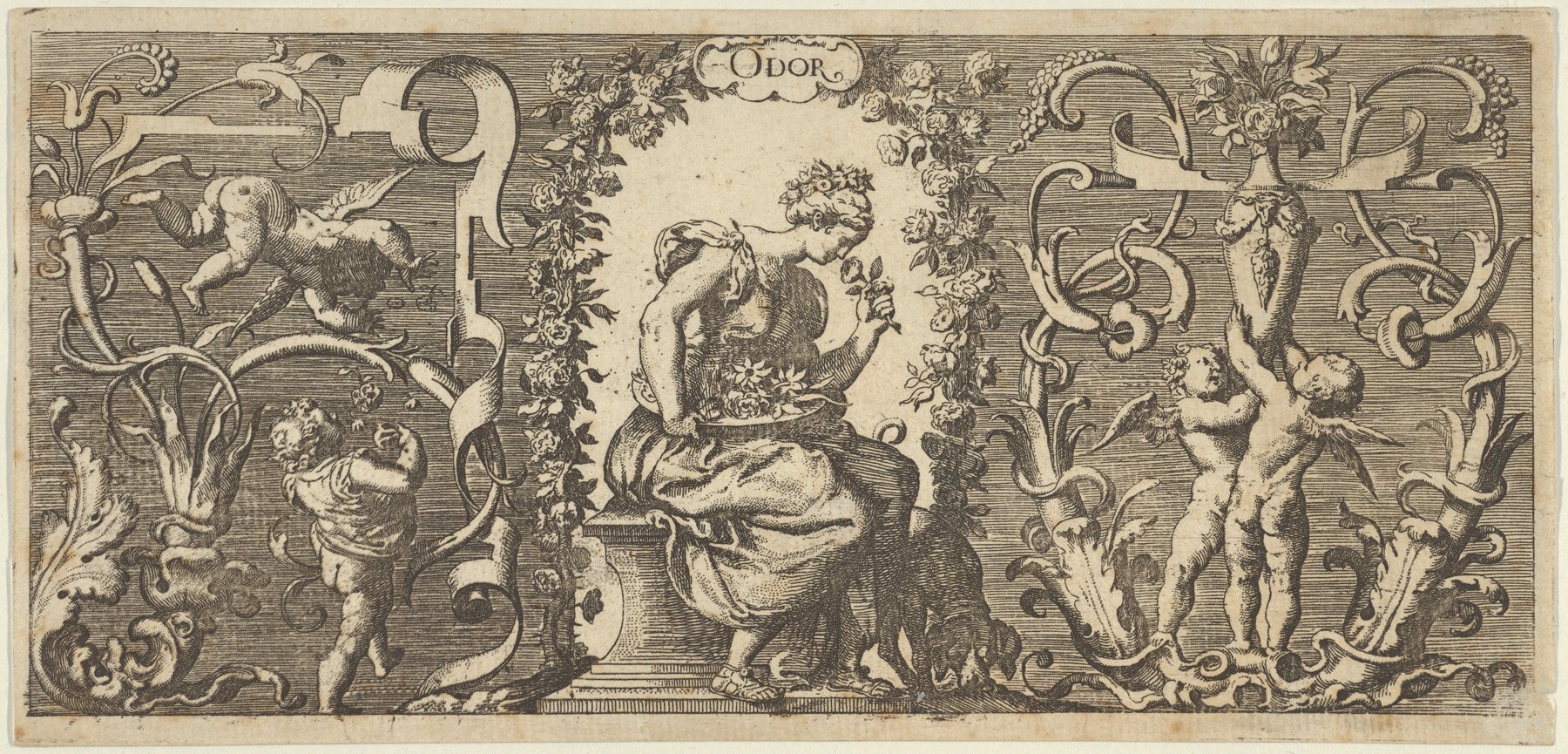
Franz Cleyn. Smell (Odor).
Khứu giác ngồi giữa một khung hoa.
Smell sits inside a frame of flowers.
The Metropolitan Museum of Art, Harris Brisbane Dick Fund, 1945 (Open Access, public domain) · The Metropolitan Museum of Art
Một dải giấy dài và hẹp
Tờ giấy chỉ cao chưa tới 10 cm và rộng 20 cm. Hình được khắc thành một dải ngang, như một đường diềm. Chính giữa, trong một ô nhãn nhỏ ở mép trên, là chữ ODOR, tiếng Latin của mùi.
Bên dưới chữ, một phụ nữ ngồi trên một bệ đá. Đầu cô đội vòng hoa. Trong lòng là một giỏ hoa. Tay cô nâng một bông hoa lên sát mặt. Quanh cô, một vòm kết bằng hoa cong lên như cổng vườn. Một con chó nằm sát chân bệ.
Hai bên là một thế giới khác. Lá cuộn thành những đường xoắn lớn, ruy băng uốn lượn, những đứa trẻ có cánh bay, đứng, trèo. Ở bên phải, hai đứa trẻ vươn tay lên một cái bình cắm đầy hoa đặt trên đỉnh một cột trang trí.
Hoa ở giữa, hoa trên đầu, hoa trong giỏ, hoa trong bình. The Met ghi nhận hoa hồng trong hình. Nếu phải kể giác quan này bằng một vật, Cleyn chọn hoa, và chọn rất nhiều.
Grottesche, một lối trang trí của người Ý
Quinque Sensuum là một bộ gồm một tờ tiêu đề và năm tờ, mỗi giác quan là một hình phụ nữ. Tờ tiêu đề nói rõ kiểu hình được dùng: năm giác quan được mô tả theo lối tranh mà người Ý gọi là grottesche.
Grottesche là lối trang trí lấy cảm hứng từ những bức vẽ tường La Mã cổ được tìm thấy ở Rome cuối thế kỷ 15, trong những căn phòng bị vùi dưới đất mà người đương thời gọi là hang, grotta. Đó là thế giới của lá cuộn, sinh vật lai, bình hoa, dây treo. Không cần logic, không cần trọng lực.
Trong lối trang trí này, khung quan trọng ngang với hình. Cleyn đặt ngụ ngôn khứu giác vào giữa một khung grottesche, và khung ấy lại đầy những thứ có mùi. Nó không chỉ bao quanh chủ đề. Nó kéo chủ đề ra hai bên.
Con chó nằm dưới chân cũng là một chi tiết quen. Trong nhiều hình ngụ ngôn châu Âu, chó đi cùng khứu giác vì cái mũi của nó. Ở đây nó nằm yên, gần như lẫn vào hoa văn.
Người vẽ thảm cho nhà vua
Franz Cleyn sinh năm 1582 ở Rostock, miền bắc nước Đức, và mất năm 1658 ở London. Phần lớn sự nghiệp của ông gắn với nước Anh, với cơ sở dệt thảm Mortlake gần London.
Ở Mortlake, Cleyn thiết kế thảm và cả những đường viền bao quanh các cảnh trên thảm. Ông cũng thiết kế một bộ thảm Năm giác quan cho vua Charles I.
Kinh nghiệm ấy hiện rõ trong Quinque Sensuum. Một tấm thảm lớn thường có một cảnh chính và một đường viền dày đầy hoa lá, chim thú. Dải giấy nhỏ của Cleyn cũng vậy, như một mẫu viền thảm thu lại vừa một bàn tay.
Tờ ở The Met mang tên nhà xuất bản Robert Walton và được ghi khoảng năm 1655, vài năm trước khi Cleyn mất. Tranh in thời đó đi qua nhiều tay: người vẽ, người khắc, người in, người bán. Một bộ hình tốt có thể sống lâu hơn người vẽ ra nó.
Một giác quan giữa đám đông
Năm giác quan là đề tài quen trong tranh và tranh in châu Âu thế kỷ 16 và 17. Khứu giác thường được nhận ra qua vài vật cố định: hoa, bình, con chó. Mùi trong hội hoạ thời ấy đủ nhiều để Mauritshuis dựng cả một triển lãm quanh nó, Fleeting: Scents in Colour.
Bản khắc của Cleyn dùng đúng những vật ấy, nhưng đặt chúng trong một cấu trúc khác. Nhân vật chính không đứng một mình trong khung cảnh. Cô bị bao quanh bởi hoa văn, bởi những đứa trẻ đang bận việc riêng, bởi một cái bình hoa ở rất xa mà cô không nhìn tới.
Nhìn lâu, câu hỏi đổi chiều. Không còn là người phụ nữ đang ngửi gì. Mà là mùi trong tờ giấy này bắt đầu từ đâu. Từ bông hoa trên tay cô, hay từ cái bình ở góc phải, hay từ cả dải lá hoa chạy ngang tờ giấy?
A long, narrow strip
The sheet is less than 10 cm tall and 20 cm wide. The image is engraved as a horizontal band, like a frieze. At the centre, in a small cartouche at the top edge, is the word ODOR, Latin for smell.
Below it, a woman sits on a stone plinth. She wears a wreath of flowers. A basket of flowers rests in her lap. She lifts a blossom close to her face. Around her, an arch of flowers curves up like a garden gate. A dog lies close to the base.
On either side is another world. Foliage curls into large spirals, ribbons wind, winged children fly, stand and climb. On the right, two of them reach up towards a vase full of flowers set on top of an ornamental column.
Flowers in the centre, flowers on her head, flowers in the basket, flowers in the vase. The Met records roses in the image. If this sense must be told through one object, Cleyn chooses flowers, and chooses a great many.
Grottesche, an Italian way of decorating
Quinque Sensuum is a set of a title plate and five sheets, each sense a female figure. The title plate names the manner used: the senses are described in the kind of painting the Italians call grottesche.
Grottesche takes its cue from ancient Roman wall paintings found in Rome in the late fifteenth century, in buried rooms that people then called grottoes, grotte. It is a world of scrolling leaves, hybrid creatures, vases and hanging garlands. No logic required, no gravity either.
In this manner the frame matters as much as the picture. Cleyn places his allegory of smell inside a grottesche frame, and fills that frame with things that smell. It does not simply surround the subject. It stretches the subject out to both sides.
The dog at her feet is a familiar detail. In many European allegories the dog accompanies smell because of its nose. Here it lies still, almost absorbed into the ornament.
A tapestry designer for the king
Franz Cleyn was born in Rostock, in northern Germany, in 1582 and died in London in 1658. Most of his career was tied to England, to the Mortlake tapestry manufactory near London.
At Mortlake, Cleyn designed tapestries and the borders that framed their scenes. He also designed a Five Senses set of tapestries for Charles I.
That training shows in Quinque Sensuum. A large tapestry often has a central scene and a deep border full of flowers, leaves, birds and animals. Cleyn's little strip of paper works the same way, like a tapestry border shrunk to the size of a hand.
The Met's impression carries the name of the publisher Robert Walton and is dated about 1655, a few years before Cleyn's death. Prints then passed through many hands: designer, engraver, printer, seller. A good set of images could outlive the person who drew it.
One sense in a crowd
The five senses were a common subject in European painting and prints of the sixteenth and seventeenth centuries. Smell was usually recognised by a few fixed objects: flowers, a vase, a dog. Scent in painting of that era was rich enough for the Mauritshuis to build a whole exhibition around it, Fleeting: Scents in Colour.
Cleyn uses those same objects but sets them in a different structure. His main figure does not stand alone in a scene. She is surrounded by ornament, by children busy with their own affairs, by a vase of flowers far off that she never looks at.
Look long enough and the question turns around. Not what the woman is smelling, but where the smell on this sheet begins. In the flower in her hand, in the vase on the right, or in the whole band of foliage running across the page?
Olfactory Art