
Essays · Olfactory Art
Raphael Sadeler I theo Maarten de Vos. Smell.
Một hình đi qua hai bàn tay trước khi tới mắt.
An image that passed through two hands before reaching the eye.
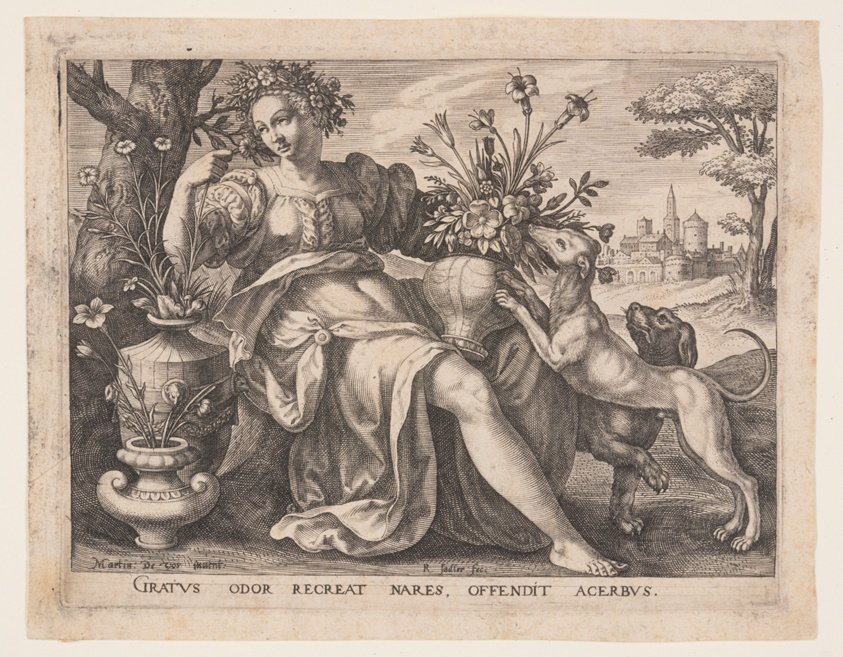
The Art Institute of Chicago, Charles Hack and the Hearn Family Trust Collection, purchased with funds provided by the Harry B. and Bessie K. Braude Memorial, Amanda S. Johnson and Marion J. Livingston, anonymous, and Suzanne Searle Dixon endowment funds · The Art Institute of Chicago
Người phụ nữ dưới gốc cây
Bản khắc rất nhỏ, chỉ khoảng 10 x 13 cm, vừa lòng bàn tay.
Theo mô tả của Rijksmuseum, nơi cũng giữ một bản in của tờ này, người phụ nữ tượng trưng cho khứu giác ngồi trên mặt đất, dưới một tán cây, đang xếp hoa vào một cái bình. Hai con chó chơi đùa dưới chân cô. Phía xa là một thành phố.
Đây là một cảnh tĩnh. Không có cử chỉ đưa hoa lên mũi, không có vẻ say mê. Người phụ nữ đang làm một việc bằng tay, bình thường. Nhưng mọi thứ quanh cô đều có mùi: hoa, lá, đất, và hai con chó, loài vật sống bằng cái mũi.
Con chó là bạn đồng hành quen thuộc của khứu giác trong tranh ngụ ngôn châu Âu. Ở đây chúng không đánh hơi. Chúng chơi. Như thể khứu giác, trong khu vườn này, đã được thả lỏng.
Dưới hình là một câu thơ Latin. Nó mở đầu bằng hai chữ Gratus odor, mùi dễ chịu, và kết thúc bằng chữ acerbus, gắt, chát. Chỉ riêng điểm đầu và điểm cuối ấy đã gợi một điều: khứu giác không chỉ gồm những gì thơm.
Invent, fec: hai cái tên trên một tấm đồng
Góc dưới bên trái bản khắc ghi Martin. de Vos invent., tức Maarten de Vos đã nghĩ ra hình. Ở giữa ghi R. sadler fec., tức R. Sadeler đã làm ra bản khắc. Đó là cách ghi công quen thuộc của tranh in thời ấy: người thiết kế một dòng, người khắc một dòng.
Maarten de Vos sinh năm 1532 và mất năm 1603. Ông là một hoạ sĩ lớn của Antwerp nửa sau thế kỷ 16, vẽ tranh thờ, chân dung, và vẽ rất nhiều mẫu cho thợ khắc.
Raphael Sadeler I sinh khoảng năm 1560 hoặc 1561, thuộc một gia đình thợ khắc Flemish. Năm 1581, khi khắc bộ Năm giác quan này, ông mới khoảng hai mươi tuổi.
Rijksmuseum còn ghi một cái tên thứ ba: Frans Floris, hoạ sĩ Antwerp thế hệ trước, được xem là nguồn cảm hứng cho thiết kế. Như vậy một tờ giấy nhỏ mang ba lớp: ý của một người đi trước, hình của người thiết kế, nét dao của người khắc.
Một bộ năm tờ, in ra nhiều bản
Bộ The Five Senses gồm năm bản khắc: thị giác, thính giác, khứu giác, vị giác, xúc giác. Theo Rijksmuseum, cả năm đều có chữ ký trên bản đồng, và một tờ có ghi năm.
Tranh in là cách hình ảnh đi xa ở châu Âu thế kỷ 16. Một bản đồng có thể in ra nhiều tờ. Những tờ ấy nhỏ, nhẹ, rẻ hơn tranh sơn dầu, đi theo người buôn và người sưu tập. Một mẫu hình của de Vos ở Antwerp có thể nằm trong tay một người ở thành phố khác vài tháng sau.
Cùng thời, ở Nuremberg, Jost Amman cũng khắc khứu giác trong một bộ Năm giác quan. Đề tài này được nhắc lại nhiều lần, bởi nhiều bàn tay, ở nhiều nơi. Mỗi lần là một biến thể nhỏ của cùng một ý.
Tờ ở Art Institute of Chicago nằm trong bộ sưu tập Charles Hack và Hearn Family Trust. Tờ ở Rijksmuseum là một bản in khác của cùng tấm đồng. Hai tờ giấy ở hai lục địa, cùng một hình, cùng hai cái tên.
Vì sao nó đáng nhớ
Nhìn từ hôm nay, Smell không có gì kịch tính. Nó nhỏ, đơn sắc, theo một quy ước ngụ ngôn đã rất quen. Nhưng chính sự bình thường đó cho thấy khứu giác được nghĩ về như thế nào vào năm 1581.
Khứu giác không được vẽ như một cơn say. Nó được vẽ như một công việc: chọn hoa, xếp hoa, đặt chúng vào một cái bình. Mùi là thứ con người sắp đặt trong một khu vườn, với một thành phố ở phía xa.
Và tờ giấy tự nó cũng là một sự sắp đặt của nhiều người. Một người nghĩ, một người khắc, một người in, một người bán, một người giữ. Hơn bốn trăm năm sau, nó vẫn còn đây, qua tất cả những bàn tay ấy.
The woman under the tree
The engraving is very small, about 10 by 13 cm, the size of a palm.
According to the Rijksmuseum, which also holds an impression, the woman who personifies smell sits on the ground beneath a tree, arranging flowers in a vase. Two dogs play at her feet. In the distance lies a city.
It is a quiet scene. No flower lifted to the nose, no rapture. The woman is doing ordinary work with her hands. Yet everything around her has a smell: flowers, leaves, earth, and two dogs, animals that live by their noses.
The dog is smell's familiar companion in European allegory. Here the dogs are not scenting. They are playing. As if smell, in this garden, has been let off the leash.
Beneath the image runs a Latin verse. It opens with Gratus odor, a pleasant smell, and ends with acerbus, harsh or bitter. Those two ends alone suggest something: smell is not only what is sweet.
Invent, fec: two names on a copper plate
At lower left the plate reads Martin. de Vos invent., meaning Maarten de Vos devised the image. At centre, R. sadler fec., meaning R. Sadeler made the engraving. This was the standard credit line of prints at the time: one line for the designer, one for the engraver.
Maarten de Vos was born in 1532 and died in 1603. He was a leading Antwerp painter of the later sixteenth century, painting altarpieces and portraits and producing a great many designs for engravers.
Raphael Sadeler I was born around 1560 or 1561 into a Flemish family of engravers. In 1581, when he cut this Five Senses set, he was about twenty.
The Rijksmuseum names a third figure: Frans Floris, an Antwerp painter of the previous generation, credited as the design's inspiration. So one small sheet holds three layers: the idea of a predecessor, the image of the designer, the burin of the engraver.
A set of five, printed many times
The Five Senses comprises five engravings: sight, hearing, smell, taste and touch. According to the Rijksmuseum, all five are signed in the plate and one is dated.
Prints were how images travelled in sixteenth century Europe. One copper plate could yield many sheets. They were small, light and cheaper than paintings, carried by dealers and collectors. A design by de Vos in Antwerp could be in someone's hands in another city months later.
In the same period, in Nuremberg, Jost Amman also engraved smell in a Five Senses series. The subject was taken up again and again, by many hands, in many places. Each time a small variation on one idea.
The Art Institute of Chicago's sheet belongs to the Charles Hack and Hearn Family Trust Collection. The Rijksmuseum's is another impression from the same plate. Two sheets on two continents, one image, the same two names.
Why it stays with us
Seen from today, Smell is not dramatic. It is small, monochrome, and follows a well worn allegorical convention. But that ordinariness shows how smell was thought about in 1581.
Smell is not pictured as intoxication. It is pictured as work: choosing flowers, arranging them, setting them in a vase. Scent is something people arrange in a garden, with a city in the distance.
And the sheet is itself an arrangement by many people. One devised it, one engraved it, one printed it, one sold it, one kept it. More than four hundred years later it is still here, having passed through all those hands.
Olfactory Art