
Essays · Olfactory Art
François Boucher. Smell.
Một mùi từ nơi xa, được vẽ bằng khói.
A scent from far away, drawn as smoke.
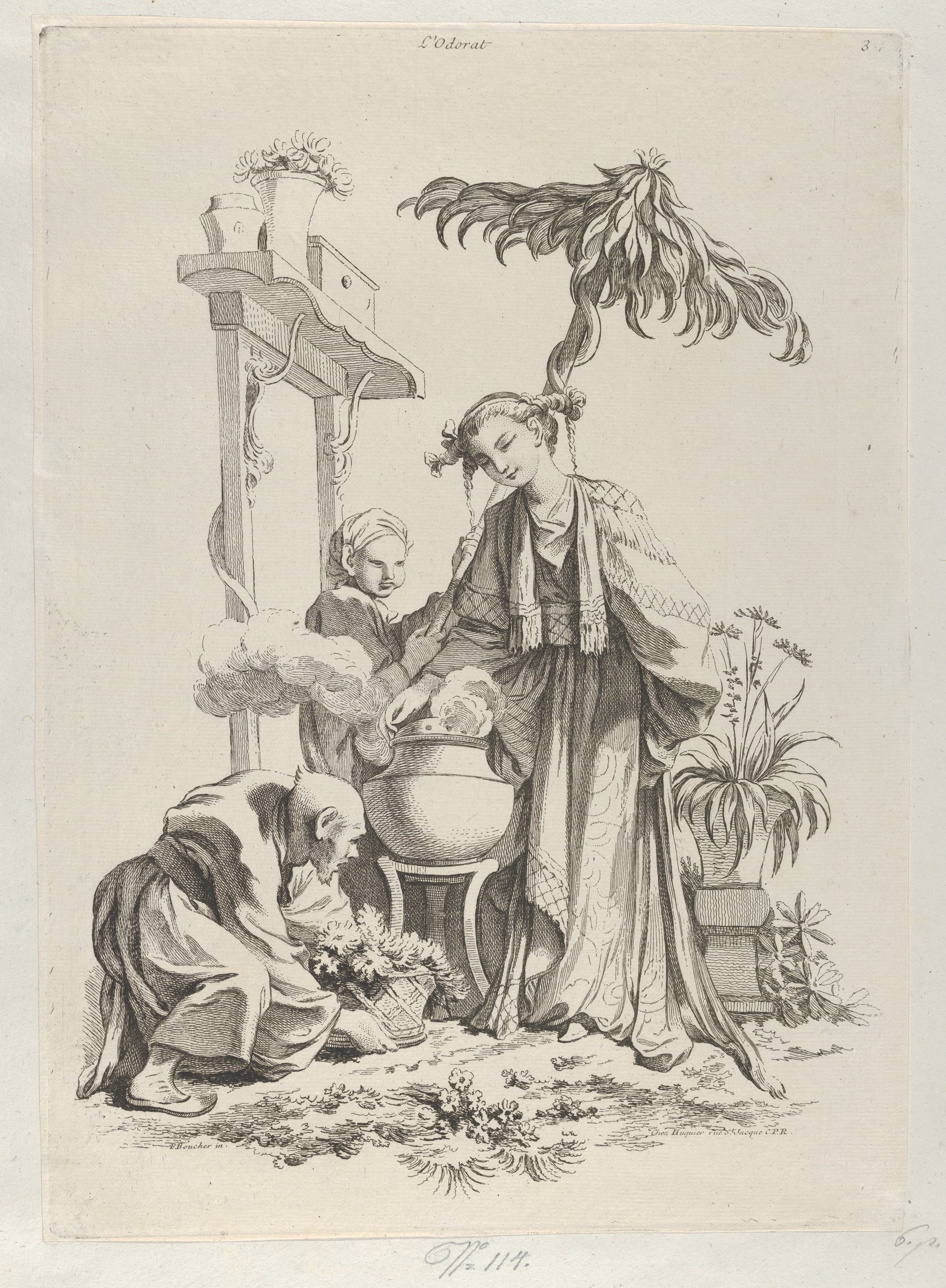
The Metropolitan Museum of Art, Harris Brisbane Dick Fund, 1953 (Open Access, public domain) · The Metropolitan Museum of Art
Một khu vườn không có thật
Trên đầu tờ giấy có dòng chữ L'Odorat, Khứu giác. Bên dưới là một cảnh vườn. Một thiếu nữ mặc áo dài nhiều lớp, khoác khăn có tua, tóc búi cao, đứng cạnh một cái bình lớn đặt trên chân đế. Từ miệng bình, một thứ khói hay hơi bốc lên thành những cụm tròn. Cô cúi đầu về phía đó.
Sau đầu cô, một nhành lá dài như lông vũ vươn lên rồi uốn cong ra khoảng trời phía trên. Bên trái, một người nhỏ hơn quấn khăn đứng sau cái bình, tay đưa về phía làn khói. Phía trước, một ông lão quỳ gối, đưa lên một giỏ hoa. Một cái kệ gỗ dựng trên cột đặt vài chậu hoa. Bên phải là một chậu cây lá dài trên bệ. Dưới đất, hoa mọc rải rác.
Mọi vật trong tranh đều hướng về mùi. Khói, hoa trong giỏ, hoa trong chậu, hoa dưới chân. Khứu giác không được tả bằng một cử chỉ đưa lên mũi. Nó được tả bằng một khung cảnh đầy những thứ có mùi.
Trung Hoa của Boucher
François Boucher sinh năm 1703 ở Paris và mất năm 1770 cũng ở Paris. Ông là một trong những hoạ sĩ tiêu biểu của Rococo Pháp, với những cảnh đồng quê, thần thoại và tình ái nhẹ nhàng.
Thế kỷ 18, châu Âu say mê hàng hoá từ Trung Hoa: sứ, lụa, sơn mài, giấy dán tường. Từ đó sinh ra chinoiserie, một lối trang trí vay hình ảnh phương Đông nhưng dựng theo trí tưởng tượng của người châu Âu. Boucher là một trong những người vẽ chinoiserie nổi tiếng nhất. Ông chưa từng đến Trung Hoa.
Vì vậy trang phục trong L'Odorat vừa quen vừa lạ. Tua khăn, búi tóc, những nếp áo buông dài mang vẻ phương Đông. Nhưng dáng đứng, gương mặt và cách dựng cảnh là của một bức tranh Rococo Paris. Đây là một Trung Hoa được ghép từ đồ vật nhập khẩu và lời kể, không phải từ quan sát tại chỗ.
Tờ tranh thuộc bộ Les Cinq Sens, Năm giác quan. Chủ đề ấy đã quen thuộc ở Paris từ lâu. Khoảng một thế kỷ trước, Abraham Bosse cũng khắc một bộ Les Cinq Sens. Điều Boucher thêm vào là khoảng cách: giác quan được đặt ở một nơi rất xa, chỉ có trong tưởng tượng.
Một tờ tranh để chép lại
The Met xếp tờ tranh vào nhóm tranh in trang trí. Nó được làm bằng khắc axit và khắc chạm, bản khắc cao khoảng 36 cm. Góc dưới có dòng chữ ghi nơi bán: nhà Huquier trên phố Saint Jacques ở Paris. Gabriel Huquier là thợ khắc và người buôn tranh in, đã xuất bản nhiều thiết kế của Boucher.
Tranh in trang trí thời đó không chỉ để ngắm. Thợ vẽ sứ, thợ dệt, thợ làm quạt, thợ trang trí nội thất dùng chúng làm mẫu. Một hình chinoiserie trên giấy có thể đi tiếp sang một cái đĩa, một tấm thảm, một cánh tủ.
The Met ghi niên đại rộng, từ 1720 đến 1770, gần trọn đời làm nghề của Boucher. Bảo tàng nhận tờ tranh này năm 1953.
Điều đó thêm cho L'Odorat một lớp nghĩa. Khói trong tranh là mùi được tưởng tượng. Còn bản thân tờ tranh là một hình sinh ra để lan đi, được chép lại, được đặt lên những đồ vật khác. Giống một mùi, nó không ở yên một chỗ.
Vẽ mùi bằng khói
Trong nhiều hình ngụ ngôn khứu giác ở châu Âu, hoa là vật mặc định. Boucher cũng dùng hoa, rất nhiều hoa. Nhưng tâm điểm của tranh là cái bình đang bốc lên.
Đốt một thứ gì đó cho có mùi là cách rất cũ, có mặt ở nhiều nền văn hoá. Ở đây nó được gắn với một phương Đông tưởng tượng, như thể mùi ở nơi xa phải đậm hơn, dày hơn, đến mức nhìn thấy được.
Những cụm khói là phần mềm nhất của bản khắc. Chúng không có góc cạnh, không có bóng đổ rõ. Giữa những nét khắc sắc của vạt áo, của kệ gỗ, của lá cây, khói là thứ duy nhất trông như đang chuyển động. Boucher vẽ một thứ vô hình bằng cách cho nó một hình dạng tạm thời.
A garden that never existed
At the top of the sheet are the words L'Odorat, Smell. Below is a garden scene. A young woman in a long layered robe, a fringed shawl and a high chignon stands beside a large vessel on a stand. From its mouth, smoke or vapour rises in round billows. She bends her head towards it.
Behind her head a long, featherlike frond rises and curves out across the sky. On the left, a smaller figure in a headscarf stands behind the vessel, a hand reaching towards the smoke. In front, an old man kneels and offers up a basket of flowers. A wooden shelf on posts holds a few flowerpots. On the right, a plant with long leaves stands on a pedestal. Flowers grow scattered on the ground.
Everything in the print points to smell. Smoke, flowers in the basket, flowers in pots, flowers underfoot. Smell is not shown by a gesture of lifting something to the nose. It is shown by a scene full of things that smell.
Boucher's China
François Boucher was born in Paris in 1703 and died there in 1770. He was one of the defining painters of French Rococo, with his pastorals, mythologies and light scenes of love.
In the eighteenth century Europe was infatuated with goods from China: porcelain, silk, lacquer, wallpaper. From this came chinoiserie, a decorative style that borrowed Eastern imagery and rebuilt it through European imagination. Boucher was one of its best known designers. He never went to China.
So the costumes in L'Odorat are both familiar and strange. The fringes, the chignon, the long falling folds read as Eastern. But the pose, the face and the staging belong to a Parisian Rococo picture. This is a China assembled from imported objects and hearsay, not from looking.
The print belongs to a set, Les Cinq Sens, The Five Senses. The theme was long familiar in Paris. About a century earlier, Abraham Bosse had engraved his own Les Cinq Sens. What Boucher adds is distance: the sense is placed somewhere very far away, somewhere that exists only in the imagination.
A print made to be copied
The Met classes the sheet as an ornament print. It is etched and engraved, the plate about 36 cm tall. At the bottom is the address where it was sold: Huquier, rue Saint Jacques, Paris. Gabriel Huquier was an engraver and print dealer who published many of Boucher's designs.
Ornament prints of the period were not only for looking at. Porcelain painters, weavers, fan makers and decorators used them as models. A chinoiserie figure on paper could travel on to a plate, a tapestry, a cabinet door.
The Met gives a wide date range, 1720 to 1770, nearly the whole of Boucher's working life. The museum acquired this impression in 1953.
That gives L'Odorat another layer. The smoke in the picture is an imagined smell. The print itself is an image made to spread, to be copied, to settle on other objects. Like a scent, it does not stay in one place.
Drawing smell as smoke
In many European allegories of smell, flowers are the default. Boucher uses flowers too, plenty of them. But the centre of the print is the vessel giving off its cloud.
Burning something for its scent is an old practice, found in many cultures. Here it is tied to an imagined East, as if smell in a faraway place had to be stronger, thicker, dense enough to see.
The billows are the softest part of the plate. They have no corners and no clear shadows. Among the crisp lines of robes, shelf and leaves, the smoke is the only thing that seems to move. Boucher draws something invisible by giving it a temporary shape.
Olfactory Art