
Essays · Olfactory Art
Honoré Daumier. L'Odorat.
Một chậu hoa là cả khu vườn của người ở phố.
A flowerpot is the whole garden of a city dweller.
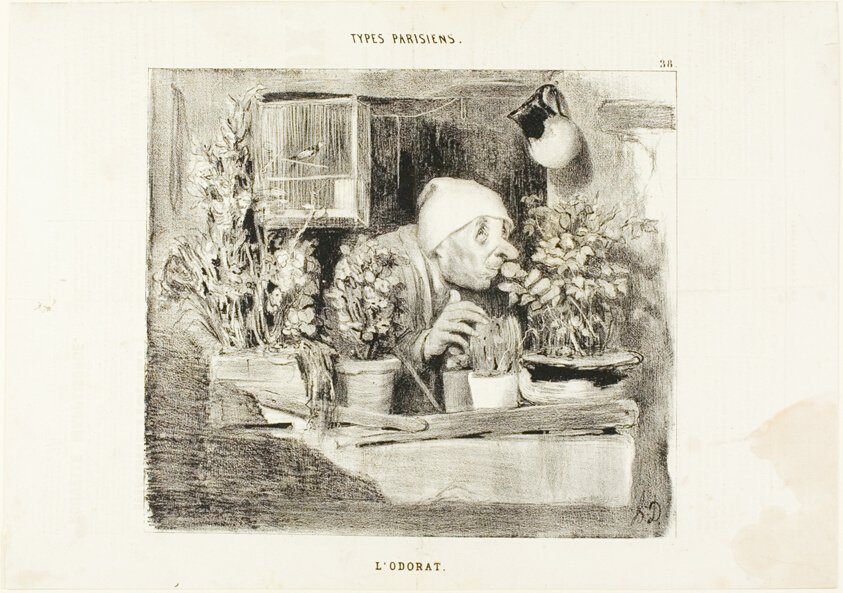
The Art Institute of Chicago, Mr. and Mrs. Carter H. Harrison Collection · The Art Institute of Chicago
Một người, một bệ cửa, năm chậu cây
Tờ in mang tên L'Odorat, Khứu giác. Nó là tờ số 38 trong Types Parisiens, loạt tranh in đá của Honoré Daumier về những kiểu người Paris.
Cảnh vẽ rất gọn. Một người đàn ông đội mũ đứng bên cửa sổ, cúi ngửi một bông hoa trong chậu. Trên bệ cửa có năm chậu cây. Bên trái, một chiếc lồng chim treo lơ lửng. Bên phải, một cái bình treo trên móc. Không có ai khác. Không có đường phố, không có đám đông.
Theo hồ sơ của Art Institute of Chicago, đây là tranh in đá mực đen trên giấy trắng, mặt sau có chữ in. Phần hình khoảng 20 x 23 cm. Chữ in mặt sau cho biết tờ tranh này từng là một trang báo: người Paris thế kỷ 19 cầm nó trên tay cùng với tin tức, quảng cáo, mục thời sự.
Niên đại của tờ này được ghi khác nhau. Art Institute of Chicago ghi năm 1839. Metropolitan Museum of Art ghi rằng L'Odorat đăng trên báo Le Charivari ngày 18 tháng 1 năm 1843. Cả hai đều nằm trong khoảng thời gian loạt Types Parisiens được in, từ 1839 đến 1843.
Daumier và những kiểu người Paris
Honoré Daumier sinh năm 1808 ở Marseille và mất năm 1879. Ông làm nghề in đá gần như suốt đời, và phần lớn tranh của ông được đăng trên báo. Le Charivari là tờ nhật báo trào phúng ở Paris, mỗi số có một tranh in đá chiếm trọn một trang.
Đầu những năm 1830, Daumier vẽ biếm hoạ chính trị và từng phải ngồi tù vì một bức vẽ chế giễu vua Louis Philippe. Sau khi luật kiểm duyệt năm 1835 siết chặt tranh chính trị, báo chí trào phúng chuyển hướng sang đời sống thường ngày. Daumier chuyển theo. Ông vẽ luật sư, bác sĩ, người đi tắm biển, người thuê nhà, người đọc báo.
Types Parisiens là một trong những loạt như vậy, khoảng năm mươi tờ. Mỗi tờ là một kiểu người hay một thói quen của thị dân. Trong loạt có cả những tờ lấy năm giác quan làm đề, như L'Odorat và Le Goût.
Năm giác quan là một đề tài cũ của tranh in châu Âu. Từ thế kỷ 16, các thợ khắc Flandre đã làm những bộ tranh nhân cách hoá khứu giác bằng những hình người trang trọng, hoa lá và lọ nước thơm. Daumier giữ lại cái đề ấy nhưng bỏ hết sự trang trọng. Khứu giác của ông là một người đàn ông bình thường bên một chậu hoa.
Khứu giác của người ở phố
Điều Daumier ghi lại không phải mùi của một bông hoa, mà là sự khan hiếm của nó. Paris những năm 1830 và 1840 là một thành phố chật, ẩm, nhiều mùi khó chịu. Một bệ cửa với năm chậu cây là thứ gần nhất với khu vườn mà nhiều người có được.
Vì vậy cái cúi người trong tranh vừa buồn cười vừa cảm động. Buồn cười vì người đàn ông quá chăm chú vào một thứ quá nhỏ. Cảm động vì chính sự chăm chú ấy. Daumier biếm hoạ, nhưng không khinh miệt. Ông nhìn thị dân với một chút trìu mến.
Các đồ vật quanh người đàn ông cũng kể chuyện. Chiếc lồng chim là một mẩu thiên nhiên khác bị nhốt vào nhà. Cái bình treo trên móc là đồ dùng hằng ngày. Căn phòng không giàu, nhưng có người chăm. Mỗi thứ ở đó đều có mùi, dù tranh chỉ vẽ bằng mực đen.
Tờ in này đáng nhớ vì nó kéo khứu giác ra khỏi tranh ngụ ngôn và đặt nó vào đời sống. Không còn nữ thần, không còn biểu tượng. Chỉ còn một người đàn ông, một bệ cửa, một chậu hoa, và cái ý rằng ngửi cũng là một cách sống ở thành phố. Người đọc báo năm ấy lật trang, thấy mình trong đó, và có lẽ mỉm cười.
One man, one sill, five pots
The print is called L'Odorat, Smell. It is plate 38 of Types Parisiens, Honoré Daumier's lithograph series on the types of people found in Paris.
The scene is spare. A man in a cap stands at a window, bending to smell a flower in a pot. Five pots sit on the sill. On the left a birdcage hangs in the air. On the right a jug hangs from a hook. No one else is there. No street, no crowd.
According to the Art Institute of Chicago, it is a lithograph in black on white wove paper with letterpress on the back. The image is about 20 by 23 cm. The printed text on the reverse tells us this sheet was once a newspaper page: nineteenth century Parisians held it together with news, advertisements and gossip.
The date varies by source. The Art Institute gives 1839. The Metropolitan Museum of Art records L'Odorat as published in Le Charivari on 18 January 1843. Both fall within the years Types Parisiens appeared, 1839 to 1843.
Daumier and the types of Paris
Honoré Daumier was born in Marseille in 1808 and died in 1879. He worked in lithography almost all his life, and most of his images were published in newspapers. Le Charivari was a satirical daily in Paris, each issue carrying a full page lithograph.
In the early 1830s Daumier drew political caricature and was jailed for a drawing that mocked King Louis Philippe. After the censorship laws of 1835 tightened control over political images, the satirical press turned to everyday life, and Daumier turned with it. He drew lawyers, doctors, bathers, tenants, newspaper readers.
Types Parisiens is one of those series, around fifty sheets. Each shows a type of person or a city habit. Some take the five senses as their subject, among them L'Odorat and Le Goût.
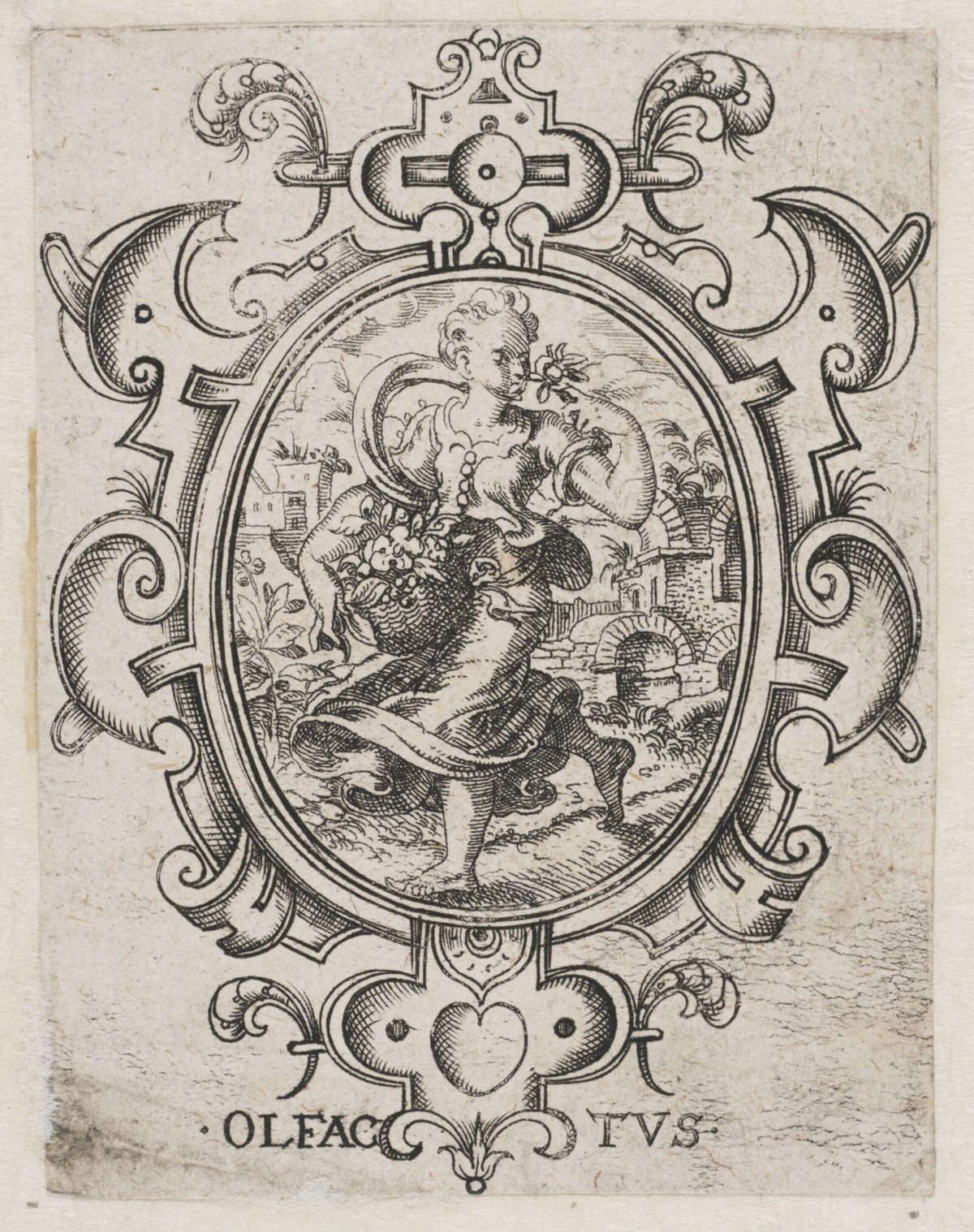
The five senses were an old theme of European prints. From the sixteenth century, Flemish engravers made sets personifying smell with stately figures, flowers and scent flasks. Daumier kept the theme and dropped the ceremony. His sense of smell is an ordinary man beside a flowerpot.
Smell for a city dweller
What Daumier records is not the smell of a flower but its scarcity. Paris in the 1830s and 1840s was crowded, damp, full of unpleasant smells. A windowsill with five pots was the nearest thing to a garden many people had.
So the bent figure is both funny and touching. Funny because the man is so absorbed in something so small. Touching because of that absorption. Daumier caricatures, but without contempt. He looks at the city dweller with some affection.
The objects around the man tell their own story. The birdcage is another piece of nature shut indoors. The jug on its hook is a daily tool. The room is not rich, but someone looks after it. Everything in it has a smell, though the print is only black ink.
The print is worth remembering because it takes smell out of allegory and puts it into life. No goddess, no emblem. Only a man, a windowsill, a flowerpot, and the idea that smelling is also a way of living in a city. A reader turning the page that year saw himself in it, and perhaps smiled.
Olfactory Art