
Essays · Olfactory Art
Hedione. Hoa nhài trong suốt.
Mùi của khoảng trống giữa các vật.
The smell of the space between things.
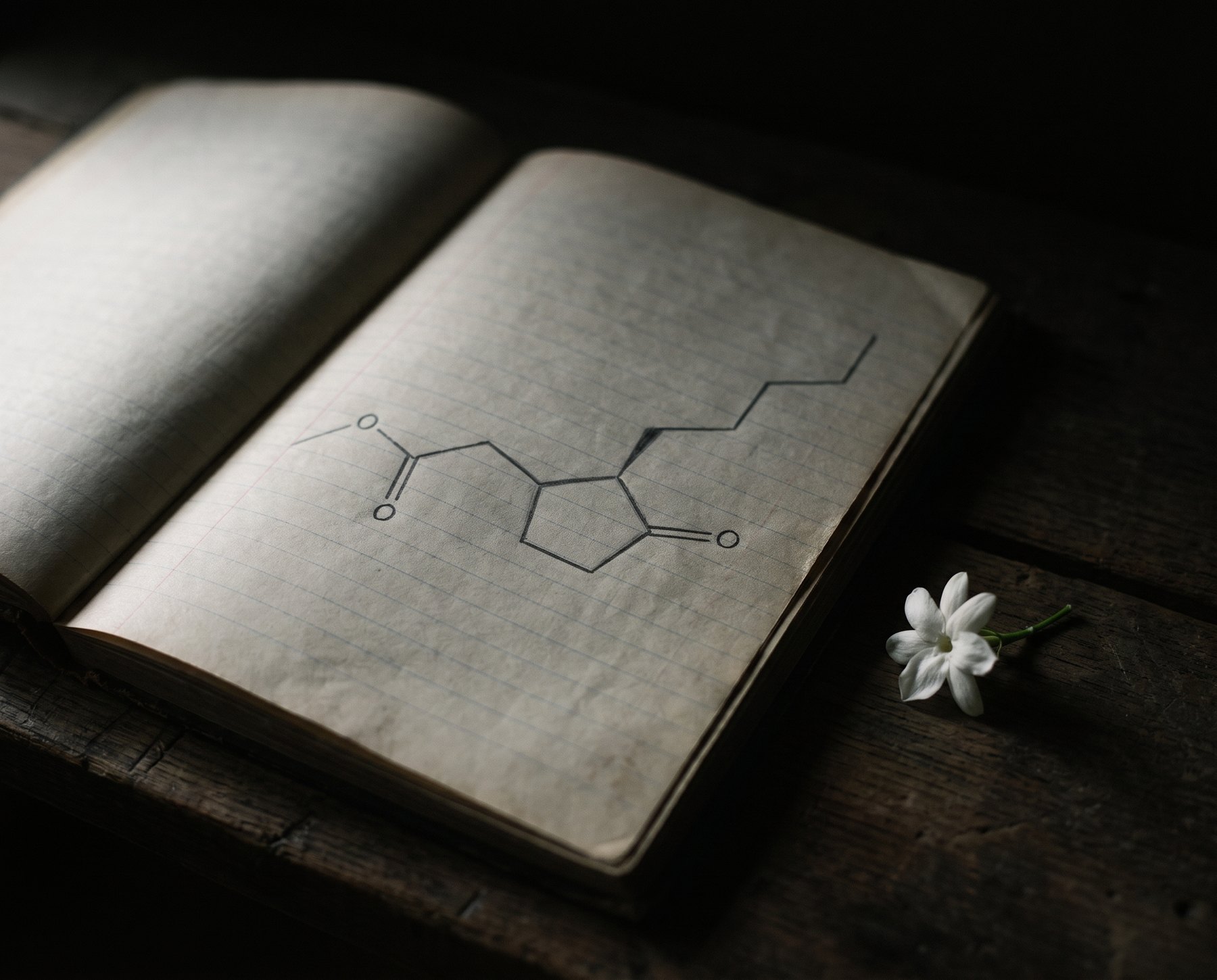
Hoa nhài và một phân tử
Mùi của hoa nhài được tạo nên từ nhiều hợp chất. Có những chất ngọt, sáp. Có indole, thứ cho nhài cái ấm hơi nồng, gần như động vật. Có benzyl acetate, cho nhài một chút trái cây. Và có một nhóm hợp chất nhỏ hơn về số lượng nhưng rất quan trọng: jasmonate.
Methyl jasmonate có mặt trong tinh dầu nhài với tỉ lệ nhỏ. Nó cũng có mặt ở nhiều loài cây khác, nơi nó làm việc như một tín hiệu: cây dùng họ jasmonate để phản ứng khi bị thương, khi bị côn trùng cắn. Nói cách khác, phân tử này vốn là một thông điệp giữa các phần của cây, trước khi là một mùi cho người.
Đầu thập niên 1960, nhóm của Edouard Demole ở Firmenich, Genève, làm việc với tinh dầu nhài. Năm 1962, họ công bố việc tách và xác định methyl jasmonate trong nhài, trên tạp chí Helvetica Chimica Acta.
Song song, Demole mô tả và tổng hợp một chất họ hàng: methyl dihydrojasmonate. Firmenich đặt tên thương mại cho nó là Hedione.
Một phiên bản nhẹ của nhài
Ngửi riêng, Hedione rất nhẹ. Có người lần đầu ngửi không thấy gì đặc biệt: một chút nhài, một chút vỏ chanh, một chút gì như trà xanh. Không có cái đậm, cái ngọt, cái nồng của một bông nhài thật.
Nhưng khi đặt vào một mùi khác, Hedione làm một việc lạ. Nó không nổi lên. Nó làm cho những thứ khác có không khí hơn. Các loài hoa dường như nở rộng ra, cam chanh sáng hơn, gỗ bớt khô. Người làm nước hoa hay dùng những từ như sáng, trong, toả, rộng khi nói về nó.
Hedione tổng hợp gồm nhiều đồng phân. Về sau người ta nhận ra rằng dạng cis mang phần lớn mùi, và loại Hedione HC, giàu dạng cis, mạnh hơn rõ rệt. Cùng một phân tử, sắp xếp khác một chút trong không gian, cho ra một mùi khác hẳn về cường độ.
Ngày nay Hedione là một trong những nguyên liệu được dùng nhiều nhất trong nước hoa. Có công thức dùng nó với tỉ lệ rất lớn, như một không khí nền cho mọi thứ khác đứng vào.
Eau Sauvage, 1966
Năm 1966, Edmond Roudnitska làm Eau Sauvage cho Christian Dior. Trên nền chanh, bergamot, húng quế và hương thảo, ông đặt Hedione ở một liều đáng kể. Eau Sauvage thường được xem là mùi thương mại đầu tiên dùng Hedione một cách rõ ràng.
Kết quả là một mùi cam chanh không tan nhanh như cam chanh thường tan. Nó giữ được độ trong lâu hơn, như thể có một lớp không khí mát nằm dưới những thứ dễ bay.
Roudnitska là người viết nhiều về nghề của mình, và ông coi trọng sự giản lược: ít nguyên liệu, mỗi thứ có lý do. Hedione hợp với cách nghĩ ấy. Nó không thêm một nhân vật mới vào câu chuyện. Nó thêm khoảng lặng giữa các câu.
Từ Eau Sauvage, Hedione đi vào hàng nghìn mùi khác, nam cũng như nữ, cam chanh cũng như hoa. Nó trở thành một thứ gần như vô hình trong nước hoa hiện đại: ở khắp nơi, ít khi được gọi tên.
Mùi của khoảng trống
Hầu hết các phân tử trong nước hoa được chọn vì chúng giống một vật. Hedione được chọn vì nó làm cho vật có chỗ để thở.
Điều này gợi đến một cách hiểu khác về mùi. Ta thường nghĩ mùi là thuộc tính của vật: hoa có mùi, gỗ có mùi. Nhưng mùi thật ra sống trong không khí, giữa vật và người ngửi. Cái ta ngửi được là khoảng cách ấy, chứ không phải chính bông hoa.
Hedione giống như việc chuyển sự chú ý từ bông hoa sang khoảng không quanh nó. Khi ta vào một khu vườn buổi tối, trước khi nhìn thấy bụi nhài, ta đã biết nó ở đó. Không khí báo trước. Hedione là mùi của lời báo trước ấy.
Có lẽ vì thế mà nó hữu ích đến vậy. Một căn phòng đầy vật sẽ chật. Một căn phòng có khoảng trống mới cho vật được nhìn thấy. Mùi cũng vậy.
Jasmine and a molecule
The smell of jasmine is built from many compounds. Some are sweet and waxy. There is indole, which gives jasmine its warm, heady, almost animal side. There is benzyl acetate, which adds a touch of fruit. And there is a smaller but important group: the jasmonates.
Methyl jasmonate is present in jasmine oil in small amounts. It also occurs in many other plants, where it works as a signal: plants use jasmonates to respond to wounding or insect bites. In other words, the molecule was a message between parts of a plant before it was a smell for people.
In the early 1960s Edouard Demole's team at Firmenich in Geneva was working on jasmine oil. In 1962 they reported isolating and identifying methyl jasmonate in jasmine, in Helvetica Chimica Acta.
Alongside this, Demole described and synthesised a relative: methyl dihydrojasmonate. Firmenich gave it the trade name Hedione.
A light version of jasmine
Smelled alone, Hedione is very soft. Some people notice little at first: a hint of jasmine, a hint of lemon peel, something like green tea. None of the depth, sweetness or heaviness of a real jasmine flower.
But inside another smell, Hedione does something strange. It does not stand out. It gives everything else more air. Flowers seem to open wider, citrus brightens, woods feel less dry. Perfumers reach for words like bright, clear, radiant, wide.
Synthetic Hedione is a mix of isomers. It was later found that the cis form carries most of the smell, and Hedione HC, rich in cis, is markedly stronger. The same molecule, arranged slightly differently in space, gives a very different strength.
Today Hedione is among the most used materials in perfume. Some formulas use it in very large proportions, as a base of air for everything else to stand in.
Eau Sauvage, 1966
In 1966 Edmond Roudnitska made Eau Sauvage for Christian Dior. Over lemon, bergamot, basil and rosemary he placed Hedione at a significant level. Eau Sauvage is usually cited as the first commercial perfume to use Hedione in a clear way.
The result was a citrus that did not vanish as citrus usually does. It stayed clear for longer, as if a layer of cool air lay beneath the more volatile parts.
Roudnitska wrote a good deal about his craft, and he valued reduction: few materials, each with a reason. Hedione suited that way of thinking. It added no new character to the story. It added pauses between the sentences.
From Eau Sauvage, Hedione went into thousands of other perfumes, for men and women, citrus and floral. It became almost invisible in modern perfume: everywhere, rarely named.
The smell of empty space
Most molecules in perfume are chosen because they resemble an object. Hedione is chosen because it gives objects room to breathe.
This suggests another way of understanding smell. We tend to think of smell as a property of things: flowers smell, wood smells. But smell actually lives in the air, between the object and the person. What we smell is that distance, not the flower itself.
Hedione is like moving attention from the flower to the space around it. Walking into a garden in the evening, we know the jasmine is there before we see it. The air tells us first. Hedione is the smell of that announcement.
Perhaps that is why it is so useful. A room full of things feels crowded. A room with space lets things be seen. Smell works the same way.

Olfactory Art