
Essays · Olfactory Art
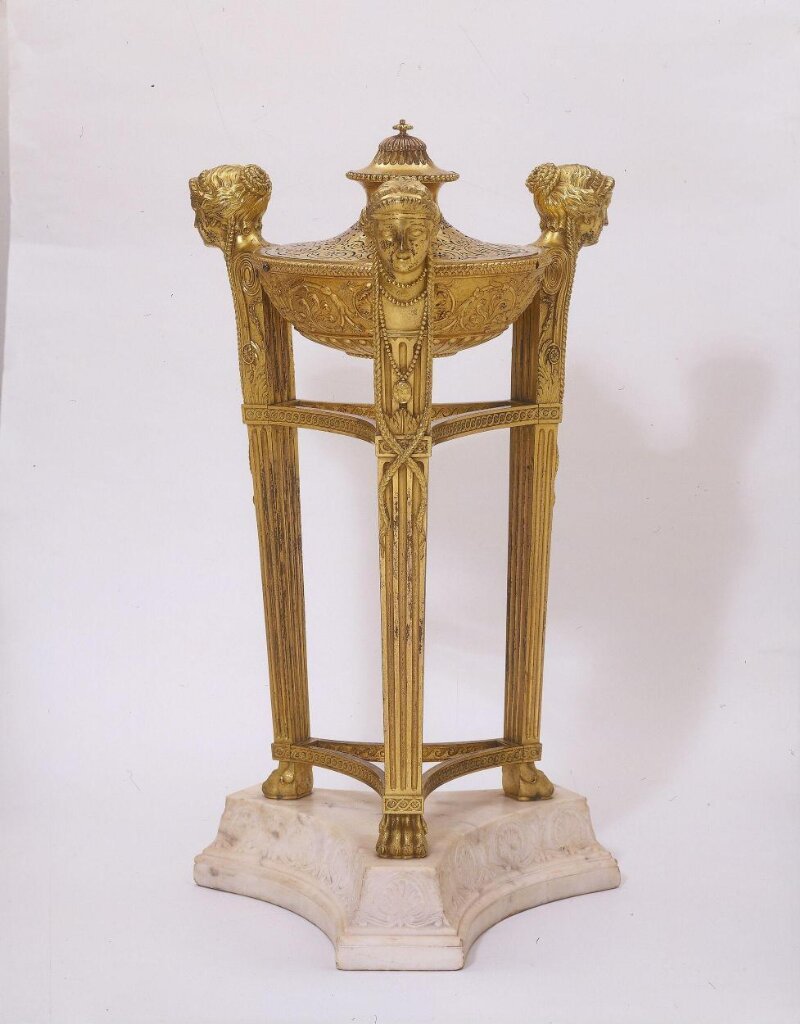
James 'Athenian' Stuart, Diederich Nicolaus Anderson. Perfume Burner.
Kiến trúc sư thiết kế cả mùi của căn phòng.
The architect designed the room's smell too.
© Victoria and Albert Museum, London · Victoria and Albert Museum (V&A)
Một kiềng ba chân bằng đồng vàng
Chiếc lư cao gần 54 cm, rộng khoảng 27 cm, sâu tối đa 28,8 cm. Nó làm bằng đồng đúc, chạm rồi mạ vàng, loại vật liệu tiếng Anh gọi là ormolu, đặt trên một đế đá hoa. Chiếc lư gồm hai phần: thân và nắp. Nó được làm ở London khoảng năm 1760, nay ở Victoria and Albert Museum, trong các phòng trưng bày về thiết kế Anh.
Hình dáng dựa trên những kiềng ba chân cổ đại của Hy Lạp, loại vật từng đứng trong đền thờ và các công trình tưởng niệm. Theo nhãn trưng bày của V&A, kiềng ba chân Hy Lạp và La Mã ban đầu gắn với bàn tế lễ, rồi được các nhà thiết kế tân cổ điển dùng lại theo nhiều cách.
Ở mép bát có ba khe nhỏ. Chúng dùng để gắn ba cành đèn có đế cắm nến. Một chiếc lư rất giống chiếc này ở Kedleston Hall, Derbyshire, vẫn còn gắn đủ các cành đèn. Chiếc ở V&A thì không.
V&A gọi đây là một ví dụ sớm. Nhãn ghi rằng Stuart thiết kế nó cho Spencer House ở London.
Kiến trúc sư và người thợ đồng
Người thiết kế là James Stuart, sinh ở London năm 1713, mất cũng ở London năm 1788. Ông được gọi là Athenian Stuart, tức Stuart người Athens, vì đã cùng Nicholas Revett đo vẽ các công trình cổ ở Athens. Tập đầu của cuốn The Antiquities of Athens của hai người ra năm 1762.
Những bản vẽ ấy mang kiến trúc Hy Lạp, không qua trung gian La Mã, vào nước Anh. Stuart dùng chúng cho nhà và vườn của giới quý tộc: đình vườn, khải hoàn môn, và cả đồ trong nhà như bàn, chân đèn, bình, kiềng ba chân. Chiếc lư xông hương này thuộc loại đồ ấy.
Người chế tác, theo V&A có lẽ là Diederich Nicolaus Anderson, một thợ làm đồ đồng mạ vàng ở London, mất năm 1767. Stuart vẽ, Anderson đúc. Kiến trúc sư đưa ra hình, người thợ biến hình thành kim loại.
Bảo tàng Sir John Soane ở London còn giữ các bản vẽ của Stuart cho những chiếc lư tương tự. Một bản vẽ có các cành đèn, bản kia không. Theo V&A, điều đó cho thấy các cành đèn là phần tuỳ chọn. Cùng một vật có thể chỉ toả mùi, hoặc vừa toả mùi vừa soi sáng.
Mùi được vẽ từ bản thiết kế
Điều khiến chiếc lư này đáng chú ý không chỉ là vẻ đẹp của nó. Mà là người đã vẽ ra nó. Một kiến trúc sư, người tính toán tỉ lệ của cả căn phòng, cũng dành thời gian thiết kế vật sẽ làm thơm căn phòng ấy.
Điều đó có nghĩa là mùi được nghĩ tới cùng lúc với trần, tường và đồ đạc. Nó không phải thứ được thêm vào sau. Hình dáng của chiếc lư nói cùng một ngôn ngữ với phần còn lại của căn phòng: Hy Lạp, cân đối, có nguồn gốc rõ ràng. Mùi toả ra từ nó, theo cách ấy, cũng là một phần của thiết kế.
Không hồ sơ nào cho biết chiếc lư từng đốt thứ gì. Bài này không đoán. Cái còn lại là hình dáng, và hình dáng ấy đủ để thấy mùi từng được coi trọng ra sao. Người ta không đặt một vật bằng đồng mạ vàng, dáng đền thờ, vào phòng khách nếu mùi chỉ là chuyện phụ.
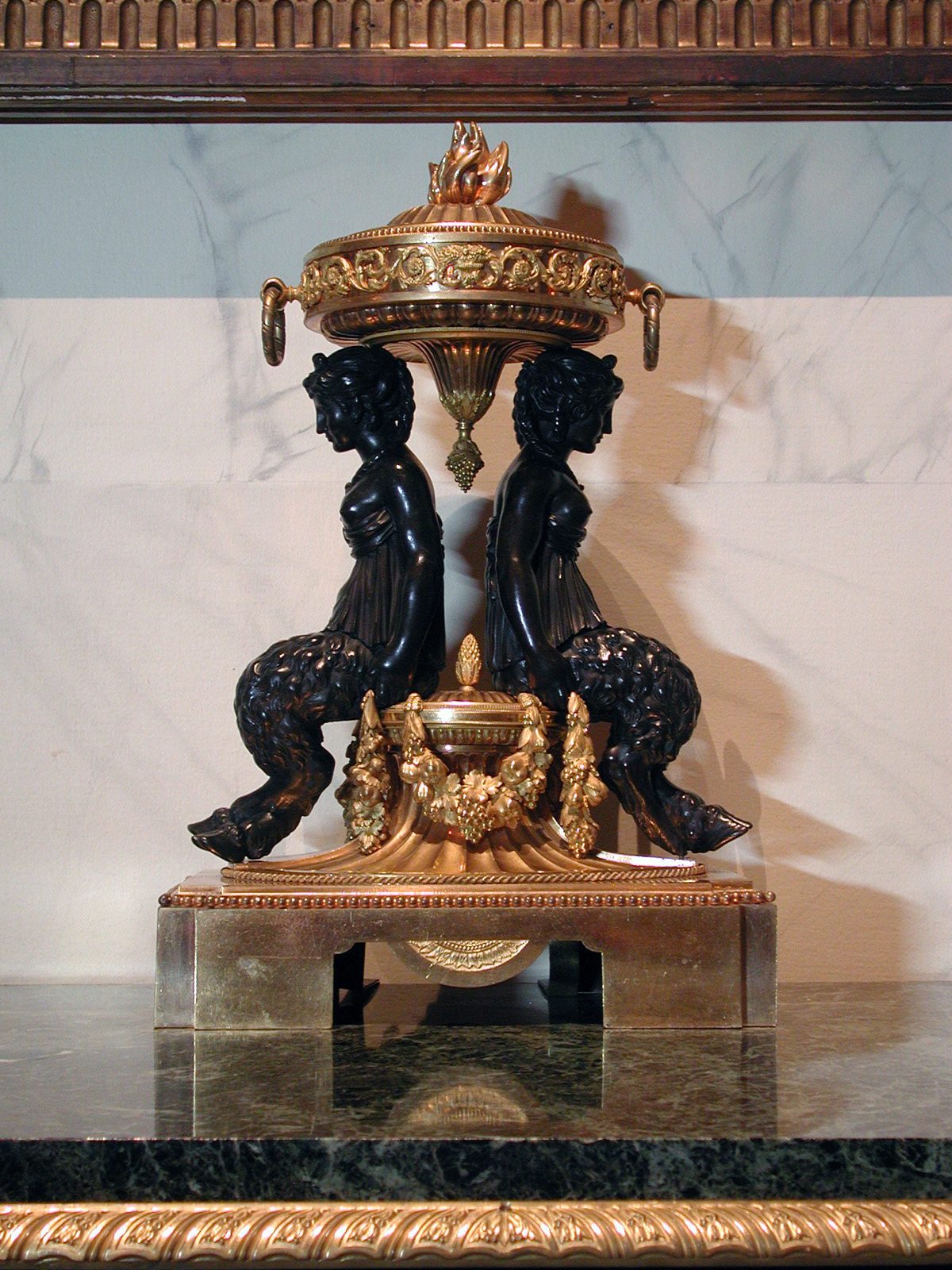
Hơn bốn mươi năm sau, Wedgwood đưa cùng dáng kiềng ba chân ấy vào đất nung, trong lò đốt viên hương Dolphin Tripod. Từ đồng vàng của Stuart đến đất đen của Wedgwood, hình dáng đi xuống dần từ dinh thự đến những căn nhà bình thường hơn. Chiếc lư của Stuart đáng nhớ vì nó ở điểm đầu của con đường ấy: lúc một kiến trúc sư quyết định rằng mùi của căn phòng cũng là việc của mình.
A tripod in gilt bronze
The burner is nearly 54 cm high, about 27 cm wide and at most 28.8 cm deep. It is cast, chased and gilded bronze, the material English calls ormolu, set on a marble plinth. It comes in two parts: burner and lid. It was made in London around 1760 and is now in the Victoria and Albert Museum, in its galleries of British design.
The form is based on the classical tripods of ancient Greece, objects that stood in temples and similar monuments. According to the V&A label, the Greek and Roman tripod was first devised for sacrificial altars and was then taken up in many ways by neoclassical designers.
At the edge of the bowl are three slots. They were meant to hold three branches with candle sconces. A very similar burner at Kedleston Hall in Derbyshire still has its branches fitted. The V&A example does not.
The V&A calls it an early example. The label states that Stuart designed it for Spencer House in London.
The architect and the metalworker
The designer was James Stuart, born in London in 1713 and died there in 1788. He was called Athenian Stuart because, with Nicholas Revett, he measured and drew the ancient buildings of Athens. The first volume of their Antiquities of Athens appeared in 1762.
Those drawings brought Greek architecture to England directly, not through Roman copies. Stuart used them for aristocratic houses and gardens: garden temples, triumphal arches, and furnishings such as tables, stands, vases and tripods. This perfume burner belongs to that group.
The maker, according to the V&A, was probably Diederich Nicolaus Anderson, a London ormolu maker who died in 1767. Stuart drew, Anderson cast. The architect gave the form; the craftsman turned it into metal.
Sir John Soane's Museum in London holds Stuart's drawings for similar burners. One shows candle branches, the other does not. According to the V&A, this suggests the branches were optional. The same object could scent a room, or scent and light it at once.
A smell drawn into the plan
What makes this burner remarkable is not only its beauty. It is who drew it. An architect, someone calculating the proportions of an entire room, also took time to design the object that would scent that room.
That means smell was considered alongside ceiling, walls and furniture. It was not added afterwards. The burner speaks the same language as the rest of the room: Greek, balanced, with a clear ancestry. The smell it released was, in that sense, part of the design.
No record says what the burner once held. This essay does not guess. What remains is the form, and the form is enough to show how seriously smell was taken. No one puts a gilt bronze temple tripod in a drawing room if smell is an afterthought.
More than forty years later, Wedgwood brought the same tripod form into fired clay with the Dolphin Tripod pastille burner. From Stuart's gilt bronze to Wedgwood's black clay, the form moved down from great houses to more ordinary homes. Stuart's burner is worth remembering because it stands at the start of that path: the moment an architect decided that a room's smell was his business too.
Olfactory Art