
Essays · Olfactory Art
Josiah Wedgwood and Sons. Pastille Burner, Dolphin Tripod.
Một mùi thơm được thắp lên để một mùi khác không ai nhắc tới.
One smell lit so that another goes unmentioned.
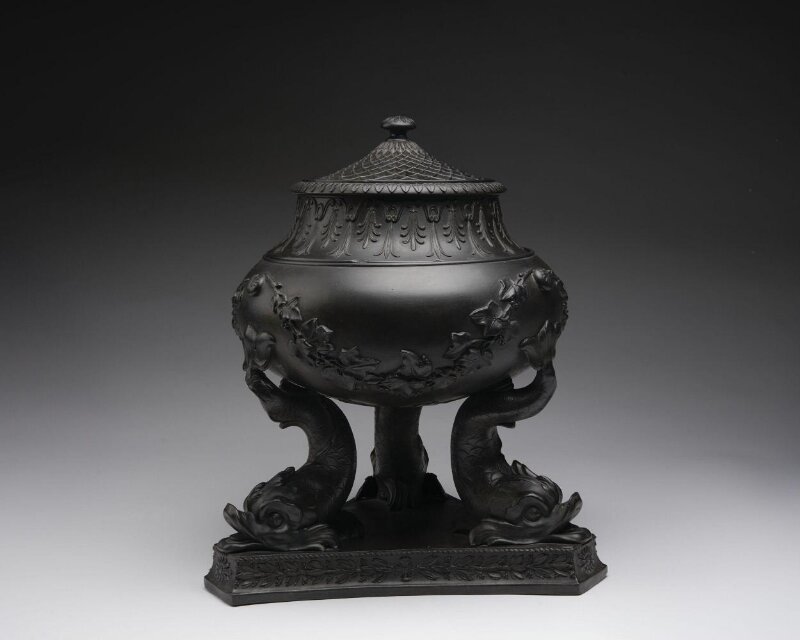
© Victoria and Albert Museum, London; V&A Wedgwood Collection. Presented by Art Fund with major support from the National Lottery Heritage Fund, private donations and a public appeal. · Victoria and Albert Museum (V&A)
Ba con cá heo và một bát đất đen
Chiếc lò cao 320 mm, rộng 280 mm, gồm hai phần: thân và nắp. Nó được làm ở xưởng Etruria của Josiah Wedgwood and Sons, khoảng năm 1807, nay thuộc V&A Wedgwood Collection. Dưới đáy có chữ WEDGWOOD in chìm. Hồ sơ lưu ghi một dòng ngắn: tìm thấy ngay tại xưởng.
Hình dáng dễ tả. Một chân đế hình tam giác, ba cạnh cong vào trong. Ở ba đỉnh tam giác là ba con cá heo, cùng đỡ lấy một chiếc bát tròn. Quanh thân bát là những dây nho rủ xuống, treo trên ba núm tròn có hoa. Mép chân đế viền lá nguyệt quế.
Nắp hình nón, đỉnh chạm thủng thành lỗ, trên cùng là một núm tròn có hoa. Viền nắp cũng là lá nguyệt quế. Cổ nắp có hoa chuông và hoa văn lá kim ngân kiểu Hy Lạp. Toàn bộ không tráng men.
Nhãn trưng bày gọi nó là lò đốt viên hương, hoặc lò đốt trầm, kiểu dáng số 496. Tên thường gọi là Dolphin Tripod: kiềng ba chân cá heo.
Viên hương và cống rãnh
Pastille burner là loại bình được ưa chuộng trong thế kỷ 18 và 19. Theo V&A, người ta dùng chúng để đốt thứ gọi là hương cassolette: than gỗ liễu nghiền mịn, trộn với dầu thơm và gôm arabic, nặn thành những viên hình nón. Viên hương đặt trong bát, cháy âm ỉ. Khói thơm thoát ra qua những lỗ trên nắp.
Lý do dùng được ghi thẳng thắn: để át mùi của những căn phòng ngột ngạt và của hệ thống cống thoát kém. Thời ấy, nhà cửa chưa có hệ thống thoát nước như bây giờ. Mùi của nhà là một vấn đề ai cũng biết, và ít ai muốn nói ra.
Chiếc lò giải quyết vấn đề ấy bằng một vật đẹp. Nó không giấu nguồn mùi. Nó thêm một mùi khác, mạnh hơn, dễ chịu hơn, và đặt mùi ấy vào một hình dáng khiến người ta muốn nhìn. Khách bước vào phòng thấy ba con cá heo trước. Họ ngửi thấy than và dầu thơm sau. Mùi còn lại, mùi cần che, không bao giờ được giới thiệu.
Có một điều đáng để ý ở đây. Vật này không mang tên của mùi nó toả ra. Nó mang tên của hình dáng. Người ta nhớ cá heo và kiềng ba chân, không nhớ viên hương cháy hôm ấy có mùi gì.
Từ đèn dầu thành lò hương
Dáng Dolphin Tripod không bắt đầu là một lò hương. Theo V&A, nó được sản xuất trước tiên như một chiếc đèn dầu, rồi khoảng năm 1804 mới được chuyển thành lò đốt viên hương. Cùng một dáng, cùng một ngọn lửa nhỏ trong bát, đổi từ việc soi sáng sang việc toả mùi.
Chất liệu là black basalt. Josiah Wedgwood I, người sống từ 1730 đến 1795, dùng một loại đất sét địa phương khi nung chuyển màu đen, gọi là Carr. Ông tinh luyện nó và đặt tên là black basalt, theo tên loại đá cứng mà nó mô phỏng. Giống đá, chất liệu này có thể cắt và đánh bóng đến sáng loáng.
Như vậy chiếc lò làm năm 1807 ra đời sau khi người tạo ra chất liệu của nó đã mất hơn mười năm. Xưởng tiếp tục dùng ngôn ngữ ông để lại: đất đen giả đá, hoa văn cổ điển, hình nổi đắp lên thân.
Kiềng ba chân là một dáng rất cổ. Người Hy Lạp và La Mã dùng nó ở đền thờ, gắn với bàn tế lễ. Những nhà thiết kế thế kỷ 18 đưa dáng ấy vào phòng khách, như lư xông hương mà kiến trúc sư James Stuart vẽ cho Spencer House. Wedgwood đưa nó xuống một bậc nữa, vào đất nung, vào một vật mà nhiều nhà có thể có.
Dolphin Tripod đáng nhớ vì nó cho thấy mùi hương trong nhà từng là một việc rất thực tế. Không phải để thư giãn, không phải để tạo không khí. Để sống được trong một căn phòng. Và người ta vẫn chọn làm việc thực tế ấy bằng ba con cá heo.
Three dolphins and a black bowl
The burner is 320 mm high and 280 mm wide, in two parts: bowl and cover. It was made at the Etruria works of Josiah Wedgwood and Sons around 1807 and now belongs to the V&A Wedgwood Collection. WEDGWOOD is impressed on the base. The record notes one short line of history: found on the works.
The form is easy to describe. A triangular foot with incurved sides. At each point of the triangle a dolphin, the three together supporting a round bowl. Around the bowl hang grapevine festoons from three bosses decorated with flower heads. The edge of the foot carries a laurel border.
The cover is conical, pierced at the top, with a round flower head finial. Its rim has a laurel border, its neck bellflowers and anthemion. The whole piece is unglazed.
The gallery label calls it a pastille or incense burner, shape 496. Its common name is the Dolphin Tripod.
Pastilles and drains
Pastille burners were popular vases in the eighteenth and nineteenth centuries. According to the V&A, they burned what were called cassolette perfumes: powdered willow charcoal mixed with scented oils and gum arabic, shaped into small cones. The pastille sat in the bowl and smouldered. Scented smoke escaped through the holes in the cover.
The reason is stated plainly: to counteract the smells of stuffy rooms and inadequate drains. Houses of the time had nothing like modern drainage. The smell of a home was a problem everyone knew and few wanted to mention.
The burner answered that problem with a beautiful object. It did not remove the source. It added another smell, stronger and more pleasant, and placed it inside a shape people wanted to look at. A guest entering the room saw three dolphins first. Then charcoal and oil. The remaining smell, the one being covered, was never introduced.
One thing is worth noticing. The object is not named after the smell it gave off. It is named after its shape. People remember dolphins and a tripod, not what the pastille smelled like that day.
From oil lamp to burner
The Dolphin Tripod did not begin as a burner. According to the V&A, it was first produced as an oil lamp and adapted as a pastille burner around 1804. The same shape, the same small fire in a bowl, moved from giving light to giving smell.
The material is black basalt. Josiah Wedgwood I, who lived from 1730 to 1795, used a local clay that fired black, known as Carr. He refined it and named the body black basalt, after the hard stone it imitated. Like stone, it could be cut and polished to a high shine.
So a burner made in 1807 came more than a decade after the man who created its material had died. The firm kept speaking the language he left: black clay imitating stone, classical ornament, reliefs applied to the body.
The tripod is an ancient form. Greeks and Romans used it in temples, tied to the sacrificial altar. Eighteenth century designers brought it into the drawing room, like the perfume burner the architect James Stuart designed for Spencer House. Wedgwood brought it one step further down, into fired clay, into an object many households could own.
The Dolphin Tripod is worth remembering because it shows that scent at home was once a practical matter. Not for relaxing, not for mood. For being able to live in a room. And people still chose to do that practical work with three dolphins.
Olfactory Art