
Essays · Olfactory Art
Jicky. Một mùi không kể về hoa.
Mùi thôi làm bản sao. Mùi bắt đầu là một vật.
A smell stops copying. It becomes an object.
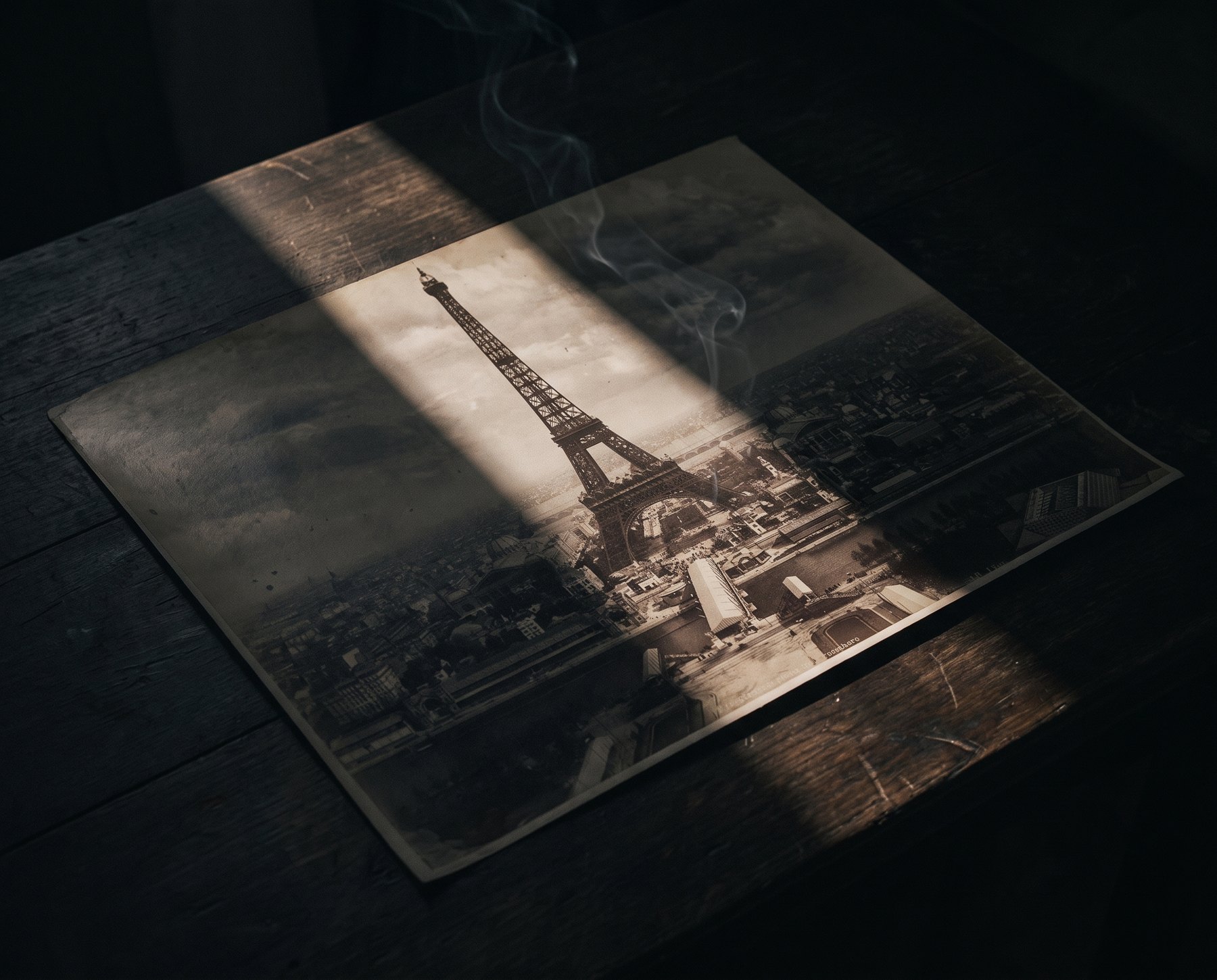
Paris, 1889
Năm 1889, Paris mở Hội chợ Thế giới. Tháp Eiffel được dựng cho dịp ấy, một khung sắt trần, không che, không trang trí theo lối cũ. Nhiều người thời đó thấy nó xấu. Nó cao hơn mọi thứ xung quanh và không giống bất cứ thứ gì đã có.
Cùng năm ấy, nhà Guerlain phát hành Jicky, do Aimé Guerlain làm. Hai vật không liên quan gì đến nhau, ngoài một điều: cả hai đều cho thấy thứ mới có thể được làm từ vật liệu mới. Sắt thay cho đá. Phân tử tổng hợp đứng cạnh tinh dầu.
Về cái tên Jicky, có nhiều cách kể khác nhau, và không cách nào được xác nhận chắc chắn. Điều rõ ràng hơn là cái tên không chỉ một bông hoa, một vùng đất hay một nguyên liệu. Nó là một cái tên riêng, ngắn, không mô tả gì.
Ngay từ cái tên, Jicky đã không kể về hoa.
Oải hương, coumarin, vanillin
Trục của Jicky là oải hương và cam bergamot ở phía trên, rồi coumarin và vanillin tổng hợp trên một nền nhựa thơm ấm. Oải hương và bergamot là những nguyên liệu quen. Coumarin và vanillin thì mới.
Coumarin có mặt tự nhiên trong đậu tonka và cỏ ngọt, cho mùi cỏ khô, hạnh nhân, thuốc lá ngọt. Năm 1868, nhà hoá học William Henry Perkin công bố cách tổng hợp nó. Vanillin, phân tử chính trong mùi vani, được tổng hợp vào thập niên 1870. Hai phân tử này cho phép người làm mùi dùng một lượng lớn, ổn định, không phụ thuộc mùa vụ.
Nhưng điều quan trọng không chỉ là chúng rẻ hơn hay dễ có hơn. Điều quan trọng là chúng không thuộc về một bông hoa nào. Khi đặt coumarin cạnh oải hương, người ta không tái tạo một cánh đồng. Họ làm ra một mùi mới, có hình dáng riêng.
Jicky nằm ở ranh giới giữa hai họ mùi, họ Fougère và họ Hổ phách. Các hệ phân loại xếp nó khác nhau. Việc nó khó xếp cũng cho thấy nó đứng ở một chỗ mới.
Không bắt chước hoa: mùi như một vật riêng
Trong phần lớn lịch sử, nước hoa là cách giữ lại mùi của một thứ đẹp đã có sẵn: hoa hồng, hoa cam, hoa violet. Một chai tốt là một chai giống. Người ngửi so với bông hoa thật trong trí nhớ.
Jicky bỏ phép so sánh ấy. Không có gì để so. Người ngửi không thể nói nó giống hay không giống, vì nó không nhắm tới cái gì ngoài chính nó.
Ở đây có một điều gần với hội hoạ. Khi bức tranh thôi làm cửa sổ nhìn ra thế giới, nó trở thành một mặt phẳng có màu, có nhịp, đáng nhìn vì chính nó. Một mùi thôi làm bản sao cũng vậy: nó trở thành một cấu trúc để ngửi, không phải một lời nhắc về vật khác.
Vì vậy, khi nói Jicky là một trong những mùi hiện đại đầu tiên, người ta không nói về tuổi của nó. Họ nói về cách nó đứng: độc lập, không vay hình của hoa.
Một mùi vẫn còn sau hơn một thế kỷ
Năm 2012, Museum of Arts and Design ở New York mở triển lãm The Art of Scent, với mười hai tác phẩm mùi hương từ năm 1889 đến năm 2012. Mốc năm 1889 của triển lãm chính là năm của Jicky. Bảo tàng chọn các tác phẩm để cho thấy những đổi mới trong cách làm mùi, trong đó có việc đưa phân tử tổng hợp vào từ cuối thế kỷ mười chín.
Hơn một thế kỷ là một khoảng rất dài với một thứ vô hình. Nhà cửa đổi, thành phố đổi, cách ăn mặc đổi. Nhưng mùi của Jicky vẫn được làm và vẫn có người ngửi.
Có lẽ vì nó không gắn với một bông hoa của mùa nào, nên nó cũng không già theo mùa nào. Nó gắn với một ý: một mùi có thể là một vật tự đứng.
Ý đó giờ quen đến mức ta không còn thấy nó. Nhưng nó có một ngày sinh, ở Paris, năm 1889.
Paris, 1889
In 1889 Paris opened a World's Fair. The Eiffel Tower was built for the occasion, a bare iron frame with none of the old ornament. Many people at the time found it ugly. It rose above everything around it and resembled nothing that had come before.
The same year the house of Guerlain released Jicky, made by Aimé Guerlain. The two objects have nothing to do with each other except one thing: both show that new things can be made from new materials. Iron in place of stone. Synthetic molecules beside essential oils.
There are several stories about the name Jicky, and none is firmly confirmed. What is clearer is that the name points to no flower, no region, no material. It is a short proper name that describes nothing.
From its name on, Jicky said nothing of flowers.
Lavender, coumarin, vanillin
Jicky is built on lavender and bergamot above, then coumarin and synthetic vanillin over a warm resinous base. Lavender and bergamot were familiar materials. Coumarin and vanillin were new.
Coumarin occurs naturally in tonka beans and sweet grasses and smells of hay, almond and sweet tobacco. In 1868 the chemist William Henry Perkin published a way to synthesise it. Vanillin, the main molecule in the smell of vanilla, was synthesised in the 1870s. Both let a perfumer work with large, steady amounts, free of harvests and seasons.
What matters is not only that they were cheaper or easier to get. It is that they belong to no flower. Setting coumarin beside lavender does not rebuild a field. It makes a new smell with a shape of its own.
Jicky sits on the border between two families, Fougère and Amber, and classifications place it differently. That it is hard to place is itself a sign that it stood somewhere new.
Not imitating flowers: the smell as its own object
For most of its history, perfume was a way to keep the smell of something beautiful that already existed: rose, orange blossom, violet. A good bottle was a faithful one. You compared it with the real flower in memory.
Jicky drops that comparison. There is nothing to compare it with. You cannot say it is like or unlike, because it aims at nothing outside itself.
There is something here close to painting. When a picture stops being a window onto the world, it becomes a flat surface with colour and rhythm, worth looking at for itself. A smell that stops copying does the same: it becomes a structure to be smelled, not a reminder of something else.
So when people call Jicky one of the first modern perfumes, they are not talking about its age. They are talking about how it stands: on its own, borrowing no shape from a flower.
A smell still here after more than a century
In 2012 the Museum of Arts and Design in New York opened The Art of Scent, twelve works of scent made between 1889 and 2012. The show's starting year, 1889, is the year of Jicky. The museum chose its works to show turning points in how scents are made, among them the arrival of synthetic molecules in the late nineteenth century.
More than a century is a long time for something invisible. Houses change, cities change, clothes change. Yet Jicky is still made and still smelled.
Perhaps because it is tied to no flower of any season, it does not age with any season. It is tied to an idea: that a smell can be an object that stands by itself.
The idea is now so familiar we no longer see it. But it has a birthday, in Paris, in 1889.
Olfactory Art