
Essays · Olfactory Art
Kate McLean. Smellmap: Amsterdam.
Một thành phố có mùi khác với tiếng tăm của nó.
A city smells different from its reputation.
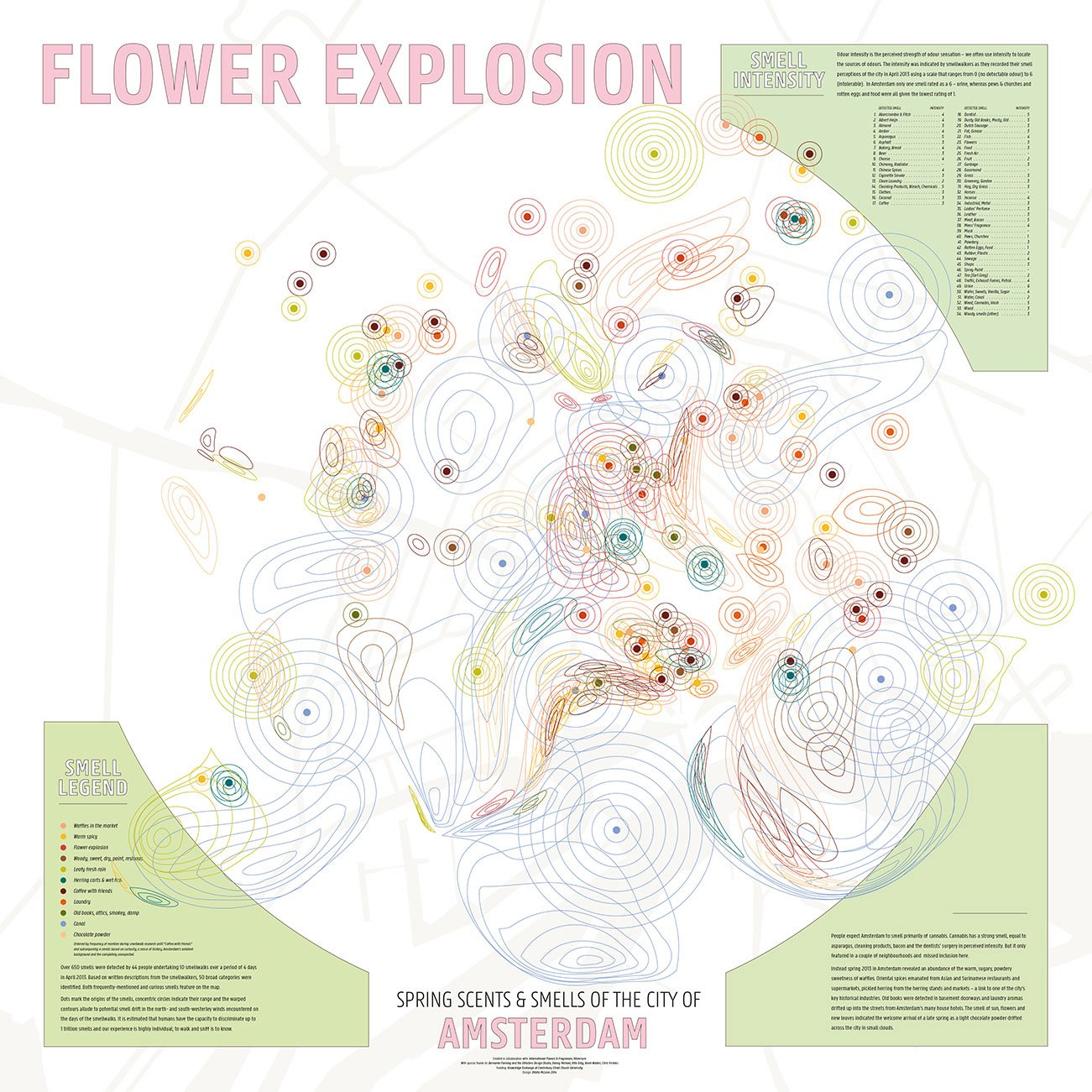
© Kate McLean · Sensory Maps (official site of Kate McLean)
Bốn ngày tháng tư
Tháng 4 năm 2013, mùa xuân đến muộn ở Amsterdam. Trong bốn ngày, 44 người đi bộ qua các khu phố của thành phố. Họ không chụp ảnh, không tìm đường. Họ ngửi.
Đó là mười cuộc smellwalk, tức đi bộ ngửi mùi, do Kate McLean tổ chức. McLean là nghệ sĩ và nhà thiết kế người Anh, nổi tiếng với những bản đồ mùi của các thành phố trên thế giới. Phương pháp của bà đơn giản: dẫn một nhóm người đi chậm, dừng lại, ghi lại mọi mùi họ nhận ra, bằng chữ của chính họ.
Sau bốn ngày, những người đi bộ ghi nhận hơn 650 mùi. Từ các mô tả viết tay ấy, McLean gom thành 50 nhóm lớn. Cả những mùi được nhắc nhiều lần lẫn những mùi lạ chỉ một người nhận ra đều được đưa vào bản đồ.
Bản đồ hoàn thành năm 2014, in kỹ thuật số khổ một mét nhân một mét. Nó được làm cùng Bernardo Fleming và studio thiết kế mùi của IFF, một tập đoàn lớn về hương liệu, tại Hilversum, Hà Lan. Năm 2021, Fleming có triển lãm cá nhân đầu tiên về những mùi anh gặp trong giấc mơ, Dreaming in Smell.
Amsterdam có mùi gì
Mùi nổi bật nhất là bánh waffle. Một thứ ngọt, ấm, có đường và bột, lan ra từ các quầy bánh. Tiếp đến là gia vị từ các nhà hàng và siêu thị châu Á và Suriname, dấu vết của những người đã đến sống ở thành phố này.
Có cá trích ngâm ở các quầy và chợ cá, nối thành phố hôm nay với một trong những ngành nghề lâu đời nhất của nó. Có mùi sách cũ ở các cửa tầng hầm. Có hơi quần áo giặt bay lên đường phố từ những khách sạn nhỏ trong nhà phố.
Và có mùa xuân. Mùi nắng, mùi hoa, mùi lá non báo hiệu mùa xuân muộn cuối cùng cũng đến. Thỉnh thoảng một đám bột sô cô la nhỏ bay qua.
Đọc danh sách ấy, người ta thấy một thành phố rất cụ thể. Không phải một thương hiệu du lịch, mà một nơi có người nấu ăn, giặt giũ, đọc sách và bán cá.
Mùi bị vắng mặt
Người ta chờ Amsterdam có mùi cần sa. Đó là mùi gắn với tiếng tăm của thành phố nhiều hơn bất cứ mùi nào khác.
McLean ghi nhận rằng cần sa có mùi mạnh, những người đi bộ cảm thấy nó mạnh ngang măng tây, chất tẩy rửa, thịt xông khói hay phòng khám nha sĩ. Nhưng nó chỉ xuất hiện ở vài khu phố. Không đủ để có mặt trên bản đồ.
Chi tiết ấy làm bản đồ thú vị. Nó cho thấy một khoảng cách giữa điều người ta tin về một nơi và điều người ta thật sự ngửi thấy ở đó. Tiếng tăm được xây bằng lời kể, bằng phim ảnh, bằng quảng cáo du lịch. Mùi thì chỉ có thể được ngửi tại chỗ.
Một bản đồ mùi vì thế không chỉ là bản đồ. Nó là một lời đính chính nhẹ nhàng.
Bản đồ đi đâu sau đó
Năm 2014, Smellmap: Amsterdam được trưng bày trong một triển lãm cá nhân tại Mediamatic, một trung tâm nghệ thuật ở Amsterdam, trong khuôn khổ hợp tác với IFF. Cùng năm, nó được chọn vào chương trình nghệ thuật của hội nghị IEEE VIS 2014 ở Paris, một hội nghị lớn về trực quan hoá dữ liệu.
Cũng năm 2014, bản đồ nhận giải Avenza cho bản đồ điện tử của Hội Bản đồ học Anh. Đó là một điều đáng để ý: một bản đồ về mùi được giới làm bản đồ công nhận như một bản đồ thật.
Năm 2018, nó có mặt trong triển lãm The Senses: Design Beyond Vision tại Cooper Hewitt, bảo tàng thiết kế Smithsonian ở New York, do Ellen Lupton và Andrea Lipps giám tuyển. Bản đồ hiện nằm trong bộ sưu tập thường trực của thư viện Đại học Manchester.
Four days in April
In April 2013, spring came late to Amsterdam. Over four days, 44 people walked through the city's neighbourhoods. They did not take photographs or look for directions. They smelled.
These were ten smellwalks led by Kate McLean, a British artist and designer known for smell maps of cities around the world. Her method is simple: lead a group slowly, stop, and record every smell they notice, in their own words.
After four days the walkers had noted more than 650 smells. From their written descriptions McLean identified 50 broad categories. Both the smells mentioned often and the curious ones noticed by a single person made it onto the map.
The map was finished in 2014, a digital print one metre square. It was made in collaboration with Bernardo Fleming and the olfactive design studio of IFF, a major flavour and scent company, in Hilversum, the Netherlands. In 2021 Fleming held his first solo show, about the smells he meets in his dreams, Dreaming in Smell.
What Amsterdam smells like
The strongest presence was waffles. Warm, sweet, sugary, powdery, drifting from the stands. Next came spices from Asian and Surinamese restaurants and supermarkets, traces of people who came to live in the city.
There was pickled herring at stands and markets, tying today's city to one of its oldest trades. There were old books in basement doorways. There was laundry steam rising into the streets from the city's small house hotels.
And there was spring. The smell of sun, flowers and new leaves announcing that a late spring had finally come. Now and then a small cloud of chocolate powder drifted past.
Read as a list, it describes a very particular city. Not a tourism brand, but a place where people cook, wash clothes, read and sell fish.
The missing smell
People expect Amsterdam to smell of cannabis. It is the smell tied to the city's reputation more than any other.
McLean notes that cannabis is strong, perceived as intense as asparagus, cleaning products, bacon or a dentist's surgery. But it turned up in only a couple of neighbourhoods. Not enough to make the map.
That detail is what makes the map interesting. It shows a gap between what people believe about a place and what they actually smell there. Reputation is built from stories, films, tourism campaigns. Smell can only be caught on the spot.
So a smell map is not only a map. It is a gentle correction.
Where the map went next
In 2014 Smellmap: Amsterdam was shown in a solo exhibition at Mediamatic, an art centre in Amsterdam, as part of the collaboration with IFF. The same year it was selected for the arts programme of IEEE VIS 2014 in Paris, a major conference on data visualisation.
Also in 2014 it received the British Cartographic Society's Avenza Award for Electronic Mapping. That is worth noticing: a map of smells recognised by mapmakers as a real map.
In 2018 it appeared in The Senses: Design Beyond Vision at Cooper Hewitt, Smithsonian Design Museum in New York, curated by Ellen Lupton and Andrea Lipps. The map is in the permanent collection of the University of Manchester Library.

Olfactory Art