
Essays · Modern Art
Marcel Broodthaers. Casserole and Closed Mussels.
Một cái vỏ rỗng vẫn giữ hình của thứ đã ở trong nó.
An empty shell still holds the shape of what lived inside.
Tate · Tate
Một cái nồi đầy vỏ
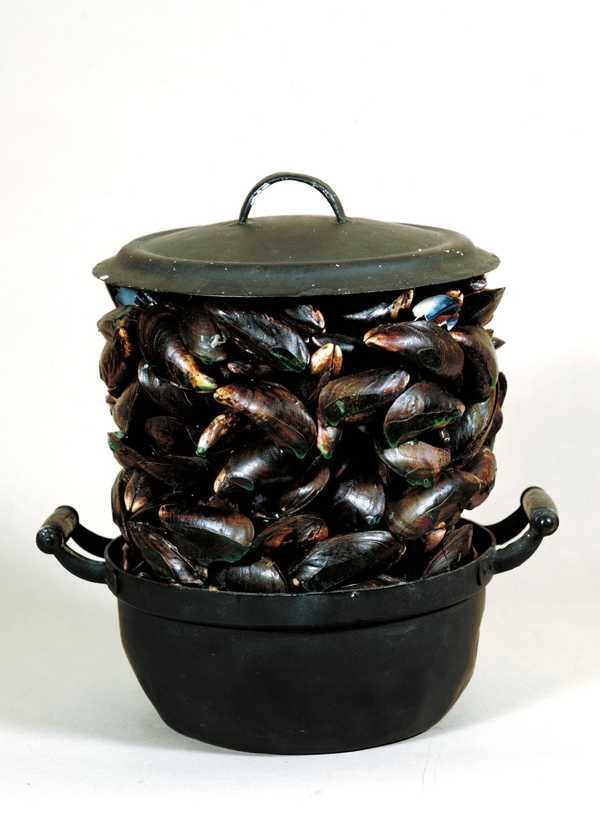
Casserole and Closed Mussels được làm năm 1964. Tate, nơi giữ tác phẩm, ghi chất liệu: vỏ vẹm, chất màu, nhựa polyester, và một cái nồi gang có quai gỗ.
Nhìn trực tiếp, tác phẩm giống một món ăn bị dừng lại giữa chừng. Cái nồi là loại nồi quen thuộc trong bếp. Bên trong, vỏ vẹm chồng lên nhau, dính chặt bằng nhựa, dựng thành một khối cao vượt khỏi miệng nồi. Cái nắp không đậy xuống được. Nó nằm chênh vênh phía trên, bị khối vỏ đẩy lên.
Những cái vỏ đều khép. Không có thịt vẹm, không có nước dùng, không có hơi nóng. Chỉ có hình dạng của một bữa ăn, đông cứng lại.
Chính cái tên cũng lạ. Trong bếp, người ta thường nói vẹm nào vẫn khép sau khi nấu thì nên bỏ đi. Broodthaers dựng cả một tác phẩm bằng những cái vỏ khép. Không ai biết chắc ông có nghĩ đến quy tắc ấy không. Nhưng tác phẩm để ngỏ khả năng: cái được trưng bày là thứ lẽ ra phải vứt.
Một nhà thơ quyết định làm vật
Marcel Broodthaers sinh năm 1924 ở Brussels và mất năm 1976. Suốt khoảng hai mươi năm, ông là nhà thơ, viết cho báo, làm những việc lặt vặt quanh giới nghệ thuật. Thơ của ông bán được rất ít.
Năm 1964, khi đã ngoài bốn mươi, ông tuyên bố chuyển sang làm nghệ sĩ thị giác. Một trong những việc đầu tiên ông làm là lấy những bản còn lại của tập thơ Pense-Bête, nhúng chúng vào thạch cao. Những cuốn sách không đọc được nữa, nhưng giờ thành một vật để nhìn. Cũng trong năm ấy, ông có triển lãm đầu tiên ở Brussels.
Cái nồi vẹm ra đời trong giai đoạn đó. Nó mang tinh thần của một người vừa bước vào nghệ thuật từ bên ngoài, và nhìn thế giới nghệ thuật với con mắt vừa tò mò vừa nghi ngờ. Cái nồi không kể chuyện về người nấu. Nó chỉ trình ra phần còn sót lại.
Vẹm, khuôn và bản sắc
Vẹm hấp là món ăn phổ biến ở Bỉ, thường nấu trong một nồi lớn, dọn ra nguyên nồi. Đặt một cái nồi vẹm vào phòng triển lãm là đặt một biểu tượng quốc gia vào chỗ người ta chờ đợi một tác phẩm nghiêm trang.
Trong tiếng Pháp, chữ moule vừa có nghĩa là con vẹm, vừa có nghĩa là cái khuôn. Broodthaers rất thích những trò chơi chữ như vậy. Con vẹm tự tiết ra vỏ để giữ hình mình. Cái khuôn đúc ra những thứ giống hệt nhau. Một nền văn hoá cũng có khuôn của nó: những món ăn, những thói quen mà ai sinh ra ở đó đều được đổ vào.
Nhìn đống vỏ dính chặt, không thể tách rời, người xem có thể nghĩ đến một đám đông, một tập thể, hay đơn giản là một bữa ăn quá nhiều. Broodthaers không chọn giúp ai. Ông đặt vật ở đó và để câu đùa tự làm việc của nó.
Châm biếm từ bên trong
Vài năm sau, từ năm 1968, Broodthaers dựng Musée d'Art Moderne, Département des Aigles, một bảo tàng hư cấu đặt ngay trong nhà mình, với thùng gỗ, bưu thiếp và nhãn chú thích. Đó là một bảo tàng giả để chế giễu bảo tàng thật: cách chúng phân loại, dán nhãn, quyết định cái gì là nghệ thuật.
Cái nồi vẹm đã chứa sẵn thái độ ấy. Nó dùng một vật tầm thường nhất, đặt vào chỗ trang trọng nhất, và để người xem tự hỏi vì sao mình lại đứng nghiêm trước một nồi vỏ vẹm.
Broodthaers không phải người duy nhất đưa đồ ăn vào nghệ thuật trong những năm 1960. Daniel Spoerri dán cả bàn ăn sau bữa tối lên tường. Nhưng cái nồi của Broodthaers ít ồn ào hơn. Nó gần như lặng lẽ. Một món ăn đã hết, và một cái vỏ không chịu biến mất.
A pot full of shells
Casserole and Closed Mussels was made in 1964. Tate, which holds the work, lists its materials: mussel shells, pigment, polyester resin, and an iron casserole with wooden handles.
Seen in person, it looks like a meal stopped halfway. The pot is the ordinary kitchen kind. Inside, the shells are stacked and fixed with resin into a mass that rises above the rim. The lid cannot close. It sits unsteadily on top, pushed up by the shells.
The shells are all closed. No flesh, no broth, no steam. Only the shape of a meal, set hard.
The title is odd too. In the kitchen, people often say that mussels still closed after cooking should be thrown away. Broodthaers built an entire work from closed shells. No one can say for sure whether he had that rule in mind. But the work leaves the possibility open: what is on display is what should have been discarded.
A poet decides to make objects
Marcel Broodthaers was born in Brussels in 1924 and died in 1976. For about twenty years he was a poet, wrote for newspapers, and did odd jobs around the art world. His poetry sold very little.
In 1964, in his forties, he announced that he would become a visual artist. One of the first things he did was take the unsold copies of his book of poems, Pense-Bête, and set them in plaster. The books could no longer be read, but they became something to look at. That same year he had his first exhibition in Brussels.
The mussel pot comes from that moment. It carries the spirit of someone who has just entered art from outside, looking at the art world with curiosity and suspicion at once. The pot tells no story about the cook. It only presents what is left over.
Mussels, moulds and identity
Steamed mussels are a common dish in Belgium, usually cooked in a large pot and served in it. Putting a pot of mussels in a gallery puts a national emblem where visitors expect a serious work of art.
In French, the word moule means both mussel and mould. Broodthaers loved puns like this. The mussel secretes its own shell to hold its shape. A mould casts identical copies. A culture has its moulds too: the dishes and habits into which everyone born there is poured.
Looking at the fused, inseparable shells, viewers might think of a crowd, a collective, or simply a meal too large. Broodthaers does not choose for anyone. He puts the object there and lets the joke do its work.
Satire from the inside
A few years later, from 1968, Broodthaers set up the Musée d'Art Moderne, Département des Aigles, a fictional museum in his own home, with packing crates, postcards and labels. It was a fake museum mocking real ones: how they classify, label, and decide what counts as art.
The mussel pot already holds that attitude. It takes the most ordinary object, places it in the most solemn position, and lets viewers wonder why they are standing respectfully before a pot of shells.
Broodthaers was not the only one bringing food into art in the 1960s. Daniel Spoerri glued whole tables after dinner to the wall. But Broodthaers' pot is quieter. Almost silent. A meal that is over, and a shell that refuses to disappear.
Modern Art