
Essays · Olfactory Art
Maryanto. Brimming in Wonocolo.
Mùi dầu là phần của cảnh vật không vẽ được.
The smell of oil is the part of the landscape no one can paint.
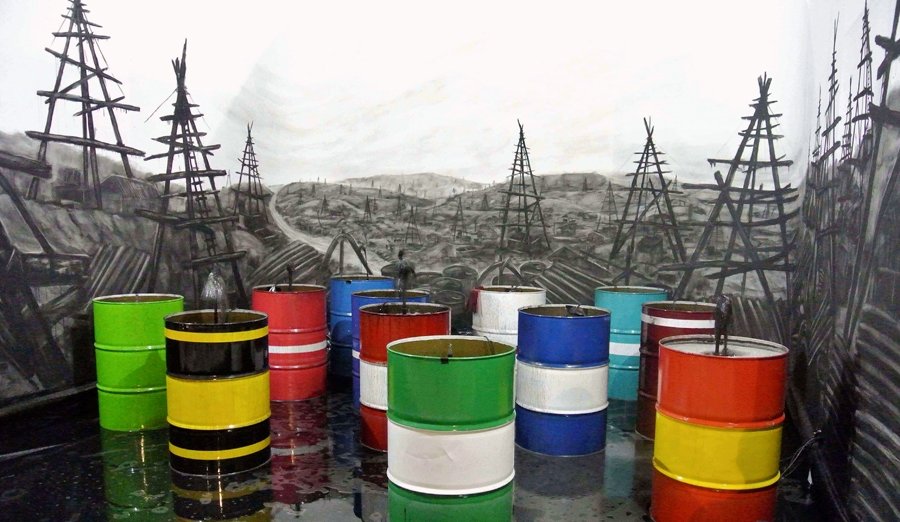
Maryanto, Brimming in Wonocolo · ArtReview Asia
Một cánh đồng giàn khoan trên tường
Brimming in Wonocolo ra mắt tại Jakarta Biennale năm 2015. Tác phẩm có hai phần. Phía sau là một bức tranh tường toàn cảnh, trải rộng như một đường chân trời, vẽ một cánh đồng dày đặc giàn khoan dầu. Phía trước là những thùng phuy thật, loại thùng chứa dầu quen thuộc ở mọi bãi khai thác.
Những thùng phuy ấy không đứng yên. Chúng phun dầu thô lên theo nhịp, đều đặn, như những giếng nhỏ đang hoạt động. Cùng với chuyển động là mùi. Mùi dầu thô nặng, đặc, hơi ngọt, lan khắp khoảng không trước bức tranh.
Người xem vì vậy đứng giữa hai thứ. Một bên là hình ảnh, đứng yên, có khoảng cách. Một bên là vật liệu, đang chảy, đang bốc mùi, ở ngay trước mặt. Bức tranh là bản đồ. Thùng phuy là chính vùng đất ấy, được mang vào phòng trưng bày.
Wonocolo, từ năm 1893
Wonocolo là một vùng ở Đông Java, Indonesia. Ở đó, dầu nằm nông, gần mặt đất. Năm 1893, một công ty Hà Lan, Dordtsche Petroleum Maatschappij, bắt đầu khoan giếng ở vùng này. Đó là thời Indonesia còn là thuộc địa, và dầu là một trong những thứ được lấy đi.
Sau khi Indonesia giành độc lập năm 1949, khoảng năm trăm giếng dầu cũ ở Wonocolo chuyển sang tay các bên quản lý trong nước và nước ngoài. Theo ArtReview Asia, những năm sau đó để lại hai thứ: đất đai bị tàn phá và một chuỗi tham nhũng chính trị quanh dầu mỏ.
Tên tác phẩm có chữ brimming, tức đầy tràn. Nó có thể đọc theo hai chiều. Một vùng đất tràn đầy dầu, giàu có. Và một vùng đất bị dầu tràn lên, thấm vào đất, vào nước, vào đời sống người ở đó. Những thùng phuy phun dầu trong phòng trưng bày giữ cả hai nghĩa cùng lúc.
Một hoạ sĩ phong cảnh làm việc với vật liệu
Maryanto sinh ra ở Jakarta. Ông học đồ hoạ in tại Viện Nghệ thuật Indonesia ở Yogyakarta, từng lưu trú ngắn hạn ở Tây Ban Nha và ở Rijksakademie tại Amsterdam trong hai năm 2012 và 2013. Hiện ông sống và làm việc ở Yogyakarta.
Phong cảnh là thể loại chính của ông. Nhưng đó không phải phong cảnh để ngắm. Với Maryanto, vẽ một vùng đất là cách đặt câu hỏi về việc ai sở hữu nó, ai khai thác nó, ai phải sống với hậu quả. Ông cũng làm việc xã hội, và kinh nghiệm ấy đi vào cách ông chọn đề tài.
Vật liệu với ông luôn mang nghĩa. Năm 2013, trong Pandora's Box, ông vẽ những cảnh khai thác than lên tường xưởng bằng than củi và bột carbon, tức là vẽ mỏ than bằng chính thứ bụi đen của nó. Năm 2015, cùng năm với Brimming in Wonocolo, ông làm Sweet Crude, Black Gold với nghệ sĩ Nigeria Victor Ehikhamenor, một bức tranh nhiều tấm gỗ về việc khai thác dầu ở Nigeria. Năm 2016 là Mineral Desire, một bức tranh phong cảnh đặt cạnh một tủ khoáng vật.
Brimming in Wonocolo đi thêm một bước. Ở đây vật liệu không chỉ để vẽ. Nó được để nguyên dạng, được cho chuyển động và toả mùi.
Vì sao mùi lại quan trọng
Ta có thể nhìn một bức ảnh giếng dầu mà không thấy gì. Ảnh báo chí, ảnh quảng cáo, ảnh tài liệu về dầu mỏ quá nhiều, đến mức mắt đã quen. Mùi thì khó quen hơn. Mùi dầu thô trong một căn phòng kín là thứ cơ thể phản ứng ngay, trước khi đầu kịp nghĩ.
Ở Wonocolo, mùi ấy là một phần của đời sống hằng ngày. Nó nằm trong không khí, trong đất, trên tay những người làm ở giếng. Khi Maryanto đưa mùi vào phòng trưng bày, ông đưa vào một chút của đời sống đó. Người xem ở Jakarta không cần đến Đông Java để biết nơi ấy ngửi thấy như thế nào.
Nhịp phun của thùng phuy cũng là một chi tiết đáng để ý. Nó giống nhịp máy bơm, nhịp của một thứ lặp lại không ngừng. Hơn một trăm năm, dầu được hút lên theo một nhịp như vậy. Tác phẩm không kể lịch sử bằng chữ. Nó để lịch sử chảy ra trước mặt, có hình, có tiếng, có mùi.
Nghệ sĩ Bỉ Peter De Cupere cũng từng cho người xem chọn thả mùi sạch hay mùi bẩn vào không khí phòng trưng bày, trong Air Polluter. Nhưng ở Maryanto, mùi không đứng một mình. Nó gắn với một địa danh cụ thể, một ngày tháng cụ thể, năm 1893, và một bức tranh cho mắt nhìn.
A field of derricks on the wall
Brimming in Wonocolo was first shown at the Jakarta Biennale in 2015. The work has two parts. Behind is a panoramic mural, spread out like a horizon, showing a dense field of oil derricks. In front are real drums, the kind of oil drum found at every extraction site.
The drums do not sit still. They spray crude oil in a steady rhythm, like small working wells. With the movement comes the smell. Heavy, thick, faintly sweet, it fills the space in front of the painting.
The viewer stands between two things. On one side, an image: still, at a distance. On the other, a material: flowing, smelling, right there. The painting is a map. The drums are the land itself, carried into the exhibition.
Wonocolo, since 1893
Wonocolo is an area in East Java, Indonesia, where oil lies close to the surface. In 1893 a Dutch company, the Dordtsche Petroleum Maatschappij, began drilling there. Indonesia was then a colony, and oil was one of the things taken away.
After independence in 1949, around five hundred old wells in Wonocolo passed to local and foreign operators. According to ArtReview Asia, the decades that followed left two things behind: damaged land and a chain of political corruption around oil.
The title uses the word brimming. It reads two ways. A land full of oil, and rich. And a land overflowing with oil, soaked into soil, water and the lives of the people there. The drums spraying oil in the gallery hold both meanings at once.
A landscape painter working with matter
Maryanto was born in Jakarta. He studied printmaking at the Indonesian Institute of the Arts in Yogyakarta, did a short residency in Spain and spent 2012 and 2013 at the Rijksakademie in Amsterdam. He lives and works in Yogyakarta.
Landscape is his main genre, but not landscape to admire. For Maryanto, painting a place is a way of asking who owns it, who extracts from it, and who lives with the result. He has also worked in social work, and it shapes the subjects he chooses.
His materials always carry meaning. In Pandora's Box, 2013, he drew coal mining scenes on studio walls in charcoal and carbon powder: a coal mine drawn in its own black dust. In 2015, the same year as Wonocolo, he made Sweet Crude, Black Gold with the Nigerian artist Victor Ehikhamenor, a multi panel painting on wood about oil drilling in Nigeria. In 2016 came Mineral Desire, a landscape canvas beside a cabinet of minerals.
Brimming in Wonocolo goes one step further. Here the material is not used to paint. It is left as it is, set in motion, allowed to smell.
Why the smell matters
We can look at a photograph of an oil well and see nothing. There are so many news images, advertisements and documentary pictures of oil that the eye has grown used to them. Smell is harder to get used to. Crude oil in a closed room is something the body reacts to at once, before the mind catches up.
In Wonocolo that smell is part of daily life. It is in the air, in the soil, on the hands of those who work the wells. By bringing it into the gallery, Maryanto brings in a piece of that life. A viewer in Jakarta does not need to travel to East Java to know what the place smells like.
The rhythm of the drums matters too. It is the rhythm of a pump, of something repeating without end. For more than a hundred years, oil has been drawn up at a pace like this. The work does not tell history in words. It lets history spill out in front of us, with shape, sound and smell.
The Belgian artist Peter De Cupere has also let viewers choose between releasing clean or dirty smells into a gallery, in Air Polluter. In Maryanto's work, though, the smell does not stand alone. It is tied to a named place, a date, 1893, and a painting for the eye.
Olfactory Art