
Essays · Olfactory Art
Musk nitro. Một phát hiện và một lệnh cấm.
Mùi ở lại quá lâu cũng là một vấn đề.
A smell that stays too long becomes a problem.
Một mùi xạ hương từ phòng thí nghiệm thuốc nổ
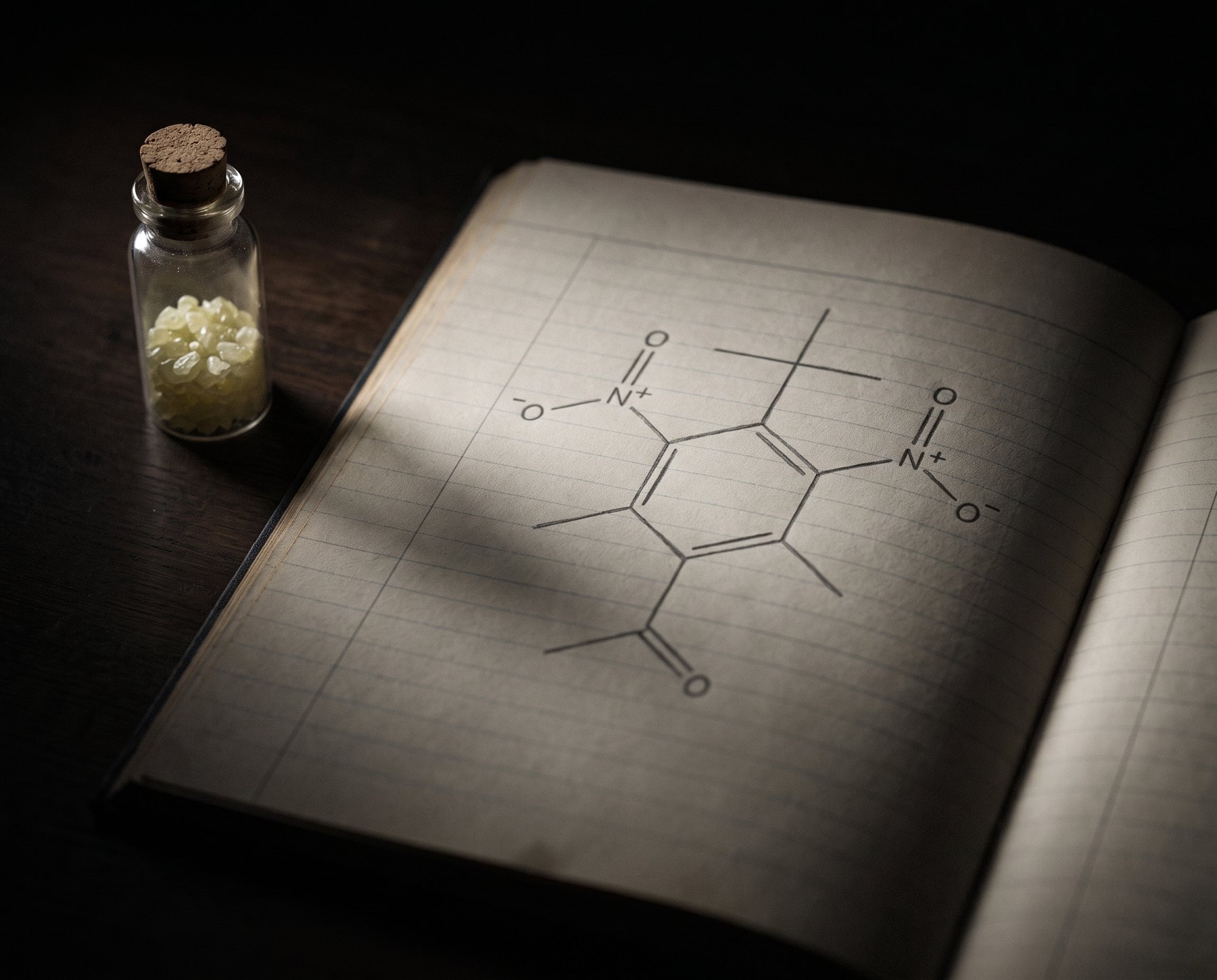
Cuối thập niên 1880, nhà hoá học Đức Albert Baur đang làm việc với các hợp chất họ hàng của TNT, loại thuốc nổ gắn nhiều nhóm nitro lên một vòng benzen. Trong những thí nghiệm ấy, ông nhận ra một chất có mùi rất giống xạ hương.
Điều này bất ngờ, vì cấu trúc của nó chẳng liên quan gì đến xạ hương tự nhiên. Xạ hương động vật mang mùi nhờ những phân tử vòng lớn, mà mãi đến thập niên 1920 hoá học mới hiểu được. Chất của Baur lại là một vòng benzen nhỏ, gắn ba nhóm nitro và một nhóm butyl. Hai cấu trúc khác nhau hoàn toàn, nhưng mũi người nói chúng giống nhau.
Baur đăng ký bằng sáng chế và bán chất này dưới tên musk Baur. Trong thập niên 1890, ông mô tả thêm nhiều musk nitro khác: musk xylene, musk ketone, musk ambrette. Mỗi chất một sắc thái: xylene rẻ và ngọt như phấn, ketone ấm và được xem là gần xạ hương nhất, ambrette gợi hạt vông vang.
Như coumarin hay vanillin trước đó, musk nitro tách một mùi quý khỏi nguồn gốc của nó. Nhưng lần này nguồn gốc là một con vật, và nơi thay thế là một phòng thí nghiệm thuốc nổ.
Thay xạ hương động vật
Trước musk nitro, xạ hương trong nước hoa đến từ túi xạ của hươu xạ, một loài hươu nhỏ sống ở vùng núi châu Á. Muốn lấy túi xạ thường phải giết con vật. Xạ hương vì thế cực hiếm và rất đắt.
Musk nitro rẻ và làm được với số lượng lớn. Chỉ trong vài thập kỷ, chúng có mặt ở khắp nơi. Musk ketone thành nền của nhiều nước hoa cổ điển. Musk xylene, rẻ nhất, được dùng với khối lượng khổng lồ trong xà bông và bột giặt suốt thế kỷ 20. Musk ambrette phổ biến trong nước hoa nam và đồ cạo râu.
Chúng có một đặc tính mà người làm mùi rất cần: bám lâu. Một chiếc áo giặt bằng xà bông có musk xylene giữ mùi nhiều ngày. Mùi sạch và ấm ấy, với nhiều thế hệ, đã là mùi của quần áo mới giặt.
Cũng chính đặc tính ấy về sau thành rắc rối.
Những lệnh cấm
Từ thập niên 1980, các nhà khoa học bắt đầu tìm thấy musk nitro ở những nơi không ai đặt chúng vào: trong nước sông, trong bùn, trong cá, trong mỡ người. Các phân tử này phân huỷ rất chậm và tích tụ trong mô sống. Cùng lúc, một số nghiên cứu nêu lo ngại về độ an toàn của musk ambrette khi dùng trên da.
Các lệnh hạn chế đến dần. IFRA, tổ chức đặt ra quy chuẩn cho ngành nước hoa, ban hành quy chuẩn cấm musk ambrette, rồi musk tibetene và musk moskene. Năm 2008, cơ quan hoá chất châu Âu ECHA đưa musk xylene vào danh sách các chất đáng lo ngại cao, vì nó rất bền và rất dễ tích tụ trong sinh vật. IFRA cấm musk xylene ngay sau đó.
Trong luật mỹ phẩm châu Âu, musk ambrette, musk moskene và musk tibetene nằm trong phụ lục các chất bị cấm. Musk xylene và musk ketone bị giới hạn nồng độ. Musk ketone, loại được quý nhất, vẫn được IFRA cho phép theo một quy chuẩn kỹ thuật, nhưng việc dùng nó đã giảm mạnh.
Chỗ trống mà musk nitro để lại được lấp bằng các họ musk khác: musk đa vòng từ giữa thế kỷ 20, rồi musk vòng lớn và musk mạch vòng. Mùi xạ hương sạch ngày nay phần lớn đến từ những phân tử ấy.
Mùi ở lại quá lâu
Người làm mùi luôn muốn mùi ở lại. Một mùi bay mất sau mười phút là một mùi thất bại. Musk nitro trả lời mong muốn ấy tốt hơn hầu hết mọi thứ. Và đó là lý do chúng phải đi.
Câu chuyện của musk nitro vì thế có hai mặt. Một mặt, nó là thành tựu: xạ hương không cần giết hươu. Mặt khác, nó là lời nhắc rằng một vật được làm để tồn tại lâu sẽ tồn tại lâu cả ở những nơi ta không muốn.
Không có mùi nào chỉ thuộc về khoảnh khắc được xịt lên da. Mùi đi tiếp: vào vải, vào nước giặt, vào ống thoát, vào sông. Phần lớn biến mất. Một số thì không.
Nhìn lại, musk nitro giống một bức thư được gửi đi quá xa. Nó được viết cho người đang mặc áo, nhưng lại đến tay cả dòng sông và con cá. Lệnh cấm là cách con người thu hồi bức thư ấy, chậm, sau gần một thế kỷ.
A musk from an explosives lab
In the late 1880s the German chemist Albert Baur was working with relatives of TNT, the explosive that carries several nitro groups on a benzene ring. In those experiments he noticed a substance that smelled strikingly of musk.
This was a surprise, because its structure had nothing to do with natural musk. Animal musk owes its smell to large ring molecules that chemistry only understood in the 1920s. Baur's compound was a small benzene ring carrying three nitro groups and a butyl group. Two entirely different structures, yet the human nose called them alike.
Baur patented the substance and sold it as musk Baur. In the 1890s he described more nitro musks: musk xylene, musk ketone, musk ambrette. Each had its own shade: xylene cheap and powdery sweet, ketone warm and regarded as closest to deer musk, ambrette recalling ambrette seed.
Like coumarin and vanillin before them, nitro musks separated a precious smell from its source. This time the source was an animal, and the substitute came from an explosives laboratory.
Replacing animal musk
Before nitro musks, musk in perfume came from the pod of the musk deer, a small deer of the Asian mountains. Taking the pod usually meant killing the animal. Musk was therefore very rare and very costly.
Nitro musks were cheap and could be made in bulk. Within a few decades they were everywhere. Musk ketone became the base of many classic perfumes. Musk xylene, the cheapest, was used in enormous volumes in soap and detergent throughout the twentieth century. Musk ambrette was popular in men's perfume and shaving products.
They had a quality perfumers prize: they last. A shirt washed with soap containing musk xylene kept its smell for days. That clean, warm smell was, for generations, the smell of fresh laundry.
The same quality later became the trouble.
The bans
From the 1980s scientists began finding nitro musks where no one had put them: in river water, in sediment, in fish, in human fat. The molecules break down very slowly and accumulate in living tissue. At the same time, some studies raised concerns about the safety of musk ambrette on skin.
Restrictions came gradually. IFRA, the body that sets standards for the perfume industry, prohibited musk ambrette, then musk tibetene and musk moskene. In 2008 the European Chemicals Agency placed musk xylene on its list of substances of very high concern, as very persistent and very bioaccumulative. IFRA prohibited musk xylene soon after.
Under European cosmetics law, musk ambrette, musk moskene and musk tibetene are listed as prohibited. Musk xylene and musk ketone are limited in concentration. Musk ketone, the most prized, is still allowed by IFRA under a specification standard, but its use has fallen sharply.
The space left by nitro musks was filled by other families: polycyclic musks from the mid twentieth century, then macrocyclic and alicyclic musks. Most of today's clean musk smell comes from them.
A smell that stays too long
Perfumers always want smell to stay. A smell gone in ten minutes is a failure. Nitro musks answered that wish better than almost anything. That is why they had to go.
So the story has two sides. On one, an achievement: musk without killing deer. On the other, a reminder that something made to last will last in places we never intended.
No smell belongs only to the moment it is sprayed on skin. It moves on: into cloth, into wash water, into drains, into rivers. Most of it disappears. Some does not.
Looking back, nitro musks resemble a letter sent too far. It was written for the person in the shirt, and it reached the river and the fish as well. The bans are how people recalled that letter, slowly, after nearly a century.

Olfactory Art