
Essays · Olfactory Art
Precious Okoyomon. the sun eats her children.
Cái thơm và cái độc mọc chung một luống đất.
The fragrant and the poisonous grow in one bed.
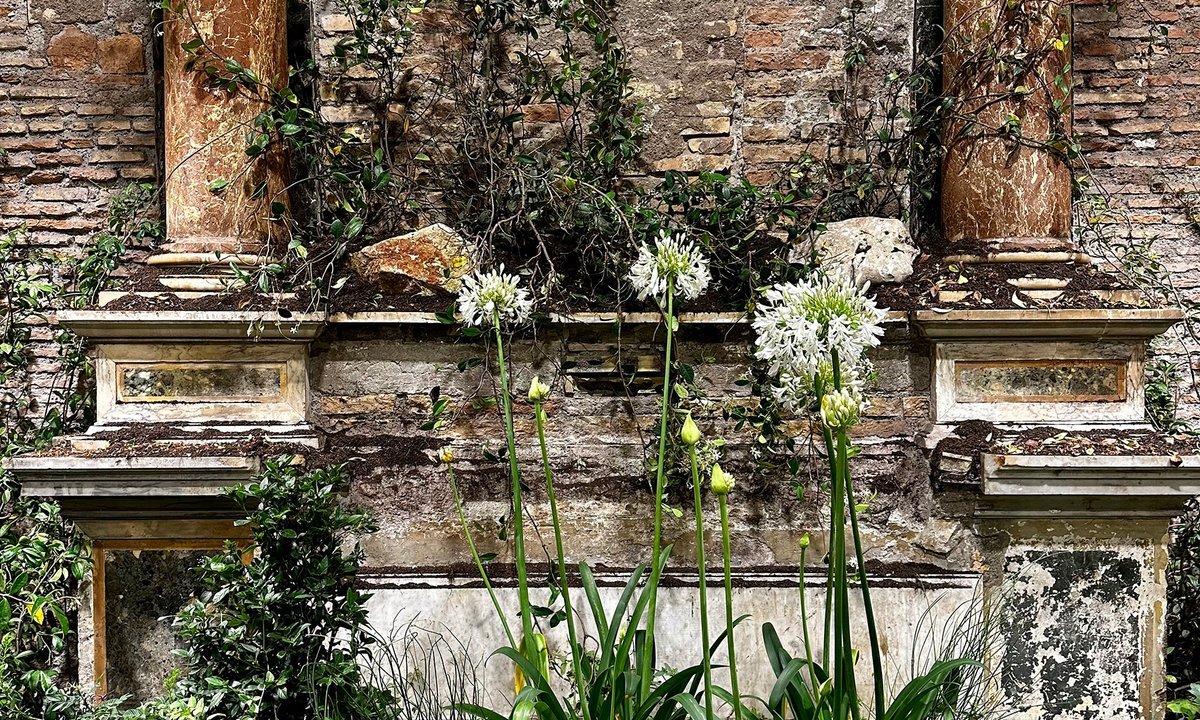
Installation view of Precious Okoyomon: the sun eats her children, Sant'Andrea de Scaphis, Rome. Courtesy of Sant'Andrea de Scaphis · The Art Newspaper
Một nhà nguyện bỏ hoang
Sant'Andrea de Scaphis là một nhà nguyện nhỏ ở Rome, có từ thế kỷ thứ chín, từ lâu không còn dùng cho việc thờ phụng. Nó bị bỏ hoang nhiều năm trước khi nhà buôn tranh Gavin Brown tiếp quản vào năm 2015 và biến nơi này thành không gian trưng bày. Joan Jonas, Arthur Jafa, Jannis Kounellis đều từng làm việc ở đây.
Mùa hè năm 2023, Precious Okoyomon lấp đầy căn phòng đá ấy bằng một khu vườn. Tác phẩm tên là the sun eats her children, viết thường toàn bộ, mở cửa đến ngày 16 tháng 9 năm 2023. Một căn phòng kín, đầy cây hoa, là một căn phòng mà mùi không có lối ra.
Theo The Art Newspaper, khu vườn có nhài, huệ tây cao, kim ngân, sơn thù du hoa trắng, hồng đỏ. Có cả sắn dây và mía, hai loài cây bà từng dùng trong sắp đặt tại Venice Biennale năm 2022. Người xem đi trên lối sỏi, dưới ánh đèn LED, giữa những con bướm đen cánh xanh da trời.
Âm thanh là một phần của khu vườn. Có nhạc giao hưởng của Kelsey Lu, và một tiếng thét ghi âm, trộn giọng của chính Okoyomon với giọng biên đạo múa Okwui Okpokwasili và nhà nghiên cứu Saidiya Hartman.
Con gấu và những cây độc
Giữa vườn có một con gấu bông máy, cao khoảng một mét, nặng gần 40 cân. Nó mặc quần lót ren trắng, quấn một dải băng trắng thắt nơ, và nằm nghiêng như đang ngất đi. Tên con gấu lấy từ một nhân vật trong Beloved, tiểu thuyết năm 1987 của Toni Morrison, cuốn sách về chế độ nô lệ và những gì nó để lại trên thân thể.
Okoyomon nói với The Art Newspaper rằng bà muốn có thật nhiều cây độc trong vườn. Không phải vì ác ý. Bà nghĩ đến những con bướm, loài sống nhờ chính những cây ấy để sinh ra thế hệ sau. Chất độc ở đây không phải kẻ thù của sự sống. Nó là một phần của chu trình.
Đặt cạnh nhau, con gấu, cây độc, tiếng thét và mùi hoa tạo thành một khung cảnh khó gọi tên. Nó màu mỡ, sum suê, nhưng không yên ổn. Tác phẩm chạm tới thân thể người da đen, quyền lực, di cư, sự mục rữa, quan hệ gia đình, và những vết thương thuộc địa, bằng ngôn ngữ của cây cỏ thay vì khẩu hiệu.
Một nhà thơ trồng đất
Okoyomon sinh ở London trong một gia đình Nigeria, sống ở Lagos rồi chuyển sang vùng Trung Tây nước Mỹ. Ở Chicago, bà học pataphysics và tâm lý học trẻ em trong lúc làm đầu bếp. Ở New York, bà làm tình nguyện cho một khu vườn cộng đồng. Bà tự nhận mình trước hết là nhà thơ. Hans Ulrich Obrist phát hiện bà qua thơ, tại Serpentine Gallery năm 2017.
Năm 2023, bà 29 tuổi, đã có triển lãm ở MMK Frankfurt, Performance Space New York, Aspen Art Museum, và có mặt trong triển lãm chính của Venice Biennale 2022. Bà chưa từng ký với gallery nào. Bà kể mình luôn chơi với đất và cây, không có kế hoạch, chỉ tin rằng chữ sẽ dẫn đường.
the sun eats her children đáng nhớ vì nó không trưng bày một khu vườn. Nó trồng một khu vườn, trong một căn phòng từng dành cho lời cầu nguyện, và để mùi hoa làm việc mà lời cầu nguyện từng làm: lấp đầy không gian, chạm vào người đứng trong đó, mà không cần xin phép. Cũng như khu vườn đêm của Hicham Berrada, cây ở đây được đưa vào phòng trưng bày để mũi người xem gặp chúng. Khi triển lãm đóng cửa, khu vườn chỉ còn là một ký ức ở những người đã hít thở nó.
An abandoned chapel
Sant'Andrea de Scaphis is a small chapel in Rome dating from the ninth century, long deconsecrated. It stood abandoned for years before the dealer Gavin Brown took it over in 2015 and turned it into an exhibition space. Joan Jonas, Arthur Jafa and Jannis Kounellis have all shown there.
In the summer of 2023 Precious Okoyomon filled that stone room with a garden. The work is titled the sun eats her children, all in lower case, and it ran until 16 September 2023. A closed room full of flowering plants is a room where smell has no way out.
According to The Art Newspaper, the garden held jasmine, tall lilies, honeysuckle, white dogwood and red roses. There was also kudzu and sugar cane, two plants she had used in her installation at the 2022 Venice Biennale. Visitors walked gravel paths under LED light, among black butterflies with sky blue wings.
Sound belonged to the garden too. There was symphonic music by Kelsey Lu, and a recorded scream blending Okoyomon's own voice with those of the choreographer Okwui Okpokwasili and the scholar Saidiya Hartman.
The bear and the poisonous plants
In the middle of the garden lay an animatronic stuffed bear, about a metre tall and weighing 85 pounds. It wore white lace underwear and a white bandage tied in a bow, and it lay on its side as if fainting. It was named after a character in Beloved, Toni Morrison's 1987 novel about slavery and what it leaves in the body.
Okoyomon told The Art Newspaper that she wanted a lot of poisonous plants. Not out of spite. She was thinking of butterflies, which live on those very plants in order to raise the next generation. Poison here is not the enemy of life. It is part of the cycle.
Together, the bear, the poison, the scream and the smell of flowers make a scene that is hard to name. It is fertile and lush, but not at ease. The work touches Black bodies, power, migration, decay, family, and colonial wounds, in the language of plants rather than slogans.
A poet who plants
Okoyomon was born in London to Nigerian parents, lived in Lagos and then moved to the American Midwest. In Chicago she studied pataphysics and child psychology while working as a chef. In New York she volunteered at a community garden. She calls herself a poet first. Hans Ulrich Obrist found her through her poetry, at the Serpentine Gallery in 2017.
In 2023 she was 29, had shown at MMK Frankfurt, Performance Space New York and the Aspen Art Museum, and had been part of the central exhibition of the 2022 Venice Biennale. She had never joined a gallery roster. She says she has always played with soil and plants, without a plan, trusting that words would guide her.
the sun eats her children stays with us because it does not display a garden. It plants one, in a room once meant for prayer, and lets the smell of flowers do what prayer used to do: fill the space and reach the people standing in it, without asking permission. As in Hicham Berrada's night garden, plants are brought indoors so that visitors' noses can meet them. When the show closed, the garden remained only as a memory in those who had breathed it.
Olfactory Art