
Essays · Photography
Stephen Shore. Uncommon Places.
Cái bình thường, nhìn đủ lâu, thành ra lạ.
The ordinary, looked at long enough, turns strange.
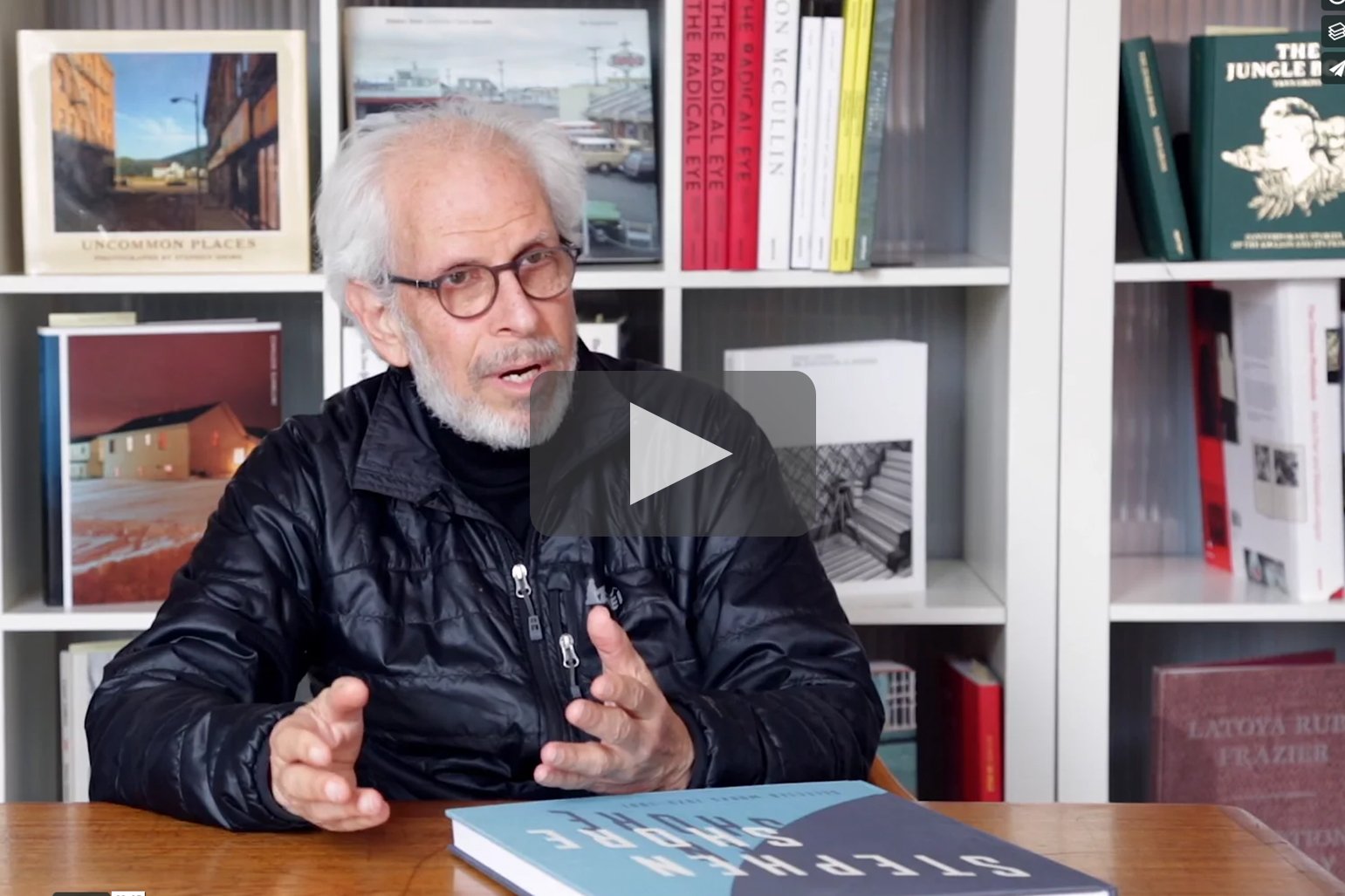
Aperture · Aperture
Một chiếc máy ảnh cỡ cánh cửa sổ
Từ năm 1973, Stephen Shore bắt đầu những chuyến đi dài bằng ô tô qua nước Mỹ và Canada. Ông mang theo một máy ảnh khổ 8x10 inch, loại máy dùng phim tấm lớn, phải đặt trên chân máy, phải trùm vải đen để lấy nét.
Trước đó, ông đã làm American Surfaces, một loạt ảnh màu chụp trên đường đi xuyên nước Mỹ, gần như một cuốn nhật ký bằng hình. Uncommon Places là bước tiếp theo, chậm hơn, nặng hơn, có chủ ý hơn.
Mỗi tấm phim 8x10 lớn gần bằng một trang giấy. Nó ghi lại một lượng chi tiết mà máy ảnh nhỏ không thể có. Nhưng cái giá là tốc độ. Mỗi lần bấm máy cần thời gian dựng, đo, chỉnh. Mỗi tấm phim đắt. Người chụp phải quyết định kỹ trước khi mở màn trập.
Cách làm ấy kéo dài đến đầu thập niên 1980. Năm 1982, Aperture xuất bản cuốn sách Uncommon Places. Sau này, cuốn sách được mở rộng qua nhiều ấn bản, thêm những tấm chưa từng in.
Giao lộ, nhà nghỉ, bữa sáng
Shore chụp những gì người ta đi ngang mỗi ngày. Một ngã tư với cột đèn và biển quảng cáo. Một trạm xăng. Mặt tiền một cửa hàng nhỏ. Một bãi đỗ xe. Một chiếc giường nhà nghỉ còn chưa ai nằm. Một đĩa trứng và bánh kếp trên bàn quán ăn, chụp từ trên xuống.
Tên ảnh thường chỉ gồm tên đường, tên thị trấn, tên tiểu bang và ngày tháng. Beverly Boulevard và La Brea Avenue ở Los Angeles là một ví dụ. Không có tính từ. Không có câu chuyện. Chỉ có một toạ độ trong không gian và thời gian.
Ảnh không có nhân vật chính. Người đi đường, nếu có, nhỏ và đứng lẫn trong cảnh. Ánh sáng thường là ánh sáng ban ngày bình thường. Bố cục cân bằng đến mức gần như vô hình: người xem không thấy người chụp đang sắp đặt, dù từng đường thẳng đã được tính kỹ.
Chính sự điềm tĩnh ấy khiến ảnh trở nên khó quên. Khi không có gì chỉ cho mắt biết nên nhìn đâu, mắt bắt đầu đi khắp khung hình. Một bảng giá xăng. Một chiếc xe màu xanh nhạt. Bóng một cột điện trên tường.
Màu sắc bước ra khỏi quảng cáo
Vào đầu thập niên 1970, ảnh màu vẫn thường bị xem là chuyện của quảng cáo, thời trang và ảnh gia đình. Ảnh nghệ thuật nghiêm túc phần lớn là đen trắng. Shore là một trong những người đầu tiên đưa ảnh màu khổ lớn vào lãnh thổ ấy, và dùng nó để nhìn vào phong cảnh đời thường của nước Mỹ.
Màu trong ảnh Shore không được đẩy lên cho rực rỡ. Nó là màu thật của sơn nhà, của bảng hiệu, của nền trời mùa hè. Nhưng chính vì thật, nó ghi lại một thời điểm rất rõ. Nhìn những tấm ảnh ấy hôm nay, ta thấy thập niên 1970 qua màu xe hơi, kiểu chữ trên biển quảng cáo, màu gạch lát.
Nhiều thập kỷ sau, Shore dành khoảng năm năm để quét lại hàng trăm tấm phim của loạt ảnh này. Năm 2017, Aperture in một tập tuyển chọn mới. Nhiều người được mời chọn ảnh, trong đó có đạo diễn Wes Anderson, các nhiếp ảnh gia Thomas Struth, Taryn Simon, An My Le. Mỗi người chọn mười tấm và viết về chúng.
Việc một đạo diễn phim và nhiều nhiếp ảnh gia thuộc những thế hệ khác nhau cùng quay lại loạt ảnh này cho thấy tầm ảnh hưởng của nó. Uncommon Places không chỉ là một cuốn sách. Nó trở thành một cách nhìn được học lại.
Vì sao đáng nhớ
Uncommon Places đổi chỗ của cái đáng chụp. Nó cho thấy một ngã tư vô danh có thể được nhìn nghiêm túc như một nhà thờ hay một ngọn núi.
Cách nhìn ấy đi tiếp qua nhiều thế hệ. Alec Soth với Sleeping by the Mississippi cũng lái xe, cũng dùng máy khổ lớn, cũng dừng ở những thị trấn nhỏ. Nếu Soth đi tìm người, Shore đi tìm cấu trúc: cách một con phố được sắp đặt, cách một căn phòng được bày.
Tên cuốn sách có một nghịch lý nhỏ. Những nơi trong ảnh hoàn toàn không hiếm. Cái hiếm là cách nhìn vào chúng.
A camera the size of a window
From 1973, Stephen Shore set out on long road trips across the United States and Canada. He carried an 8x10 inch view camera, a large sheet film camera that sits on a tripod and is focused under a dark cloth.
Before that he had made American Surfaces, colour pictures taken on the road across America, almost a diary in images. Uncommon Places was the next step: slower, heavier, more deliberate.
Each 8x10 negative is close to the size of a page. It holds a quantity of detail no small camera can match. The price is speed. Every exposure takes time to set up, meter, adjust. Every sheet of film is costly. The photographer must decide carefully before opening the shutter.
He worked this way into the early 1980s. In 1982 Aperture published the book Uncommon Places. Later editions expanded it with pictures never printed before.
Intersections, motels, breakfast
Shore photographed what people pass every day. An intersection with a lamppost and billboards. A gas station. The front of a small shop. A parking lot. A motel bed nobody has slept in yet. A plate of eggs and pancakes on a diner table, seen from above.
The titles usually give only a street, a town, a state and a date. Beverly Boulevard and La Brea Avenue in Los Angeles is one. No adjectives. No story. Just a coordinate in space and time.
The pictures have no protagonist. Passers by, when present, are small and part of the scene. The light is usually ordinary daylight. The composition is balanced to the point of vanishing: the viewer does not see the photographer arranging, though every line was weighed.
That calm is what makes the pictures hard to forget. With nothing telling the eye where to look, it begins to travel the whole frame. A gas price sign. A pale blue car. The shadow of a pole on a wall.
Colour leaves advertising
In the early 1970s colour photography was still widely seen as the business of advertising, fashion and family snapshots. Serious art photography was mostly black and white. Shore was among the first to bring large format colour into that territory, and to turn it on the everyday American landscape.
His colour is not pushed for effect. It is the real colour of house paint, of signs, of a summer sky. Because it is real, it fixes a moment precisely. Looking now, we see the 1970s in car colours, billboard lettering, floor tiles.
Decades later Shore spent about five years scanning hundreds of negatives from the series. In 2017 Aperture published a new selection. Many people were invited to choose pictures, among them the director Wes Anderson and the photographers Thomas Struth, Taryn Simon and An My Le. Each chose ten and wrote about them.
That a film director and photographers of several generations returned to this work shows its reach. Uncommon Places is not only a book. It became a way of seeing that people keep relearning.
Why it stays
Uncommon Places moved the line of what deserves a photograph. It showed that a nameless intersection can be looked at as seriously as a cathedral or a mountain.
That way of looking carried on. Alec Soth, in Sleeping by the Mississippi, also drove, also used a large camera, also stopped in small towns. Where Soth looked for people, Shore looked for structure: how a street is laid out, how a room is set.
The title holds a small paradox. The places in the pictures are not rare at all. What is rare is the way of looking at them.
Photography