
Essays · Fashion as Design
Thierry Mugler, Couturissime.
Quần áo như sân khấu, cơ thể như nhân vật.
Clothes as a stage, the body as a character.
Musée des Arts Décoratifs (MAD Paris) · Musée des Arts Décoratifs (MAD Paris)
Một triển lãm chia thành hồi
Thierry Mugler, Couturissime mở tại Musée des Arts Décoratifs ở Paris từ ngày 30 tháng 9 năm 2021 đến ngày 24 tháng 4 năm 2022. Triển lãm do Montreal Museum of Fine Arts khởi xướng, sản xuất và đưa đi lưu diễn từ năm 2019. Giám tuyển là Thierry-Maxime Loriot.
Ở Paris, triển lãm chiếm hai tầng của các phòng thời trang Christine và Stephen A. Schwarzman vừa được cải tạo. Những tác phẩm trưng bày có niên đại từ năm 1973 đến năm 2014, bao quát sự nghiệp thời trang của Mugler từ thập niên 1970 cho đến năm 2002.
Cách sắp xếp không theo dòng thời gian thông thường. MAD mô tả triển lãm được dựng thành nhiều hồi, như một vở opera cổ điển. Trang phục đứng cạnh hình chiếu động, ảnh chụp và âm nhạc. Người xem không đi qua một kho lưu trữ. Họ đi qua một buổi diễn.
Lựa chọn ấy hợp với chính Mugler. Ông từng làm trang phục cho vở Macbeth của Comédie-Française, dàn dựng tại Festival d'Avignon năm 1985. Sân khấu không phải một nhánh phụ trong công việc của ông. Nó là cách ông nghĩ về quần áo ngay từ đầu.
Côn trùng, chimera, người máy
Cuối thập niên 1970, Mugler đã có một ý niệm mà sau này được gọi là Glamazon: người phụ nữ cao, vai rộng, eo thắt, bước đi như một nhân vật bước ra từ phim. Hình dáng ấy được đẩy xa dần qua từng bộ sưu tập.
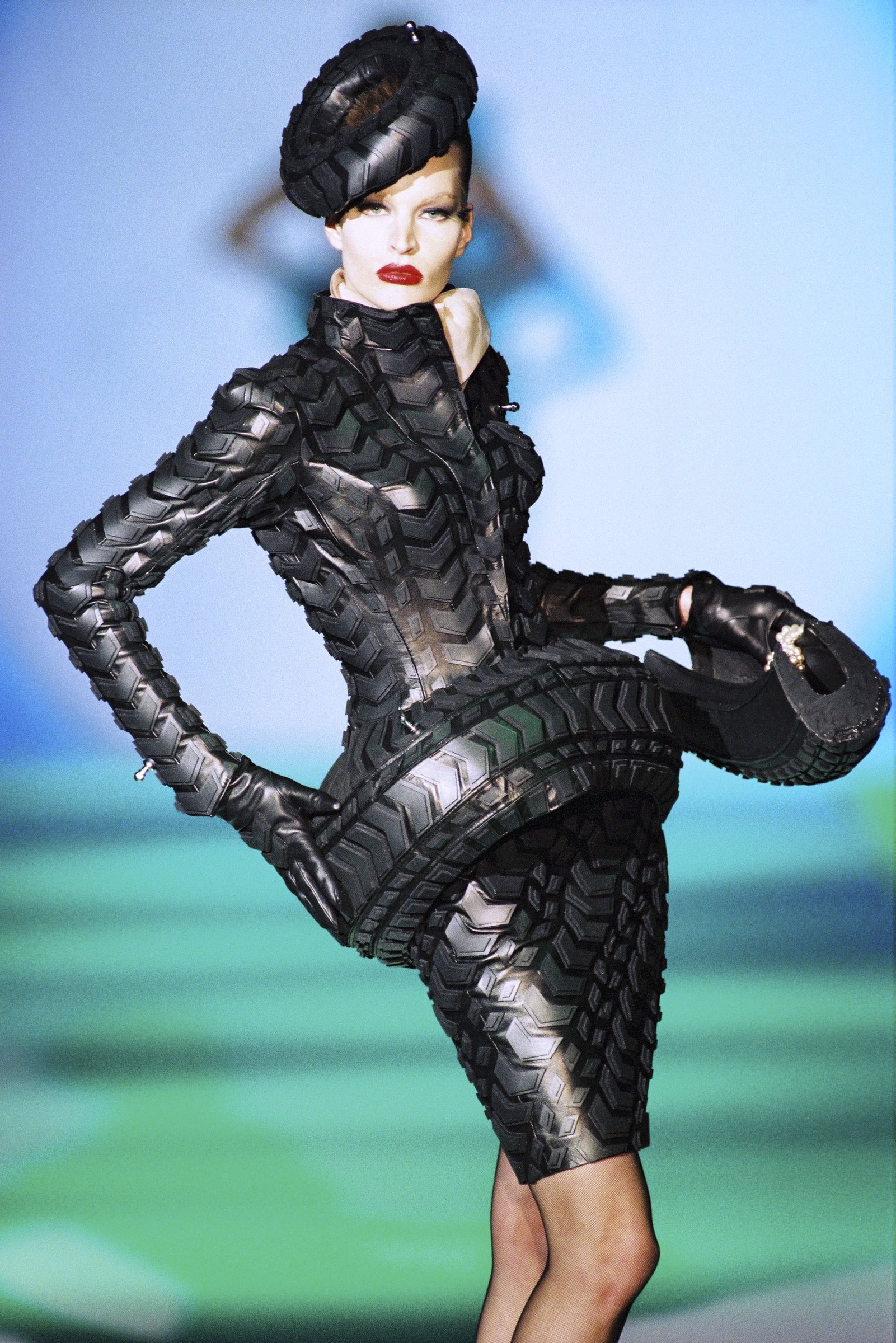
Bộ sưu tập haute couture xuân hè 1997 mang tên Les Insectes. Mùa thu đông 1997 đến 1998 là La Chimère, một bộ sưu tập về những sinh vật lai. Trước đó, bộ haute couture thu đông 1995 đến 1996 đánh dấu hai mươi năm của nhà mốt. Năm 1995, cho dịp kỷ niệm ấy, ông làm Maschinenmensch, một hình người máy.
Nhìn qua các tên gọi, có thể thấy một hướng đi rõ ràng. Cơ thể con người không phải điểm đến của trang phục. Nó là khung để dựng lên một thứ khác: một con bọ có vỏ bóng, một sinh vật chưa ai từng thấy, một cỗ máy biết đi.
Điều khiến những bộ đồ ấy đáng nhớ không chỉ là độ kỳ lạ. Chúng được làm theo chuẩn haute couture, nghĩa là từng đường ráp, từng chi tiết đều được tính toán cho một cơ thể cụ thể. Sự tưởng tượng đi cùng với sự chính xác.
Hình ảnh và mùi
Couturissime không chỉ trưng bày quần áo. Nó trưng bày cả những hình ảnh mà quần áo ấy đã tạo ra. Triển lãm đưa vào ảnh của nhiều nhiếp ảnh gia: Guy Bourdin, Jean-Paul Goude, Karl Lagerfeld, Dominique Issermann, David LaChapelle, Helmut Newton. Những người mẫu và ngôi sao như Jerry Hall, Iman, Eva Herzigova, Linda Evangelista, Diana Ross, Sharon Stone cũng có mặt trong câu chuyện.
Đặt những bức ảnh ấy cạnh trang phục, người xem hiểu rằng với Mugler, một bộ đồ chỉ trọn vẹn khi có bối cảnh, ánh sáng, một khung hình. Quần áo là một phần của cảnh, không đứng riêng.
Rồi đến năm 1992, nước hoa Angel ra đời. MAD gọi nó là một cuộc cách mạng khứu giác. Đặt cạnh những bộ giáp và cánh côn trùng, chai nước hoa là một vật nhỏ. Nhưng nó mang logic của cả nhà mốt: tạo ra một nhân vật, và để nhân vật ấy đi theo người mặc ra khỏi sân khấu.
Rời triển lãm, người xem không mang theo được một bộ đồ. Họ mang theo một cảnh. Đó có lẽ là điều Mugler muốn: không phải quần áo được nhớ như quần áo, mà như một khoảnh khắc trên sân khấu mà ai cũng từng được mời bước lên.
An exhibition in acts
Thierry Mugler, Couturissime ran at the Musée des Arts Décoratifs in Paris from 30 September 2021 to 24 April 2022. It was initiated, produced and toured by the Montreal Museum of Fine Arts from 2019, and curated by Thierry-Maxime Loriot.
In Paris it filled two floors of the newly renovated Christine and Stephen A. Schwarzman fashion galleries. The works on show dated from 1973 to 2014, covering Mugler's fashion career from the 1970s to 2002.
The layout did not follow a plain chronology. MAD describes the exhibition as built in several acts, like a classical opera. Garments stood alongside animated projections, photographs and music. Visitors did not walk through an archive. They walked through a performance.
That choice suited Mugler. He designed costumes for the Comédie-Française's Macbeth, staged at the Festival d'Avignon in 1985. The stage was not a side branch of his work. It was how he thought about clothes from the start.
Insects, chimeras, machines
By the late 1970s Mugler had an idea later called the Glamazon: a tall woman, broad shoulders, cinched waist, walking like a character stepping out of a film. Collection by collection, the silhouette was pushed further.
The spring summer 1997 haute couture collection was Les Insectes. Autumn winter 1997 to 1998 was La Chimère, a collection of hybrid creatures. Earlier, the autumn winter 1995 to 1996 haute couture show marked the house's twentieth anniversary, and for that occasion he made Maschinenmensch, a robot figure.
The titles alone show a direction. The human body is not where the garment ends. It is a frame for building something else: a beetle with a glossy shell, a creature no one has seen, a walking machine.
What makes these pieces memorable is not only their strangeness. They were made to haute couture standards, every seam and detail calculated for a particular body. Imagination travelled with precision.
Image and scent
Couturissime showed not only clothes but the images those clothes produced. It included work by Guy Bourdin, Jean-Paul Goude, Karl Lagerfeld, Dominique Issermann, David LaChapelle and Helmut Newton. Models and stars such as Jerry Hall, Iman, Eva Herzigova, Linda Evangelista, Diana Ross and Sharon Stone are part of the story.
Set beside the garments, those photographs suggest that for Mugler an outfit was only complete with a setting, a light, a frame. Clothing was part of a scene, never alone.
Then, in 1992, came the perfume Angel, which MAD calls an olfactory revolution. Beside the armour and insect wings, a bottle is a small object. Yet it carries the logic of the whole house: create a character, and let that character follow the wearer off the stage.
Leaving the exhibition, no one takes an outfit home. They take a scene. Perhaps that is what Mugler wanted: clothes remembered not as clothes, but as a moment on a stage everyone was invited to step onto.
Fashion as Design