
Essays · Olfactory Art
Bertrand Duchaufour. Mùi của nơi chốn.
Mỗi mùi là dấu vết của một chỗ đã đứng.
Each smell is the trace of a place once stood in.
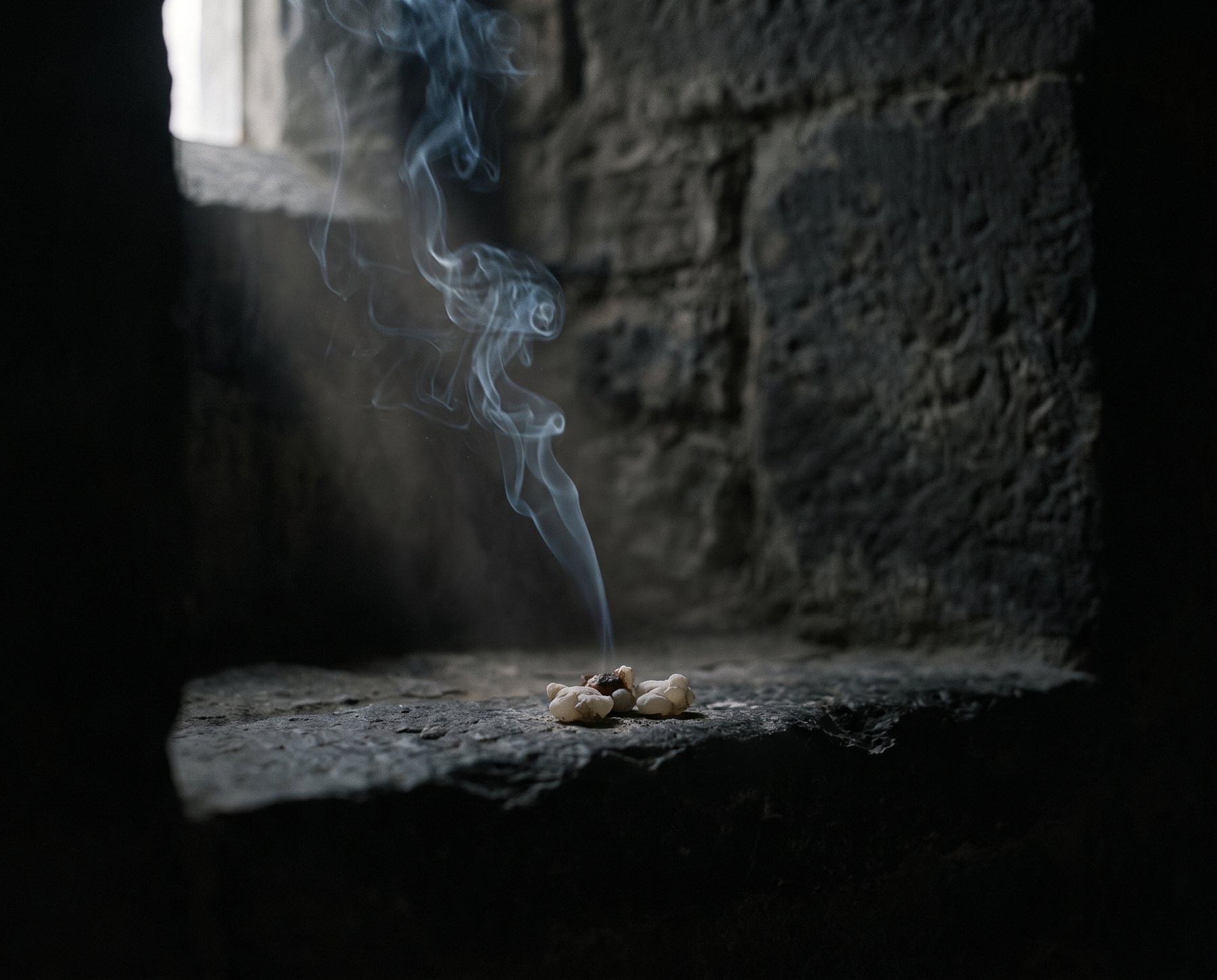
Avignon, 2002: một thành phố bằng khói
Năm 2002, Comme des Garçons dành trọn một bộ sưu tập cho trầm nhựa thơm. Bộ Incense gồm năm mùi, mỗi mùi mang tên một nơi: Avignon, Jaisalmer, Kyoto, Ouarzazate, Zagorsk. Nhà Comme des Garçons mô tả bộ này như một chuyến đi tinh thần qua những trung tâm lịch sử của thế giới.
Avignon là mùi do Bertrand Duchaufour làm. Danh sách nguyên liệu mà nhà công bố ngắn và cụ thể: cúc La Mã, dầu cistus, elemi, trầm, vani, hoắc hương, gỗ hồng. Không có chữ nào nói về đá, về tu viện hay về thời gian. Nhưng tên của thành phố đã làm phần việc đó.
Avignon là một thành phố cổ bên sông Rhône. Đặt tên ấy lên một mùi nhựa cháy là mời người ngửi tưởng tượng một không gian: mát, cao, tường dày, khói đọng lại lâu vì không có gió. Mùi không mô tả nơi chốn. Nó cho người ngửi đứng vào đó.
Tạp chí Nez, khi viết về lịch sử trầm trong nước hoa, gọi Avignon là một trong những mùi được ngưỡng mộ nhất của bộ Incense. Năm 2017, nó có mặt trong triển lãm về nước hoa đương đại tại Somerset House ở London, cạnh những mùi của thế hệ cùng thời.
Một đêm ở Seville
Có một câu chuyện khác, được kể trong sách. Denyse Beaulieu, một người viết về nước hoa, kể cho Duchaufour nghe về một đêm trong tuần lễ Thánh ở Seville, dưới một cây cam đang nở hoa. Từ đêm ấy, ông làm một mùi. Cuốn sách của bà, bản tiếng Pháp tên là Parfums. Une histoire intime, ghi lại quá trình đó.
Chi tiết đáng chú ý là điểm xuất phát. Mùi không bắt đầu từ một chuyến đi của chính người điều hương, mà từ lời kể của một người khác. Nơi chốn đến với ông qua trí nhớ của người kia: hoa cam, đêm lễ, hơi ấm của một khoảnh khắc riêng.
Như vậy, mùi của nơi chốn không nhất thiết là mùi được ghi tại chỗ. Nó có thể là mùi của một ký ức về chỗ ấy. Người điều hương trở thành người chép lại trí nhớ của người khác, bằng một ngôn ngữ không có chữ.
Bếp, tranh, và những chỗ khác
Nơi chốn trong các mùi của Duchaufour không phải lúc nào cũng là một thành phố. Đầu những năm 2000, ông làm Harissa cho Comme des Garçons và Piment brûlant cho L'Artisan Parfumeur, hai mùi xoay quanh ớt. Nơi chốn ở đây là một căn bếp, một nồi sốt, một cái nóng trên đầu lưỡi. Cả hai đều đã ngừng bán.
Có lúc nơi chốn là một bức tranh. Nez ghi rằng những bức tranh màu đen outrenoir của Pierre Soulages đã gợi cho một số người điều hương, trong đó có Duchaufour với Corpus Equus cho Naomi Goodsir. Một bức tranh cũng là một chỗ để đứng trước.
Nhìn chung các mùi ấy, có thể thấy một cách làm việc giống người đi thực địa hơn là người trang trí. Mỗi mùi bắt đầu từ một chỗ cụ thể, có tên, có nhiệt độ, có vật. Mùi không phải là đồ trang sức gắn thêm lên người. Nó là một ghi chép.
Nơi chốn ở lại trong chai
Một bức ảnh chụp một thành phố giữ lại hình của thành phố. Một bản đồ giữ lại đường đi. Một mùi giữ lại thứ mà cả ảnh lẫn bản đồ đều bỏ sót: không khí.
Đó là phần khó giữ nhất của một nơi chốn, vì nó thay đổi theo giờ, theo mùa, theo người đứng đó. Khói trong một không gian đá buổi sáng khác khói buổi chiều. Một mùi cố định được một khoảnh khắc trong dòng thay đổi ấy, rồi mang nó đi xa.
Người ngửi Avignon ở Tokyo hay ở Sài Gòn không đứng ở Avignon. Nhưng họ đứng ở một chỗ mà ai đó đã hình dung ra từ Avignon. Giữa hai chỗ ấy là một khoảng cách, và mùi là cây cầu duy nhất.
Triển lãm Perfume: A Sensory Journey through Contemporary Scent trình bày Avignon cùng những mùi khác mà không cho người xem biết trước mùi nào ở đâu. Người xem chỉ có mùi, và phải tự tìm ra nơi chốn của nó.
Avignon, 2002: a city made of smoke
In 2002 Comme des Garçons devoted an entire collection to incense. The Incense series held five scents, each named for a place: Avignon, Jaisalmer, Kyoto, Ouarzazate, Zagorsk. The house describes the series as a spiritual journey through historical centres of the world.
Avignon was made by Bertrand Duchaufour. The list of materials the house publishes is short and concrete: Roman chamomile, cistus oil, elemi, incense, vanilla, patchouli, rosewood. Not one word about stone, cloister or time. The name of the city does that work.
Avignon is an old city on the Rhône. Putting that name on a smell of burning resin invites the person smelling it to imagine a space: cool, high, thick walled, smoke hanging because there is no wind. The smell does not describe the place. It lets the person stand inside it.
Writing on the history of incense in perfume, Nez magazine calls Avignon one of the most admired scents of the series. In 2017 it was shown in the exhibition on contemporary perfume at Somerset House in London, beside scents of its generation.
A night in Seville
Another story is told in a book. Denyse Beaulieu, a writer on perfume, told Duchaufour about a night during Holy Week in Seville, under an orange tree in flower. From that night he made a perfume. Her book, published in French as Parfums. Une histoire intime, records the process.
The striking detail is the starting point. The perfume did not begin with the perfumer's own journey but with someone else's telling. The place reached him through another person's memory: orange blossom, a festival night, the warmth of a private moment.
So the smell of a place need not be recorded on the spot. It can be the smell of a memory of that place. The perfumer becomes a copyist of someone else's recollection, in a language without words.
Kitchens, paintings, and other places
The place in Duchaufour's scents is not always a city. In the early 2000s he made Harissa for Comme des Garçons and Piment brûlant for L'Artisan Parfumeur, two scents built around chilli. The place here is a kitchen, a pot of sauce, heat on the tongue. Both have since been discontinued.
Sometimes the place is a painting. Nez notes that Pierre Soulages's black outrenoir paintings inspired several perfumers, among them Duchaufour with Corpus Equus for Naomi Goodsir. A painting is also somewhere to stand before.
Taken together, these scents suggest a way of working closer to fieldwork than to decoration. Each begins from a specific place, with a name, a temperature, objects. The smell is not an ornament added to a person. It is a record.
A place kept in a bottle
A photograph of a city keeps its image. A map keeps its routes. A smell keeps what both leave out: the air.
That is the hardest part of a place to keep, because it shifts with the hour, the season, the person standing there. Smoke in a stone space in the morning is not smoke in the afternoon. A smell fixes one moment of that flux and carries it far away.
Someone smelling Avignon in Tokyo or in Saigon is not standing in Avignon. But they are standing in a place someone imagined from Avignon. Between the two is a distance, and the smell is the only bridge.
The exhibition Perfume: A Sensory Journey through Contemporary Scent showed Avignon among other scents without telling visitors in advance which was which. Visitors had only the smell, and had to find its place themselves.
Olfactory Art