
Essays · Olfactory Art
Calone. Mùi biển không có trong biển.
Ta nhận ra biển ở nơi biển chưa từng có mặt.
We recognise the sea where the sea has never been.
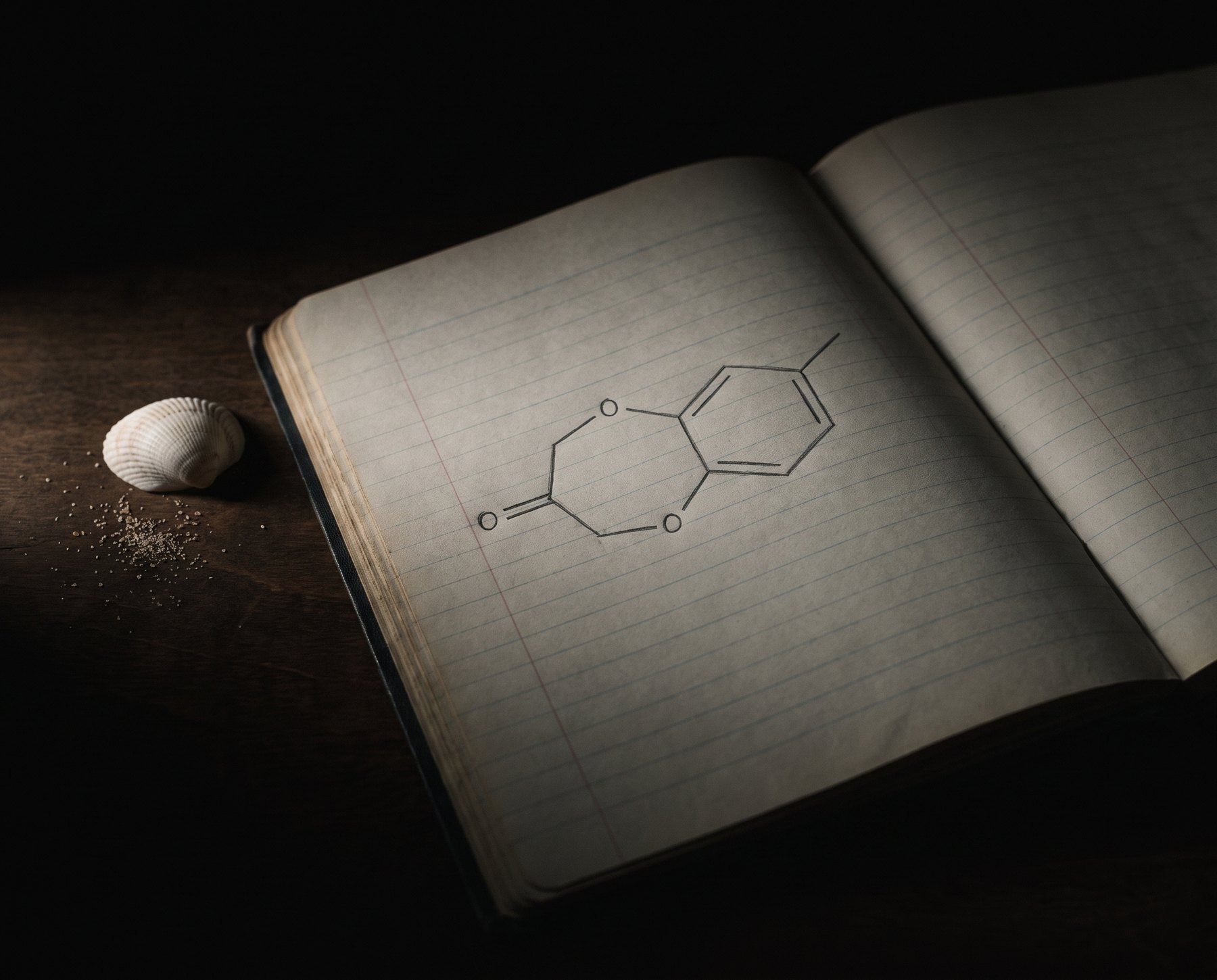
Một phân tử ra đời ngoài ý định
Năm 1966, ba nhà hoá học J. J. Beereboom, D. P. Cameron và C. R. Stephens ở phòng thí nghiệm của Pfizer tại New York tổng hợp một phân tử có tên dài: 7 methyl 2H 1,5 benzodioxepin 3(4H) one. Họ không đi tìm mùi biển. Phân tử này xuất hiện trong một chương trình nghiên cứu hoá học hương thơm, và người ta chỉ nhận ra mùi đặc biệt của nó sau đó.
Pfizer khi ấy có một nhánh làm nguyên liệu mùi, sau khi mua lại một nhà sản xuất ở Grasse. Tên thương mại Calone, theo tài liệu của Osmetheca, lấy từ tên nhà ấy.
Mùi của Calone khó xếp loại. Người ta mô tả nó bằng dưa hấu, dưa lưới, vỏ sò, không khí có iốt ven biển, một cạnh hơi kim loại. Nó rất mạnh, chỉ cần một lượng rất nhỏ. Dùng quá tay, nó thành kim loại và gắt.
Suốt gần hai mươi năm, Calone chỉ được dùng kín đáo, với lượng rất ít, lẫn trong các mùi hoa. Nó chưa có tên gọi nào để người ta nghĩ đến nó như mùi biển.
Mùi nào gọi là biển?
Biển thật có mùi gì? Nếu đứng ở một bến cá, mùi đó là rong phân huỷ, muối, dầu, cá. Một phần mùi biển thật đến từ các hợp chất lưu huỳnh do sinh vật biển tạo ra. Đó không phải mùi dễ chịu cho lắm, và không ai muốn mặc nó.
Calone không có những thứ ấy. Nó sạch, mát, hơi ngọt như ruột dưa hấu vừa bổ. Nó giống biển trong bưu thiếp hơn là biển ở bến cá: một buổi sáng có gió, không có ai, nước trong.
Vậy tại sao người ta lại nhận ra biển trong nó? Có lẽ vì mùi biển mà ta mang trong đầu vốn đã là một phiên bản chọn lọc. Ta nhớ gió, nhớ độ lạnh, nhớ muối trên da. Ta quên phần tanh. Calone khớp với phiên bản đã chọn lọc ấy, nhiều hơn là với biển thật.
Nói cách khác, Calone không bắt chước biển. Nó bắt chước ký ức về biển.
Thập niên 1990, mùi biển thành một thời
Cuối thập niên 1980, Calone bắt đầu bước ra khỏi vai phụ. Năm 1988, New West for Her của Aramis, do Yves Tanguy làm, dùng nó rõ ràng, và mở ra một kiểu mùi mà người ta về sau gọi là mùi nước.
Năm 1992, Jacques Cavallier làm L'Eau d'Issey cho Issey Miyake: Calone đặt giữa một bó hoa trong, bên cạnh sen và dưa. Chai nước hoa ấy thường được xem là cột mốc của nhánh hoa biển. Vài năm sau, mùi nước xuất hiện ở khắp nơi, trong nước hoa nam lẫn nữ, trong sữa tắm, trong nước giặt.
Thập niên 1990 vì thế có một mùi riêng. Ai lớn lên trong những năm ấy có thể nhận ra nó ngay: trong, mát, hơi ngọt, như một phòng tắm mới lau. Sau năm 2000, người làm nước hoa dùng Calone dè dặt hơn, để tránh cái mác của một thời.
Một phân tử không có trong biển đã trở thành mùi biển của cả một thế hệ. Và giờ đây, với nhiều người, nó còn là mùi của một thập niên.
Nhận ra một nơi chưa từng có mặt
Mỗi mùi ta nhận ra là một mùi ta đã học. Không ai sinh ra đã biết mùi cà phê hay mùi mưa. Ta học chúng qua việc gặp đi gặp lại, cùng với một nơi, một lúc.
Calone cho thấy việc học ấy có thể đi ngược chiều. Người ta không gặp phân tử này ở biển. Họ gặp nó trong chai, trên da người khác, trong phòng tắm. Nhưng vì nó được gọi là biển, được bán kèm hình ảnh sóng và cát, họ dần học để nhận ra biển trong nó.
Đến một lúc, trật tự đảo lại hoàn toàn. Có người đứng trước biển thật và thấy biển không có mùi giống biển. Mùi họ chờ đợi nằm trong một chai thuỷ tinh ở nhà.
Calone vì thế là một vật chứng thú vị. Nó cho thấy dấu vết không nhất thiết phải đến từ vật. Đôi khi, dấu vết có trước, và vật được dựng lên quanh nó.
A molecule nobody went looking for
In 1966 three chemists, J. J. Beereboom, D. P. Cameron and C. R. Stephens, at Pfizer's laboratories in New York, synthesised a molecule with a long name: 7 methyl 2H 1,5 benzodioxepin 3(4H) one. They were not looking for the sea. The molecule came out of aromatic chemistry work, and its unusual smell was noticed afterwards.
Pfizer then had a branch making smell materials, having bought a producer in Grasse. The trade name Calone, according to Osmetheca, comes from that house's name.
Calone is hard to classify. People describe watermelon, cantaloupe, seashell, the iodine air of a coast, a metallic edge. It is very strong; tiny amounts suffice. Overdosed, it turns metallic and harsh.
For almost twenty years Calone was used discreetly, in small amounts, hidden in floral accords. Nothing yet invited anyone to think of it as the sea.
Which smell is the sea?
What does the real sea smell of? On a fishing quay, it is rotting seaweed, salt, diesel, fish. Part of the real sea smell comes from sulphur compounds produced by marine organisms. It is not especially pleasant, and nobody wants to wear it.
Calone has none of that. It is clean, cool, slightly sweet like a freshly cut watermelon. It resembles the postcard sea more than the quay: a windy morning, no one around, clear water.
So why do people find the sea in it? Perhaps because the sea we carry in our heads is already an edited version. We remember the wind, the cold, salt on skin. We forget the fishiness. Calone matches that edited version more than the sea itself.
In other words, Calone does not imitate the sea. It imitates the memory of the sea.
The 1990s, when the sea became an era
In the late 1980s Calone stepped out of the background. In 1988 New West for Her by Aramis, made by Yves Tanguy, used it openly and opened a style later called aquatic.
In 1992 Jacques Cavallier made L'Eau d'Issey for Issey Miyake: Calone set in a clear bouquet beside lotus and melon. It is often cited as the landmark of the floral marine branch. Within a few years the watery smell was everywhere, in men's and women's perfume, in shower gel, in laundry products.
The 1990s therefore have a smell of their own. Anyone who grew up then can name it at once: clear, cool, a little sweet, like a freshly cleaned bathroom. After 2000 perfumers used Calone more carefully, to avoid the label of an era.
A molecule absent from the sea became the sea of a generation. For many people it is now also the smell of a decade.
Recognising a place that was never there
Every smell we recognise is one we have learned. No one is born knowing the smell of coffee or rain. We learn them by meeting them again and again, with a place, at a time.
Calone shows the learning can run backwards. People did not meet this molecule at the sea. They met it in bottles, on other people's skin, in bathrooms. But because it was called the sea, sold with pictures of waves and sand, they learned to find the sea in it.
At some point the order flipped completely. Some people stand before a real sea and find that it does not smell like the sea. The smell they expect is in a glass bottle at home.
So Calone is a curious piece of evidence. It shows a trace need not come from an object. Sometimes the trace comes first, and the object is built around it.
Olfactory Art