
Essays · Contemporary Art
Haegue Yang. Series of Vulnerable Arrangements, Voice and Wind.
Một cái tên trên chai không phải là nơi chốn.
A name on a bottle is not a place.
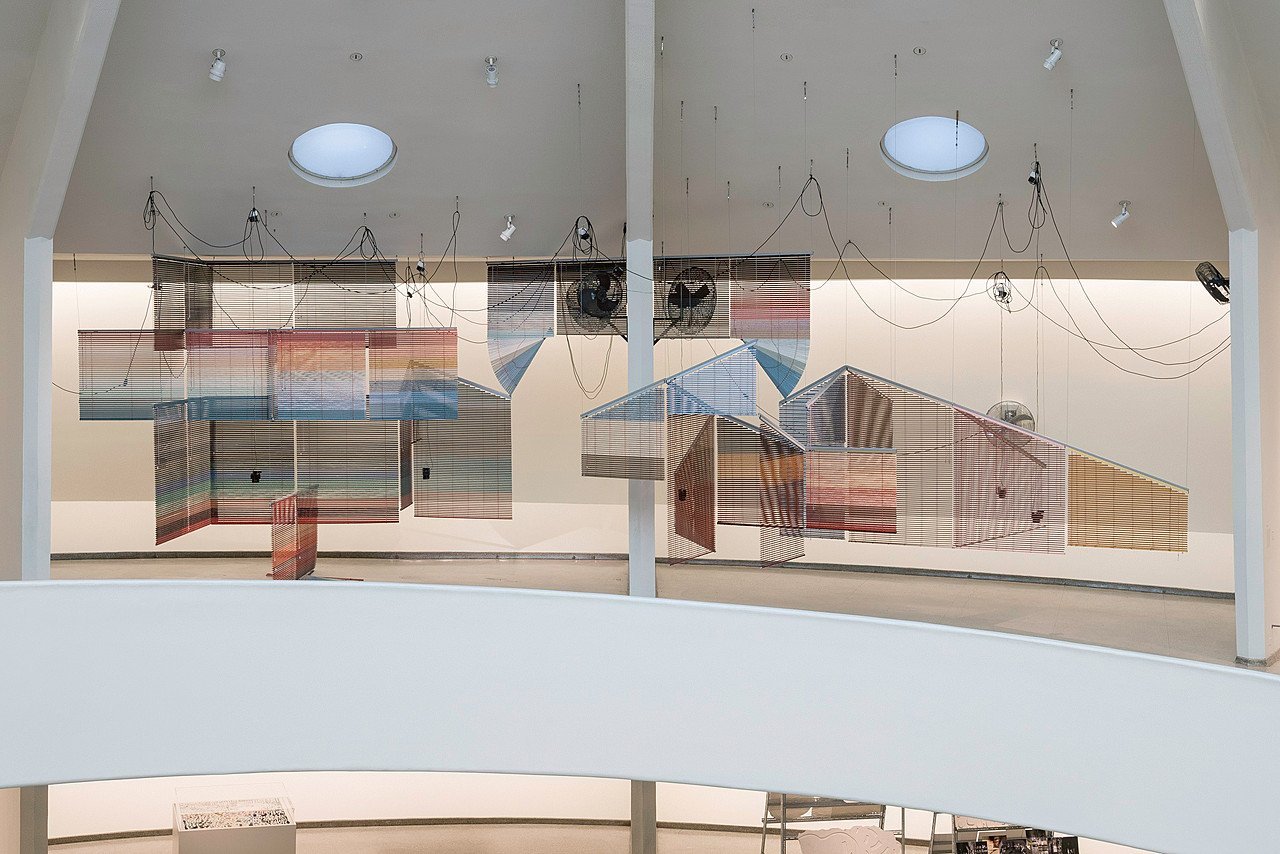
Solomon R. Guggenheim Museum · Solomon R. Guggenheim Museum
Rèm, quạt và máy toả mùi
Series of Vulnerable Arrangements, Voice and Wind là một sắp đặt năm 2009 của Haegue Yang, nay thuộc bộ sưu tập của bảo tàng Solomon R. Guggenheim ở New York. Kích thước của nó thay đổi theo từng không gian.
Danh mục vật liệu đọc lên rất khô: rèm lá sách bằng nhôm, khung nhôm, quạt điện công nghiệp, máy toả mùi, và mùi. Không có gì được làm riêng cho tác phẩm. Tất cả đều là đồ mua được.
Rèm được treo thành những vách mỏng, chia căn phòng thành các lối đi. Quạt quay, làm các lá rèm khẽ lay. Giữa những lần lay ấy, mùi từ các máy toả lan ra. Người xem đi xuyên qua, nhìn qua khe rèm, và thấy những người khác chỉ qua từng dải hẹp.
Không có điểm nhìn chính. Không có vật trưng bày ở giữa phòng. Tác phẩm là tổng của gió, ánh sáng lọt qua khe, tiếng quạt và mùi.
Sáu cái tên
Guggenheim ghi rõ tên sáu mùi trong tác phẩm: Buddha Temple, Fresh Cut Grass, Rainforest, Ocean Mist, Cedar Wood và Eucalyptus. Chùa Phật, cỏ mới cắt, rừng mưa, sương biển, gỗ tuyết tùng, bạch đàn.
Đọc liền nhau, danh sách này giống một tấm bản đồ du lịch. Một ngôi chùa ở châu Á, một bãi cỏ ngoại ô, một khu rừng nhiệt đới, một bờ biển. Tất cả được sản xuất bằng hoá chất và bán trong những chiếc máy như nhau.
Theo bảo tàng, Yang đặt câu hỏi vì sao sản xuất hàng loạt lại cố bắt lấy những cảm giác vốn thay đổi, gắn với văn hoá, và khó nắm bắt. Mùi của một ngôi chùa không giống nhau ở hai nơi. Nó phụ thuộc vào gỗ, vào nhang, vào người thắp, vào mùa. Một chiếc máy không giữ được những điều đó. Nó chỉ giữ được cái tên.
Khi mùi Buddha Temple lan qua một tấm rèm nhôm trong phòng triển lãm ở New York, khoảng cách giữa cái tên và nơi chốn hiện ra rất rõ. Người xem ngửi thấy một thứ gì đó. Nhưng đó là gì thì mỗi người tự điền vào.
Đồ trong nhà, ra giữa phòng
Rèm và quạt là đồ của một căn nhà. Bảo tàng đọc chúng như một lời gợi nhắc tới khái niệm nhà, đồng thời là những vách ngăn chia không gian và tách người xem khỏi xung quanh, khỏi nhau.
Tác phẩm của Yang thường xoay quanh chuyện di chuyển, rời chỗ, sống giữa nhiều nơi. Rèm lá sách là thứ ta kéo xuống để giữ riêng tư. Quạt là thứ ta bật lên khi căn phòng quá ngột. Đưa chúng ra giữa một không gian công cộng, cái riêng tư bị bày ra, nhưng không kể câu chuyện của ai cụ thể.
Đó là lý do tác phẩm có chữ dễ tổn thương trong tên. Mọi thứ đều nhẹ. Rèm lay theo gió, mùi tan dần, ánh sáng đổi theo góc nhìn. Không có gì cố định. Sự sắp đặt chỉ đứng vững chừng nào quạt còn quay.
Ba giác quan trong một lối đi
Guggenheim mô tả tác phẩm như một môi trường nơi khứu giác, xúc giác và thị giác sụp vào nhau. Mắt thấy dải rèm, da cảm được gió, mũi nhận ra mùi. Không giác quan nào dẫn đường.
Điều này khiến Voice and Wind khó chụp ảnh. Một tấm ảnh chỉ giữ được rèm và quạt. Gió và mùi, hai phần quan trọng nhất, biến mất. Người chưa từng đứng trong phòng sẽ chỉ thấy một sắp đặt bằng nhôm.
Có lẽ vì vậy tác phẩm để lại một câu hỏi lâu hơn hình ảnh của nó. Những cái tên in trên chai mùi quanh ta, trong xe hơi, khách sạn, cửa hàng, đang hứa hẹn những nơi chốn nào? Và ta đã bao giờ thật sự đến đó chưa? Cùng loạt tác phẩm này, một phiên bản khác được bàn trong bài Version Utrecht.
Blinds, fans and scent emitters
Series of Vulnerable Arrangements, Voice and Wind is a 2009 installation by Haegue Yang, now in the collection of the Solomon R. Guggenheim Museum in New York. Its dimensions change with each space.
The list of materials reads dryly: aluminium venetian blinds, aluminium frame, industrial electric fans, scent emitters, and scents. Nothing was made specially for the work. Everything can be bought.
The blinds hang as thin partitions, dividing the room into passages. The fans turn and the slats sway. Between those movements, scent drifts out of the emitters. Visitors walk through, look between the slats, and see other people only in narrow strips.
There is no main viewpoint. No object sits in the middle of the room. The work is the sum of wind, light through the gaps, the sound of fans, and smell.
Six names
The Guggenheim lists the six scents by name: Buddha Temple, Fresh Cut Grass, Rainforest, Ocean Mist, Cedar Wood and Eucalyptus.
Read together, the list is like a travel map. A temple in Asia, a suburban lawn, a tropical forest, a coast. All of it produced chemically and sold in identical machines.
According to the museum, Yang asks why mass production would try to capture sensations that are variable, culturally bound and sublime. The smell of a temple is not the same in two places. It depends on the wood, the incense, the person lighting it, the season. A machine cannot hold that. It can only hold the name.
When Buddha Temple drifts through an aluminium blind in a New York gallery, the distance between name and place becomes very clear. Visitors smell something. What that something is, each fills in for themselves.
Household things in the middle of the room
Blinds and fans belong to a home. The museum reads them as an allusion to home, and at the same time as partitions that divide the space and separate viewers from their surroundings and from each other.
Yang's work often turns on travel, displacement, living between places. A blind is what we lower for privacy. A fan is what we switch on when a room is stuffy. Brought into a public space, the private is put on show, yet it tells no particular person's story.
That is why the title carries the word vulnerable. Everything is light. The slats sway, the scent fades, the light shifts with the angle. Nothing is fixed. The arrangement holds only as long as the fans keep turning.
Three senses in one passage
The Guggenheim describes the work as an environment where smell, touch and sight collapse together. The eye sees the slats, the skin feels the wind, the nose picks up the scent. No sense leads.
This makes Voice and Wind hard to photograph. A picture keeps only the blinds and fans. Wind and scent, the two most important parts, vanish. Someone who never stood in the room will see only an aluminium installation.
Perhaps that is why the work leaves a question that outlasts its image. The names printed on the scents around us, in cars, hotels, shops: what places are they promising? And have we ever actually been there? Another work from the same series is discussed in Version Utrecht.
Contemporary Art