
Essays · Olfactory Art
Mùi mưa. Đất ướt trước khi có tên.
Cả một mùa khô được thả ra trong vài phút.
A whole dry season released in a few minutes.
Bear và Thomas, 1964: đặt tên cho mùi mưa
Mùi đất khi mưa đầu mùa rơi xuống là một trong những mùi được biết đến rộng nhất trên đời. Nông dân biết, trẻ con biết, người thành phố biết. Nhưng trong một thời gian rất dài, nó không có một cái tên riêng trong khoa học.
Năm 1964, hai nhà khoa học của tổ chức nghiên cứu CSIRO ở Úc, Isabel Joy Bear và Richard Thomas, công bố một bài ngắn trên tạp chí Nature với tựa đề về bản chất của mùi đất sét. Họ đề xuất gọi mùi ấy là petrichor.
Chữ này ghép từ hai gốc Hy Lạp. Petra là đá. Ichor, trong thần thoại, là chất lỏng chảy trong mạch của các vị thần. Mùi mưa, theo cách gọi ấy, là máu của đá.
Bear và Thomas cho rằng một phần mùi đến từ dầu do cây cỏ tiết ra trong thời gian khô, bám vào bề mặt đá và đất sét, rồi được giải phóng khi gặp nước. Một cái tên, và một lời giải thích: mùi ấy đã ở đó từ trước cơn mưa.
Geosmin: một phân tử từ vi khuẩn đất
Một năm sau, năm 1965, Nancy Gerber và Hubert Lechevalier tách được một chất có mùi đất từ nhóm vi khuẩn actinomycetes sống trong đất. Họ gọi nó là geosmin, nghĩa là mùi của đất.
Geosmin là phần mà nhiều người nhận ra rõ nhất trong mùi mưa. Nó cũng là mùi đất trong củ dền, mùi bùn đôi khi thấy trong cá nước ngọt hay nước máy. Mũi người cực kỳ nhạy với nó: chỉ một lượng rất nhỏ trong không khí là đủ để nhận ra.
Vậy là mùi mưa có ít nhất hai nguồn: dầu của cây cỏ ngấm vào đá, và phân tử do vi khuẩn làm ra trong đất. Cả hai đều tích lại trong mùa khô. Cả hai đều cần nước để bay lên. Mưa chỉ là chiếc chìa khoá.
Giọt mưa bắn mùi lên không khí
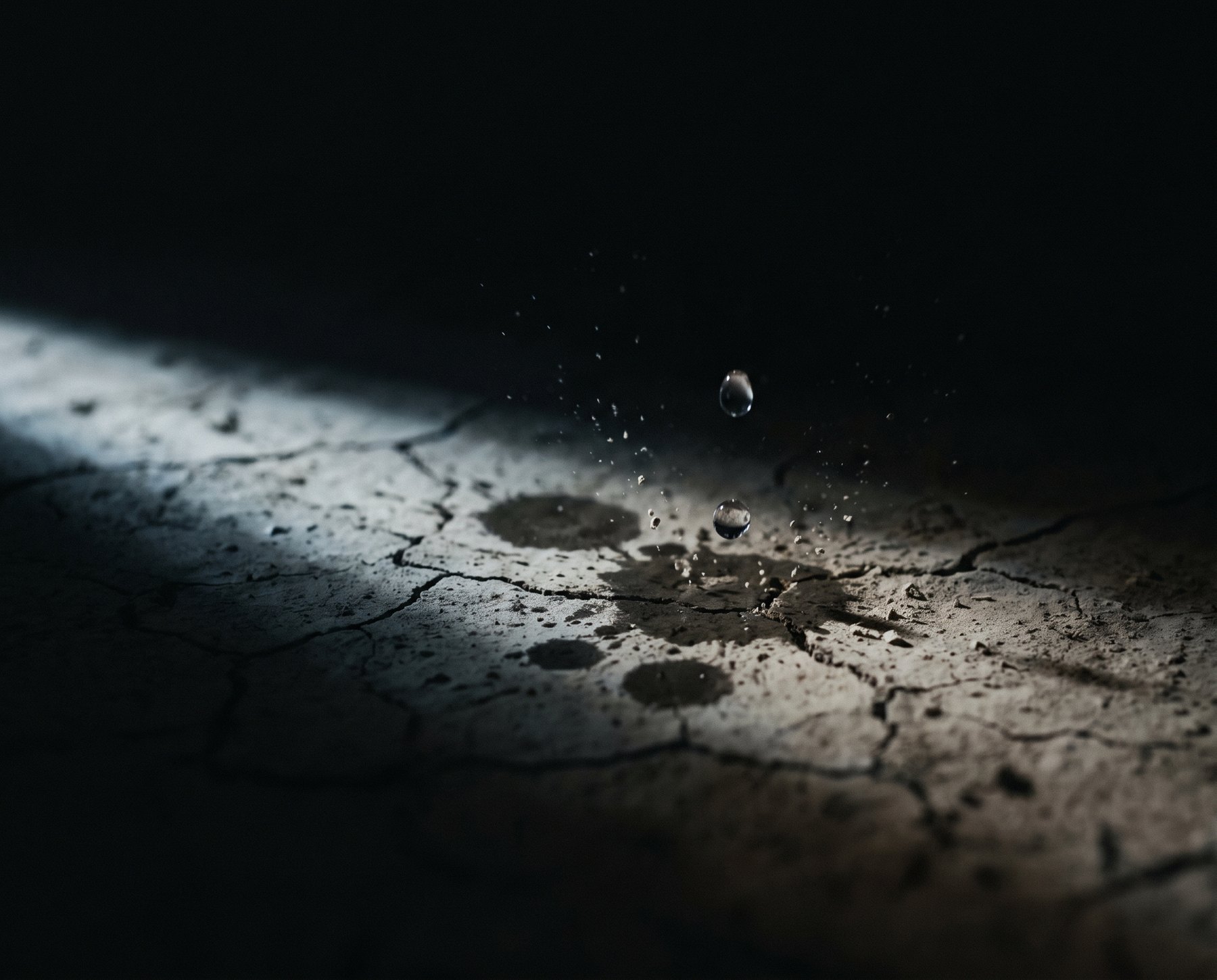
Còn một câu hỏi: làm sao mùi từ mặt đất lên được tới mũi người? Năm 2015, Youngsoo Joung và Cullen Buie ở MIT công bố trên tạp chí Nature Communications một nghiên cứu dùng camera tốc độ cao để quan sát giọt nước rơi xuống các bề mặt xốp.
Họ làm khoảng sáu trăm thí nghiệm trên hai mươi tám bề mặt, trong đó có mười sáu mẫu đất. Điều họ thấy: khi giọt nước chạm một bề mặt xốp, nó giữ lại những bọt khí nhỏ. Bọt khí đi lên trong giọt nước rồi vỡ ra, bắn vào không khí những hạt li ti, giống bọt trong một ly nước có ga.
Mưa nhẹ và vừa tạo ra nhiều hạt như vậy hơn mưa lớn. Điều này khớp với điều người ta vẫn biết mà không cần đo: mùi mưa rõ nhất khi những giọt đầu tiên, thưa thớt, rơi xuống mặt đất khô. Khi mưa đã xối xả, mùi lại nhạt đi.
Mỗi giọt mưa, theo cách nhìn ấy, là một cái máy nhỏ đưa đất lên không khí.
Một cơn mưa dựng lại
Người làm mùi từ lâu đã muốn giữ lại cơn mưa. Ở Kannauj, miền bắc Ấn Độ, có một loại attar gọi là mitti, nghĩa là đất. Người ta nung những đĩa đất sét, rồi chưng cất chúng trong nồi đồng, cho hơi nước đi vào dầu đàn hương. Mùi thu được gợi đến đất khô sau cơn mưa đầu tiên, đồ gốm vừa nung, đá ướt.
Nước hoa phương Tây đi một đường khác. Từ cuối thập niên 1980, một kiểu mùi gọi là ozone ra đời, dùng những phân tử như Calone hay Floralozone để gợi không khí sau mưa, gió biển, nước. Đó là mưa theo nghĩa sạch và trong, ít đất hơn.
Cả hai đều là dựng lại. Mitti giữ phần đất. Ozone giữ phần không khí. Không bản nào có đủ cả mùa khô ở bên trong.
Có lẽ vì mùi mưa thật không phải là một vật. Nó là một sự kiện: đất khô, rồi nước, rồi vài phút. Muốn ngửi nó trọn vẹn, vẫn phải đứng ngoài trời, đúng lúc cơn mưa đầu mùa bắt đầu.
Bear and Thomas, 1964: naming the smell of rain
The smell of earth when the first rain of the season falls is among the most widely known smells in the world. Farmers know it, children know it, city people know it. Yet for a long time it had no name of its own in science.
In 1964 two scientists at the Australian research organisation CSIRO, Isabel Joy Bear and Richard Thomas, published a short paper in Nature on the nature of the smell of clay. They proposed calling it petrichor.
The word joins two Greek roots. Petra is stone. Ichor, in myth, is the fluid that runs in the veins of the gods. The smell of rain, by that name, is the blood of stone.
Bear and Thomas argued that part of the smell comes from oils released by plants in dry weather, held on the surface of rock and clay and freed when water arrives. A name, and an explanation: the smell was there before the rain.
Geosmin: a molecule from soil bacteria
A year later, in 1965, Nancy Gerber and Hubert Lechevalier isolated an earthy smelling substance from actinomycetes, bacteria that live in soil. They called it geosmin, the smell of earth.
Geosmin is the part of rain's smell many people recognise most. It is also the earthiness of beetroot, the muddy note sometimes found in freshwater fish or tap water. The human nose is extremely sensitive to it: a tiny amount in the air is enough.
So the smell of rain has at least two sources: plant oils held in stone, and a molecule made by bacteria in soil. Both build up in the dry season. Both need water to rise. Rain is only the key.
Raindrops throw smell into the air
One question remained: how does a smell on the ground reach a nose? In 2015 Youngsoo Joung and Cullen Buie at MIT published a study in Nature Communications using high speed cameras to watch drops falling on porous surfaces.
They ran about six hundred experiments on twenty eight surfaces, sixteen of them soils. What they saw: when a drop hits a porous surface it traps tiny bubbles of air. The bubbles rise through the drop and burst, throwing fine particles into the air, like the fizz in a glass of soda.
Light and moderate rain made more of these particles than heavy rain. This fits what people have always known without measuring: the smell is strongest when the first sparse drops hit dry ground. Once the rain pours, the smell fades.
Each raindrop, seen this way, is a small machine that lifts earth into the air.
A rebuilt rain
Makers of scent have long wanted to keep the rain. In Kannauj, in northern India, there is an attar called mitti, meaning earth. Discs of clay are baked, then distilled in copper pots, the vapour passing into sandalwood oil. The result recalls dry earth after the first rain, freshly fired pottery, wet stone.
Western perfume took another road. From the late 1980s a style called ozonic appeared, using molecules such as Calone and Floralozone to suggest air after rain, sea breeze, water. That is rain in a clean, clear sense, with less earth.
Both are reconstructions. Mitti keeps the earth. Ozonic keeps the air. Neither holds a whole dry season inside.
Perhaps because the real smell of rain is not a thing. It is an event: dry ground, then water, then a few minutes. To smell it whole, you still have to stand outside at the moment the first rain begins.
Olfactory Art