
Essays · Olfactory Art
Xạ hương trắng. Không có con hươu nào.
Cái tên ở lại. Con vật thì không.
The name stayed. The animal did not.
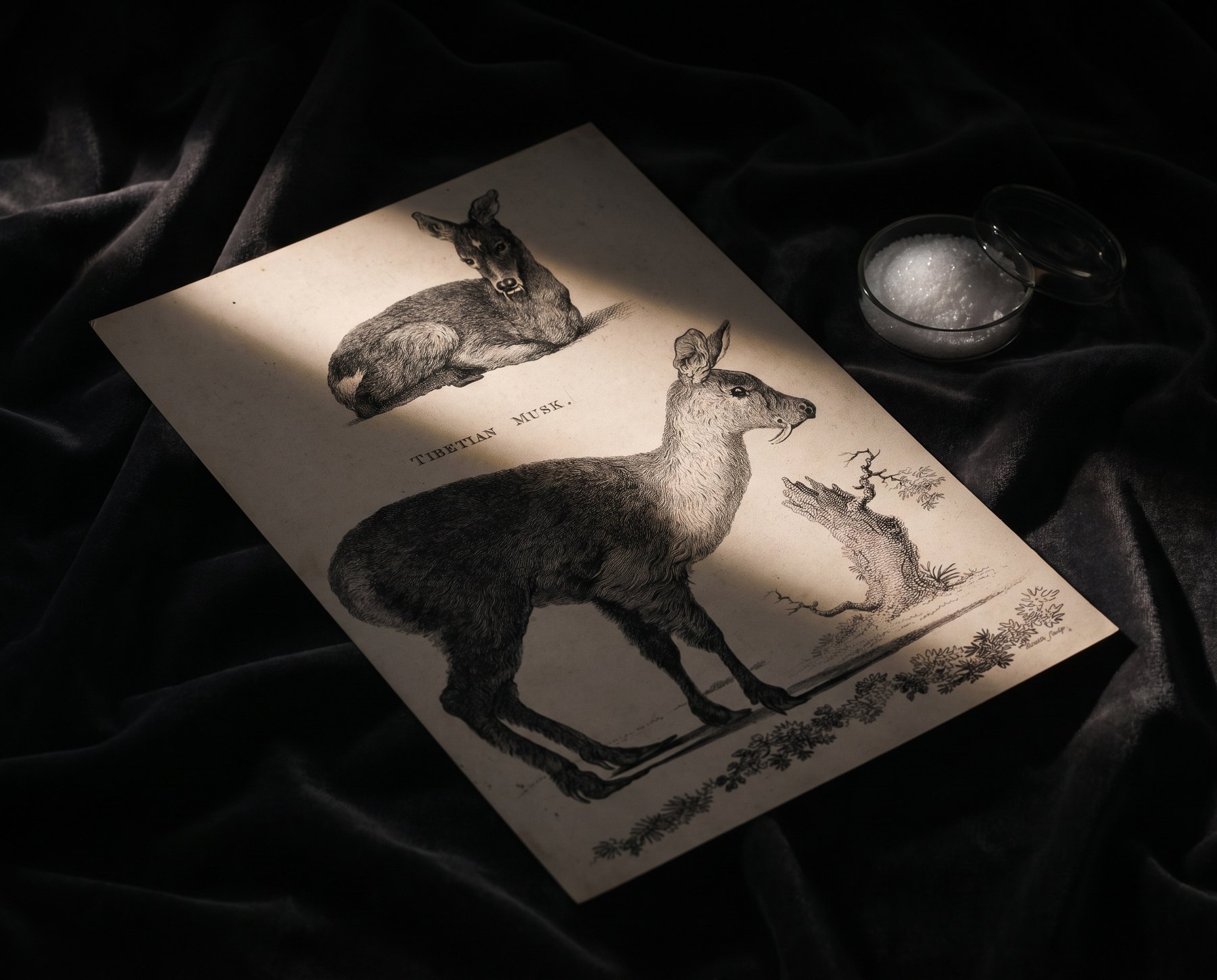
Hươu xạ và một túi tuyến
Hươu xạ là một loài hươu nhỏ, không có sừng, sống trong rừng núi châu Á, từ Siberia qua dãy Himalaya xuống miền nam Trung Quốc. Con đực có một túi tuyến nằm dưới bụng. Chất tiết bên trong khô lại thành những hạt nâu sẫm. Đó là xạ hương theo nghĩa gốc.
Trong nhiều thế kỷ, muốn có xạ hương thì phải giết con hươu để cắt lấy túi tuyến. Thứ này đắt, nặng mùi khi còn đậm đặc, và chỉ cần một lượng rất nhỏ là đủ lan khắp một căn phòng. Người làm nước hoa pha nó thành cồn ngâm, để lâu, rồi dùng từng giọt.
Có một chi tiết gần với Việt Nam. Trong thương mại châu Âu thế kỷ 19, loại xạ hương được đánh giá cao mang tên Tonkin, tức Bắc Kỳ. Cái tên không chỉ một loài riêng. Nó chỉ một con đường buôn bán, nơi hàng từ Vân Nam và vùng núi phía bắc đi ra biển.
Hôm nay, các loài hươu xạ được Công ước CITES kiểm soát, một số quần thể ở mức bảo vệ cao nhất. Xạ hương tự nhiên gần như đã biến mất khỏi nước hoa quốc tế từ cuối thế kỷ 20. Con hươu đã rời câu chuyện.
Từ musk nitro đến musk vòng lớn
Phần thay thế bắt đầu bằng một sự tình cờ. Năm 1888, nhà hoá học Albert Baur đang nghiên cứu các hợp chất gần với thuốc nổ thì thu được một chất có mùi giống xạ hương. Đó là họ musk nitro. Chúng rẻ, bền, và được dùng rất rộng trong nửa đầu thế kỷ 20. Về sau, phần lớn bị cấm hoặc hạn chế vì lo ngại độc tính và tồn lưu trong môi trường.
Năm 1906, Heinrich Walbaum tách được muscone, phân tử tạo mùi chính của xạ hương hươu. Năm 1926, Leopold Ružička chỉ ra rằng muscone là một vòng lớn gồm mười lăm nguyên tử carbon. Công trình về các vòng lớn này góp phần đưa ông tới giải Nobel Hoá học năm 1939. Từ đó ra đời họ musk vòng lớn.
Năm 1965, các nhà hoá học của IFF tìm ra Galaxolide, một musk đa vòng. Nó rẻ, bền trong xà phòng và bột giặt, và mùi của nó sạch. Chẳng bao lâu nó trở thành musk được dùng nhiều nhất thế giới. Về sau người ta phát hiện nó trong nước thải và bùn, và ngành này dần chuyển sang những phân tử dễ phân huỷ hơn.
Mỗi thế hệ musk là một câu trả lời cho câu hỏi của thế hệ trước. Không thế hệ nào cần đến con hươu.
Vì sao gọi là trắng
Chữ trắng không đến từ màu của phân tử. Nó đến từ nơi người ta gặp mùi ấy nhiều nhất: áo sơ mi vừa giặt, khăn trải giường phơi khô, xà phòng trong phòng tắm. Galaxolide và các musk sau nó đi vào bột giặt và nước xả vải trước khi đi vào nước hoa. Mũi của cả một thế hệ học mùi ấy từ quần áo.
Vì vậy xạ hương trắng không gợi con vật. Nó gợi sự sạch sẽ, sự gần gũi, làn da sau khi tắm. Một số musk vòng lớn được mô tả như mùi vải lanh vừa giặt, hơi kim loại, hơi sáp. Không có gì của rừng núi.
Có một điều lạ nữa. Không phải ai cũng ngửi thấy mọi phân tử musk. Nhiều người không nhận ra một musk nào đó, dù người bên cạnh thấy rất rõ. Vì thế người làm nước hoa thường dùng vài loại musk cùng lúc, để mỗi người đều bắt được ít nhất một. Xạ hương trắng, theo nghĩa đó, là một mùi được dựng cho đám đông, với những cái mũi khác nhau.
Cái tên còn lại
Lịch sử của xạ hương là lịch sử của một sự thay thế trọn vẹn. Vật gốc đã đi. Phân tử thay thế cũng đã đổi nhiều lần. Chỉ có chữ là ở lại, như một cái nhãn dán trên một chiếc hộp đã đổi đồ bên trong.
Điều đó không làm mùi hôm nay kém thật. Nó chỉ khác. Mùi vải sạch là một sự thật của đời sống hiện đại, cũng như mùi túi tuyến là sự thật của một thời khác. Cả hai đều có chỗ đứng. Chỉ là khi nghe chữ xạ hương trắng, ít ai nghĩ tới một con hươu nhỏ đứng trong sương trên sườn núi.
Có lẽ đó là cách nhiều chữ trong ngôn ngữ vẫn sống. Chúng mang theo một vật đã khuất, và ta dùng chúng mỗi ngày mà không cần biết.
The musk deer and a gland
The musk deer is a small, antlerless deer of the mountain forests of Asia, from Siberia across the Himalaya to southern China. The male carries a gland under its belly. The secretion inside dries into dark brown grains. That is musk in its original sense.
For centuries, getting musk meant killing the deer to cut out the gland. The material was costly, harsh when concentrated, and a tiny amount could fill a room. Perfumers steeped it in alcohol, let it age, and used it by the drop.
One detail touches Vietnam. In nineteenth century European trade, a highly graded musk went by the name Tonkin, the colonial name for northern Vietnam. The name did not mark a separate species. It marked a trade route, where goods from Yunnan and the northern mountains reached the sea.
Today the musk deer species are controlled under CITES, some populations at the highest level of protection. Natural musk has been almost absent from international perfumery since the late twentieth century. The deer has left the story.
From nitro musks to large rings
The substitutes began by accident. In 1888 the chemist Albert Baur, working on compounds related to explosives, obtained a substance that smelled of musk. These were the nitro musks: cheap, stable, and widely used in the first half of the twentieth century. Most were later banned or restricted over toxicity and persistence in the environment.
In 1906 Heinrich Walbaum isolated muscone, the main odorant of deer musk. In 1926 Leopold Ružička showed that muscone is a large ring of fifteen carbon atoms, work that fed into his Nobel Prize in Chemistry in 1939. The macrocyclic musks grew from there.
In 1965 chemists at IFF found Galaxolide, a polycyclic musk. It was cheap, stable in soap and detergent, and it smelled clean. It soon became the most used musk in the world. Later it was found in wastewater and sludge, and the industry moved slowly toward molecules that break down more easily.
Each generation of musk answers the problem of the one before. None of them needs the deer.
Why white
The word white does not come from the colour of any molecule. It comes from where people meet the smell most: a freshly washed shirt, sheets dried in the sun, soap in the bathroom. Galaxolide and the musks after it entered detergent and fabric softener before they entered perfume. A whole generation learned the smell from its clothes.
So white musk does not recall an animal. It recalls cleanliness, closeness, skin after a shower. Some macrocyclic musks are described as freshly washed linen, faintly metallic, faintly waxy. Nothing of the mountains.
There is one more oddity. Not everyone can smell every musk molecule. Many people miss one musk that the person beside them finds obvious. Perfumers therefore often use several musks at once, so that each nose catches at least one. White musk, in that sense, is built for a crowd of different noses.
The name that remains
The history of musk is a history of complete substitution. The original thing has gone. The substitutes have changed many times. Only the word stayed, like a label on a box whose contents were replaced.
That does not make today's smell less real. It is simply different. Clean laundry is a fact of modern life, as the gland was a fact of another time. Few people, hearing white musk, picture a small deer standing in mountain mist.
Perhaps that is how many words survive. They carry something that has gone, and we use them every day without needing to know.

Olfactory Art