
Essays · Olfactory Art
Zwaardemaker. Chín lớp mùi và một cái máy.
Khi mùi có một con số, nó vẫn chưa có một cái tên.
A smell with a number still has no name.
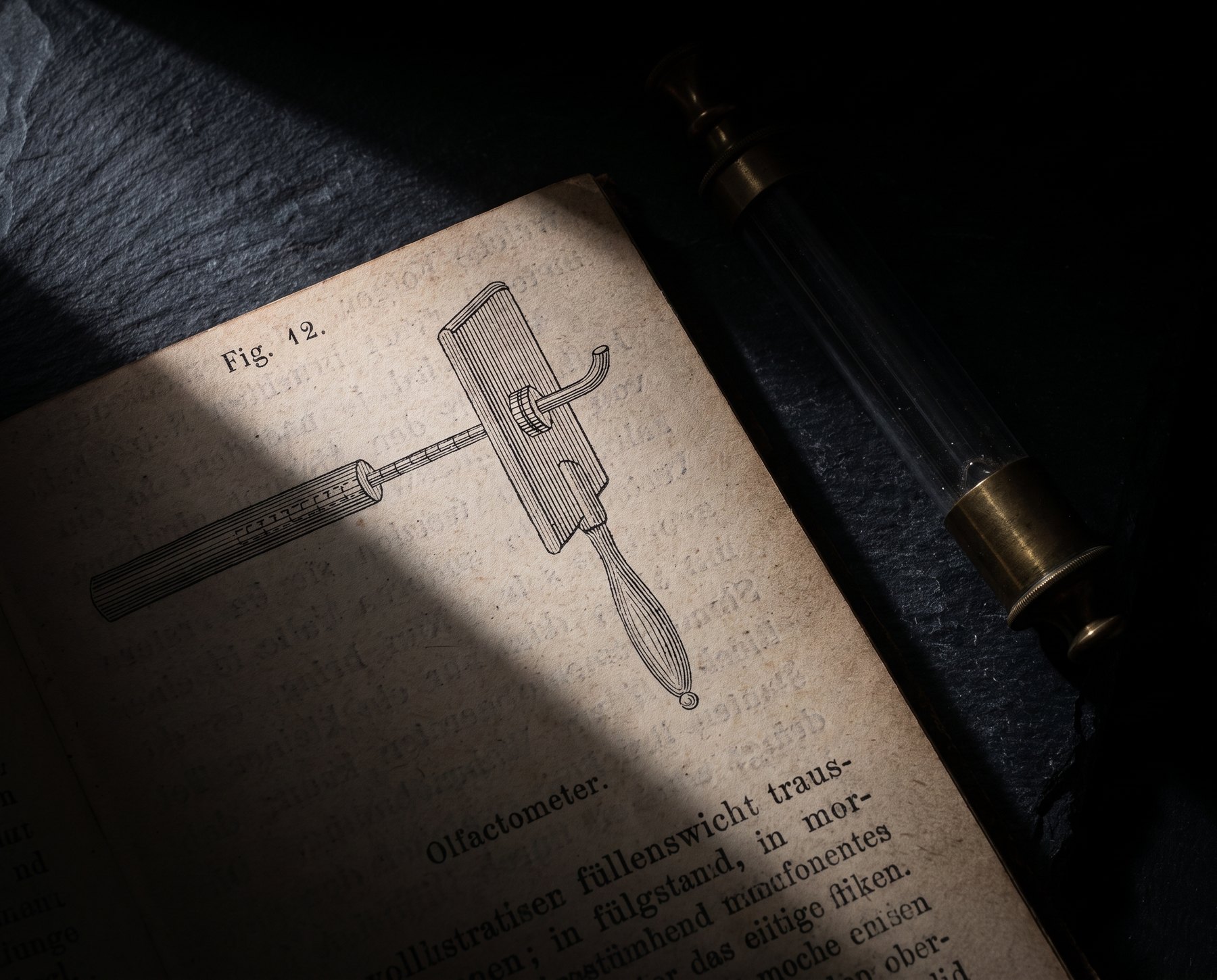
Utrecht, 1888: chiếc olfactometer
Hendrik Zwaardemaker sống từ năm 1857 đến năm 1930. Ông là bác sĩ và nhà sinh lý học người Hà Lan. Năm 1888, khi còn là bác sĩ quân y ở Utrecht, ông mô tả lần đầu một dụng cụ mà ông gọi là Riechmesser, tức máy đo mùi, hay olfactometer. Bài mô tả xuất hiện trong một tập kỷ niệm tặng nhà nhãn khoa Donders, rồi trên một tạp chí y khoa ở Berlin cùng năm, và trên The Lancet năm sau.
Cấu tạo không có gì phức tạp. Một ống thuỷ tinh cong, một đầu đặt vào nửa trước lỗ mũi. Ống ấy lồng trong một ống trụ làm bằng, hoặc tẩm, chất có mùi, dài mười centimet. Khi kéo ống trụ ra xa đầu hít, phần bề mặt có mùi tiếp xúc với luồng khí dài hơn, và mùi mạnh hơn. Một tấm chắn gỗ che lỗ mũi bên kia.
Điều quan trọng là độ dài. Nó đọc được trên ống. Nhờ vậy, người làm thí nghiệm có thể nói: người này bắt đầu ngửi thấy ở vạch này, người kia ở vạch kia. Mùi, từ một cảm giác riêng tư, trở thành một thứ có thể so sánh giữa người với người.
Từ phép đo ấy, Zwaardemaker đặt ra một đơn vị mà ông gọi là olfactie, dựa trên ngưỡng ngửi của một người có khứu giác bình thường.
Chín lớp mùi và các phân lớp
Bảy năm sau chiếc máy là cuốn sách. Die Physiologie des Geruchs, sinh lý học của khứu giác, do nhà W. Engelmann in ở Leipzig năm 1895; lời tựa ghi Utrecht, tháng ba năm ấy. Phần lớn sách nói về đo lường: ngưỡng ngửi, cường độ, sự mỏi của mũi, và việc hai mùi có thể làm nhau yếu đi. Bảng phân loại nằm ở chương mười ba.
Chín lớp là: ether, thơm hăng, thơm hoa và nhựa thơm, hổ phách và xạ, mùi tỏi, mùi khét, mùi dê, mùi khó chịu, mùi buồn nôn. Hầu hết các lớp có phân lớp. Lớp thơm hăng, chẳng hạn, chia thành nhóm long não, nhóm gia vị, nhóm hồi và oải hương, nhóm chanh và hoa hồng, nhóm hạnh nhân.
Điểm mới nằm ở cột ví dụ. Khi có thể, Zwaardemaker chọn một hợp chất đã biết cấu trúc làm mẫu cho mỗi phân lớp: eugenol cho nhóm gia vị, benzaldehyde cho nhóm hạnh nhân, geraniol và citral cho nhóm chanh và hoa hồng. Lớp mùi khét gom cà phê rang, bánh mì nướng, khói thuốc lá.
Cuối chương, ông thử rút chín lớp thành hai nhóm lớn: bốn lớp đầu là mùi của thức ăn, năm lớp sau là mùi của sự phân huỷ.
Kế thừa Linnaeus và Rimmel
Zwaardemaker không bắt đầu từ số không. Ông giữ khung bảy lớp mà Linnaeus đưa ra năm 1752, rồi thêm hai lớp. Lớp ether lấy từ Lorry, lớp khét lấy từ Haller. Ông giải thích rằng bảy lớp cũ được lập cho các vị thuốc thời Linnaeus; hoá học mới cần chỗ cho các este trái cây và cho mùi của khói, hắc ín, benzen.
Ông cũng dẫn nhiều lần cuốn The Book of Perfumes của Eugène Rimmel, người làm hương ở London. Lớp ether mở đầu bằng dãy trái cây của Rimmel, với quả lê làm mẫu. Hoá học sau đó cho thấy mùi lê, táo, dứa đều đến từ các este, nên một nhóm mà người làm hương gom theo mũi lại trùng với một nhóm hoá học.
Nhưng ông cũng ghi chỗ không khớp. Những mùi giống nhau thường có cấu tạo gần nhau, ông viết, nhưng những chất có cấu tạo gần nhau thì không nhất thiết cùng mùi. Câu hỏi ấy đến nay vẫn còn mở.
Khi mùi có đơn vị đo
Chiếc olfactometer không trả lời được mùi là gì. Nó trả lời một câu khác: mùi mạnh bao nhiêu, và mũi của ai nhạy hơn. Đó là một câu hỏi hẹp, nhưng nó có thể được trả lời bằng một con số mà người khác kiểm lại được.
Phân loại và đo lường, trong sách của Zwaardemaker, đứng cạnh nhau như hai nửa của một việc. Bảng chín lớp vẫn dựa vào mũi và vào truyền thống. Cái máy thì dựa vào thước. Giữa hai thứ ấy là cả khoa học về khứu giác của thế kỷ 20.
Nhìn lại, Zwaardemaker giống người đặt cái mũi lên bàn thí nghiệm. Ông không làm nó bớt bí ẩn. Ông chỉ cho thấy rằng một phần của nó, dù nhỏ, có thể đếm được. Phần còn lại vẫn thuộc về người ngửi.
Utrecht, 1888: the olfactometer
Hendrik Zwaardemaker lived from 1857 to 1930. He was a Dutch physician and physiologist. In 1888, while an army doctor in Utrecht, he first described a device he called the Riechmesser, a smell meter, or olfactometer. The description appeared in a volume honouring the ophthalmologist Donders, then in a Berlin medical weekly the same year, and in The Lancet the year after.
Its construction was simple. A curved glass tube, one end placed in the front of a nostril. The tube slid inside a cylinder ten centimetres long, made of or soaked in an odorous material. Pull the cylinder away from the inhaling end and more of the scented surface meets the airflow, so the smell grows stronger. A wooden screen covered the other nostril.
What mattered was the length. It could be read on the tube. Now an experimenter could say that one person began to smell at this mark and another at that one. Smell, a private sensation, became something that could be compared between people.
From this measurement Zwaardemaker defined a unit he called the olfactie, based on the threshold of a person with a normal sense of smell.
Nine classes and their subclasses
Seven years after the device came the book. Die Physiologie des Geruchs, the physiology of smell, was printed by W. Engelmann in Leipzig in 1895; the preface is dated Utrecht, March of that year. Most of it concerns measurement: thresholds, intensity, fatigue of the nose, and the way two smells can weaken each other. The classification sits in chapter thirteen.
The nine classes are ethereal, aromatic, fragrant or balsamic, ambrosial, alliaceous, empyreumatic, caprylic, repulsive and nauseous. Most have subclasses. The aromatic class, for instance, splits into camphor, spicy, anise and lavender, lemon and rose, and almond groups.
The novelty lies in the examples. Where he could, Zwaardemaker chose a compound of known structure to stand for each subclass: eugenol for the spicy group, benzaldehyde for almond, geraniol and citral for lemon and rose. The burnt class gathers roasted coffee, toasted bread, tobacco smoke.
At the end of the chapter he tries to fold the nine into two large groups: the first four are the smells of food, the last five the smells of decay.
Building on Linnaeus and Rimmel
Zwaardemaker did not start from nothing. He kept the seven class frame Linnaeus had set out in 1752 and added two. The ethereal class came from Lorry, the burnt class from Haller. The old seven, he explained, had been made for the remedies of Linnaeus's day; modern chemistry needed room for fruit esters and for the smells of smoke, tar and benzene.
He also cited Eugène Rimmel's The Book of Perfumes again and again. The ethereal class begins with Rimmel's fruit series, with the pear as its type. Chemistry had since shown that pear, apple and pineapple all owe their smell to esters, so a group that perfumers had gathered by nose coincided with a chemical group.
He also recorded where things did not fit. Similar smells often have similar structures, he wrote, but similar structures do not necessarily smell alike. That question is still open.
When smell gets a unit
The olfactometer could not say what a smell is. It answered another question: how strong a smell is, and whose nose is more sensitive. A narrow question, but one that could be answered with a number that others could check.
In Zwaardemaker's book, classification and measurement stand side by side as two halves of one task. The nine classes still rest on the nose and on tradition. The device rests on a ruler. Between the two lies the whole science of smell of the twentieth century.
Looking back, Zwaardemaker is the one who put the nose on the laboratory bench. He did not make it less mysterious. He showed that one part of it, however small, could be counted. The rest still belongs to the one who smells.
Olfactory Art